Recorded November 25, 2026
Chemistry & MaterialsReported finding
Phosphate Ions Make Copper Convert Nitrate to Ammonia 10x Faster
A neutral phosphate buffer made copper electrodes convert nitrate to ammonia roughly ten times faster and more than doubled selectivity, by shuttling protons to reaction intermediates.
By Marcus Bennett4 min read775 words
In brief
- A neutral phosphate buffer raised the nitrate-to-ammonia reaction rate on copper roughly 10-fold versus a pH 13 alkaline solution.
- Selectivity to ammonia more than doubled under the phosphate buffer at fixed driving force.
- Phosphate ions adsorb onto copper and act as 'proton shuttles' delivering protons to nitrite intermediates.
- The study, led by Yu Katayama with University of Osaka researchers, appears in the Journal of the American Chemical Society (2026).
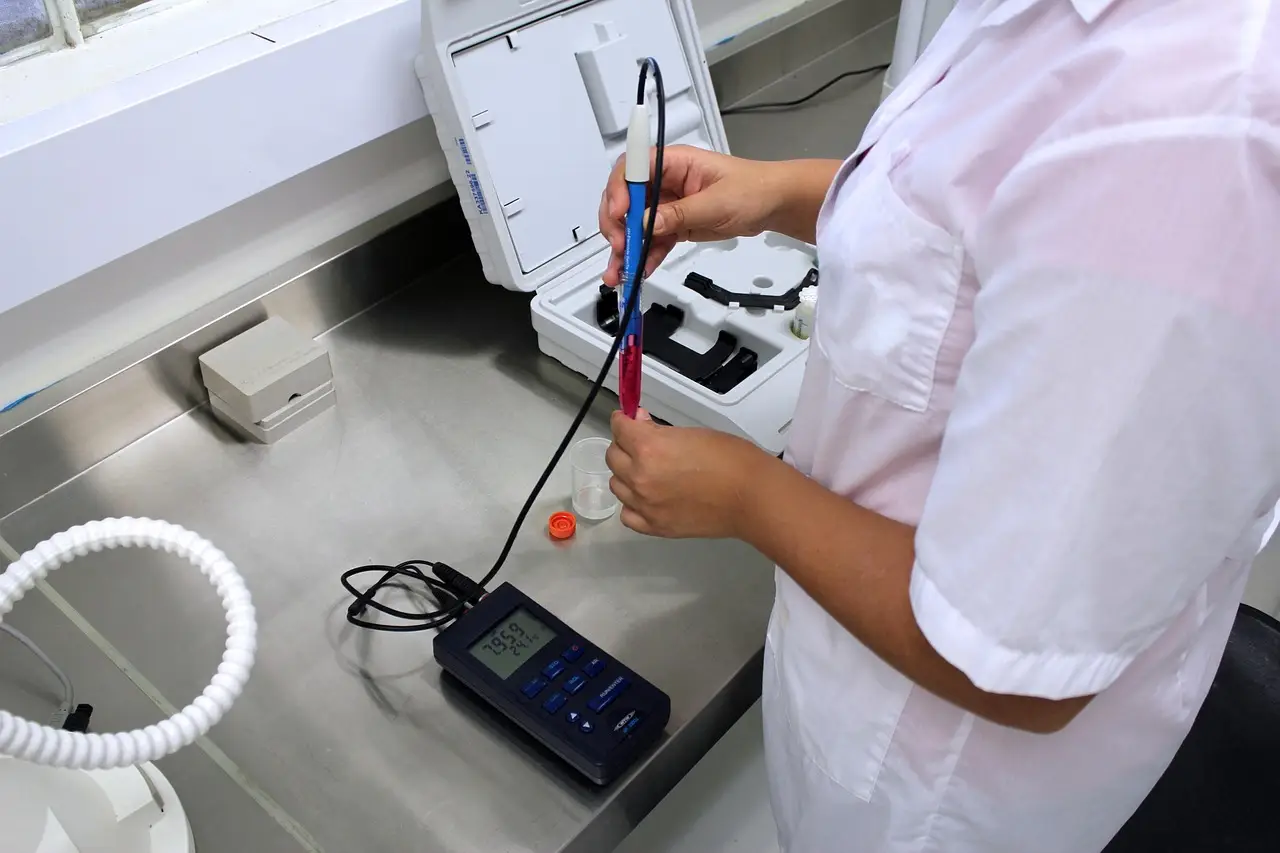
A neutral phosphate buffer makes copper electrodes convert nitrate to ammonia roughly 10 times faster than an alkaline solution, and more than doubles the selectivity toward ammonia. An international team including researchers from the University of Osaka reports the result in the Journal of the American Chemical Society, and the finding shifts attention from the catalyst itself to the electrolyte that surrounds it.
For practitioners who design electrochemical nitrate remediation systems, that is the headline change: you can tune performance by changing the solution, not just the electrode material.
Why does nitrate-to-ammonia conversion matter?
Nitrate ranks among the major water pollutants. It enters supplies through agricultural fertilizer use, livestock operations and wastewater treatment, and it poses health risks to humans and animals when ingested while causing severe ecological damage.
Catalytic electrochemical reduction is one established remediation route. The process applies electrolysis to a nitrate solution using electrodes made of a catalyst. Electron transfer to the nitrate ions transforms them chemically, but the reaction pathway is complex and yields numerous end products.
Ammonia is one of those end products, and it is valuable: an important fertilizer feedstock and a hydrogen carrier with many uses in agriculture and chemistry. The practical problem is that obtaining it selectively from a copper catalyst has been difficult.
What was holding copper back?
Many nitrate-contaminated waste streams are neutral or alkaline. Under those conditions, copper and other catalysts first convert nitrate into a nitrite intermediate, which is then transformed into ammonia.
Copper delivers a high reaction rate, but the nitrite intermediate is soluble, which makes it hard to capture ammonia as the final product. The step that reduces nitrite to ammonia depends on how many protons are available in the reaction system, and proton concentration is reflected in the solution's pH.
Past research attacked this bottleneck by modifying the catalyst materials. This team took a different path: it changed the environment around the electrode.
What did the team change?
The researchers noticed that real nitrate-contaminated feedstocks frequently contain anions such as phosphate and carbonate. So they ran the reduction in a neutral phosphate buffer instead of a conventional alkaline electrolyte.
"Feedstocks contaminated with nitrate frequently contain anions such as phosphate and carbonate. Consequently, we electrochemically reduced nitrate in a neutral phosphate buffer," says corresponding author Yu Katayama. "At a fixed driving force, the reaction rate was approximately 10 times higher and the selectivity to ammonia was more than twice as high as for an alkaline solution with pH 13."
In plain terms: same catalyst, same applied driving force, dramatically better output — just from swapping the surrounding solution.
How does the phosphate work?
The team probed the environment around the electrodes with local pH measurements, operando infrared spectroscopy (a technique that watches the surface during the reaction itself) and theoretical calculations.
The measurements ruled out the obvious explanation. The surface pH at the copper electrode roughly matched the pH of the bulk reference alkaline solution — considerably higher than the bulk phosphate buffer's pH 7. Since both surfaces sat at similar pH, acidity alone could not explain the improvement.
"We found that phosphate adsorbed on the copper electrode acts as a 'proton shuttle,' extracting protons from water and delivering them to the reaction intermediates," adds Katayama. "This promotes the further reduction of the nitrite intermediate, thereby increasing selectivity to ammonia."
The mechanism, in short: phosphate ions stick to the copper surface, pull protons out of water and hand them directly to the nitrite species waiting there, driving them on to ammonia rather than letting them slip back into solution.
What does this change for the field?
The results show that the environment around the catalyst electrode can affect reaction performance as much as the catalyst material itself — a conclusion that reframes how practitioners approach electrolyte design.
The insight points toward two applications:
- Nitrate remediation: designing electrolytes around contaminated feedstocks rather than fighting their anion content.
- Ammonia production: a lower-environmental-impact route to a fertilizer feedstock and hydrogen carrier, using waste nitrate as input.
One caveat for anyone sizing up the work: the reported gains come from laboratory electrochemistry at fixed driving force, and the study demonstrates the mechanism on copper in a phosphate buffer. Scaling the approach to real waste streams, with their mixtures of anions and impurities, remains to be worked out.
Publication details: Devesh K. Pathak et al., "Phosphate-Mediated Proton Shuttling Governs Nitrate Electroreduction Selectivity on Copper," Journal of the American Chemical Society (2026). DOI: 10.1021/jacs.6c11961.
The short version: a buffer ingredient did what years of catalyst redesign struggled to do, by delivering protons exactly where the reaction needs them.
via phys.org/rss-feed/ (Source)
More from Marcus Bennett
Show full bio
News editor covering regulation, policy and their impact on general science news at SciBeat.
614 articles
Nearby plates
- Light-Powered Iron Complex Turns Nitrate Pollution into Usable Fuel
- New Electrode Design Breaks Energy Barrier in Green Ammonia Production
- NUS Catalyst Regeneration Keeps Hydrogen Output Alive for 2,000 Hours
- Palladium Membrane Lets Hydrogen Through and Keeps Water Out
- Harvard Team Hits 91% Yield With Battery Molecules in Clean Chemistry