Recorded November 27, 2026
Biology & EvolutionReported finding
Pitcher plant sex chromosome mapped; 21 markers identify male seedlings
Researchers at the South China Botanical Garden mapped chromosome 12 as the sex chromosome in Nepenthes mirabilis and built 21 male-specific PCR markers to sex seedlings years before flowering.
By Elena Vasquez4 min read864 words
In brief
- 21 male-specific PCR markers identify Nepenthes mirabilis seedlings years before flowering
- Chromosome 12 carries the XX/XY sex system, with a 3.50 Mb sex-linked region on the Y
- The male-specific Y region spans 2.34 Mb and contains 27 annotated genes
- Only three genes — DYT1, LFY and MMD1 — are shared with the related species N. gracilis
- Study published Nov. 20 in Horticulture Research, DOI 10.1093/hr/uhag478
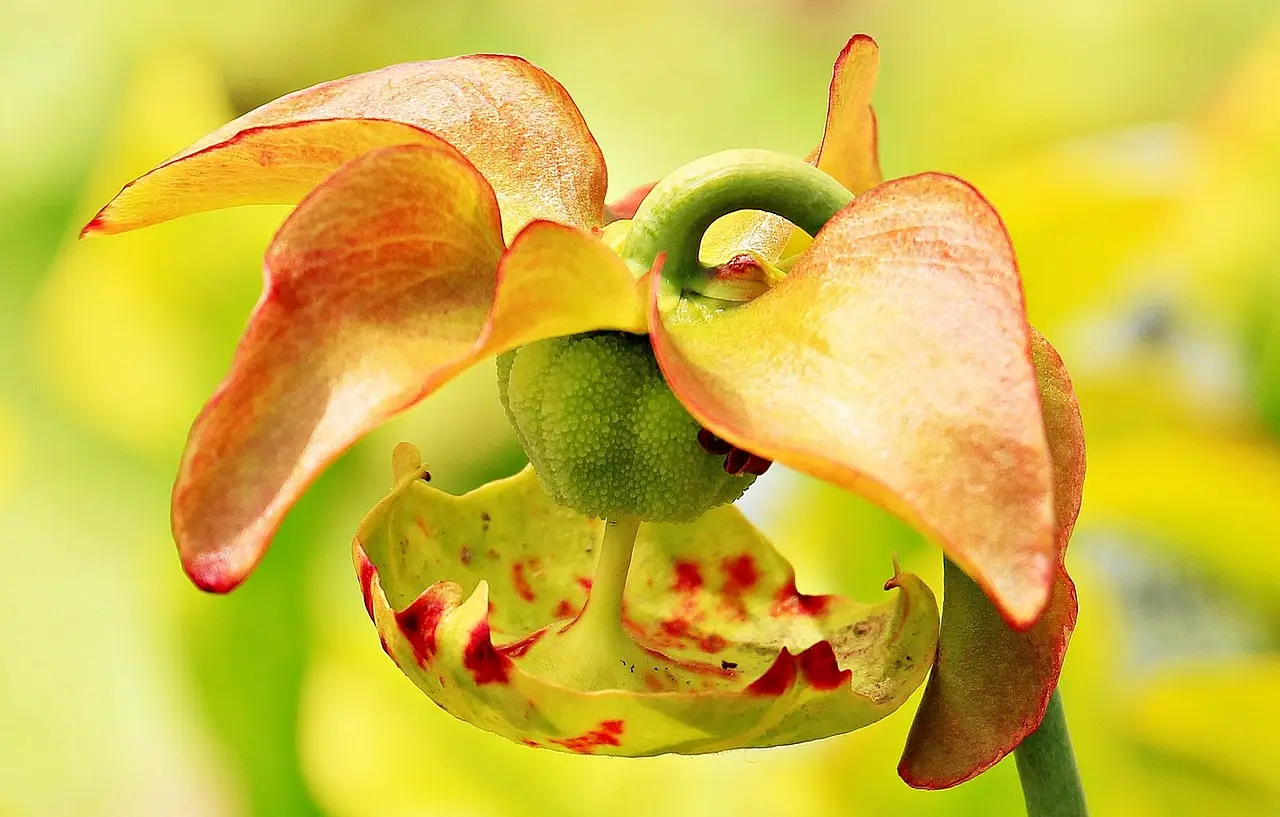
Twenty-one DNA markers now separate male from female Nepenthes mirabilis seedlings, years before either plant flowers, after a team pinned the Chinese pitcher plant's sex system to chromosome 12 and mapped a 2.34-megabase male-specific region on it.
The work, published on Nov. 20 in Horticulture Research, comes from scientists at the South China Botanical Garden of the Chinese Academy of Sciences, with South China Agricultural University, the University of Oxford and Shenzhen University of Advanced Technology.
Hanghui Kong and colleagues report the results in "Chromosome-level and haplotype-resolved genomes shed light on the sex chromosome evolution of the dioecious carnivorous plant Nepenthes mirabilis," DOI 10.1093/hr/uhag478. N. mirabilis is the only pitcher plant native to China.
Most flowering plants carry bisexual flowers, with stamens and pistils in the same bloom. A minority have gone dioecious, meaning male and female flowers sit on separate plants. How that split arose, and which genes decide sex, are long-standing questions in plant evolutionary biology. This carnivorous species offers a clean test case, because males and females look alike for years.
How did the team locate chromosome 12?
Researchers assembled and annotated a chromosome-level genome for one female plant, plus haplotype-resolved genomes for males. Haplotype-resolved means they read each of the two chromosome sets a male carries separately, so a Y chromosome can be distinguished from its X counterpart. The team added three more layers of evidence:
- Population resequencing, reading DNA across many individuals of the species.
- Transcriptomic data, snapshots of which genes switch on and when.
- Comparative genomics, comparing the species with the related pitcher plant N. gracilis.
Four independent signals pointed at chromosome 12: genome-wide association analysis, a statistical sweep for DNA variants that track with sex; sex-associated single-nucleotide polymorphisms, or single-letter changes in DNA; sequencing-depth comparisons, which measure how much of each chromosome the reads cover; and chromosomal synteny, which checks whether the same genes sit in the same order across species.
Several independent genetic signals, not one test, flagged the same chromosome as the plant's sex chromosome.
On that chromosome the team delineated a sex-linked region of roughly 3.50 megabases on the Y chromosome, called the Y-SLR. Nested inside it lies a 2.34-megabase male-specific region, the MSY, carrying 27 annotated genes. A megabyte here means about one million DNA base pairs, the letters of the genome. The pattern matches the familiar XX/XY arrangement, with two X chromosomes in females and one X plus one Y in males.
The male-specific region alone holds most of the sex-linked signal, and it holds it in a compact, gene-poor stretch of DNA.
Why does the male-specific region look the way it does?
Comparing the MSY with its counterpart in N. gracilis revealed marked differences in size, position, gene content and repeat composition. Only three genes are homologous, meaning matched gene for gene, between the two species' male-specific regions: DYT1, LFY and MMD1. Those three also show relatively little sequence divergence.
That pattern supports a specific scenario: a small ancestral sex-linked region, carrying a limited set of male-associated genes, existed before the two lineages diverged. After the split, each lineage changed and expanded its own non-recombining region, stretches of DNA where X and Y no longer swap segments during meiosis, the cell division that produces sex cells.
Repeats fill much of the story. The MSY holds far more repetitive sequence than the pseudoautosomal regions, the PARs, which are the portions of X and Y that still recombine. The excess runs to Gypsy-family long terminal repeat (LTR) retrotransposons, DNA sequences that copy themselves across a genome. Insertion-time estimates indicated that some of these LTR elements arrived relatively recently, consistent with transposable-element accumulation playing a role in the region's recent reshaping.
The male-specific region looks like a young, fast-changing stretch of DNA that expanded after the two species split.
How can the markers help breeders and collections?
Breeding has been awkward because Nepenthes plants take several years to reach reproductive maturity, and males and females are hard to tell apart at the seedling stage. The researchers screened 27 candidate MSY genes with PCR assays, standard tests that amplify specific DNA stretches, and found 21 that amplified only in males.
The authors say those markers could allow early sex identification, sharpen decisions about which plants to cross, and support conservation and use of Nepenthes germplasm, the plant material held in collections and seed banks.
The practical win is straightforward: sex seedlings early, and breed with confidence.
What remains unsettled?
The team frames its evolutionary reconstruction as a hypothesis for the origin and later evolution of sex-linked regions in N. mirabilis, and the markers as a resource for future work rather than a finished breeding tool. The study also rests on a single species, so how far the picture generalizes to other carnivorous plants remains an open question.
For growers and collectors, though, the near-term result stands on its own: 21 tested DNA markers that read male seedlings correctly, years ahead of flowering.
via phys.org/rss-feed/ (Source)
More from Elena Vasquez
Show full bio
Correspondent covering money, funding and market shifts around general science news at SciBeat.
659 articles
Nearby plates
- Why hybridizing darters use three different sex chromosomes
- Climate, not latitude, drives global plant-pollinator specialization
- Flashy Courtship Traits Evolve Twice as Fast as Combat Weapons
- X-rays uncover 100-million-year-old flower inside 130-year-old museum rock
- New Database Brings Together Genomes of China's Protected Plants