Plate Nº 16 · recorded November 14, 2026
Biology & EvolutionReported finding
Flashy Courtship Traits Evolve Twice as Fast as Combat Weapons
Ornaments evolve at roughly twice the rate of weapons, a study of 531 animal species finds, because drifting mate preferences keep courtship traits on a moving evolutionary target.
By Elena Vasquez5 min read943 words
In brief
- Ornaments evolved at a standardized rate of 0.129 versus 0.064 for weapons — roughly twice as fast.
- The study analyzed 531 species across 10 datasets, with datasets ranging from 17 to 103 species.
- The twofold gap held in 4 of 5 matched species pairs after body-size adjustment under a stabilizing model.
- The model assumed an effective population size of 1,000 individuals across thousands of generations.
- The study was published in Proceedings of the Royal Society B by Dashtbali, Hutton-Adams, Watts, Henshaw and Allen.
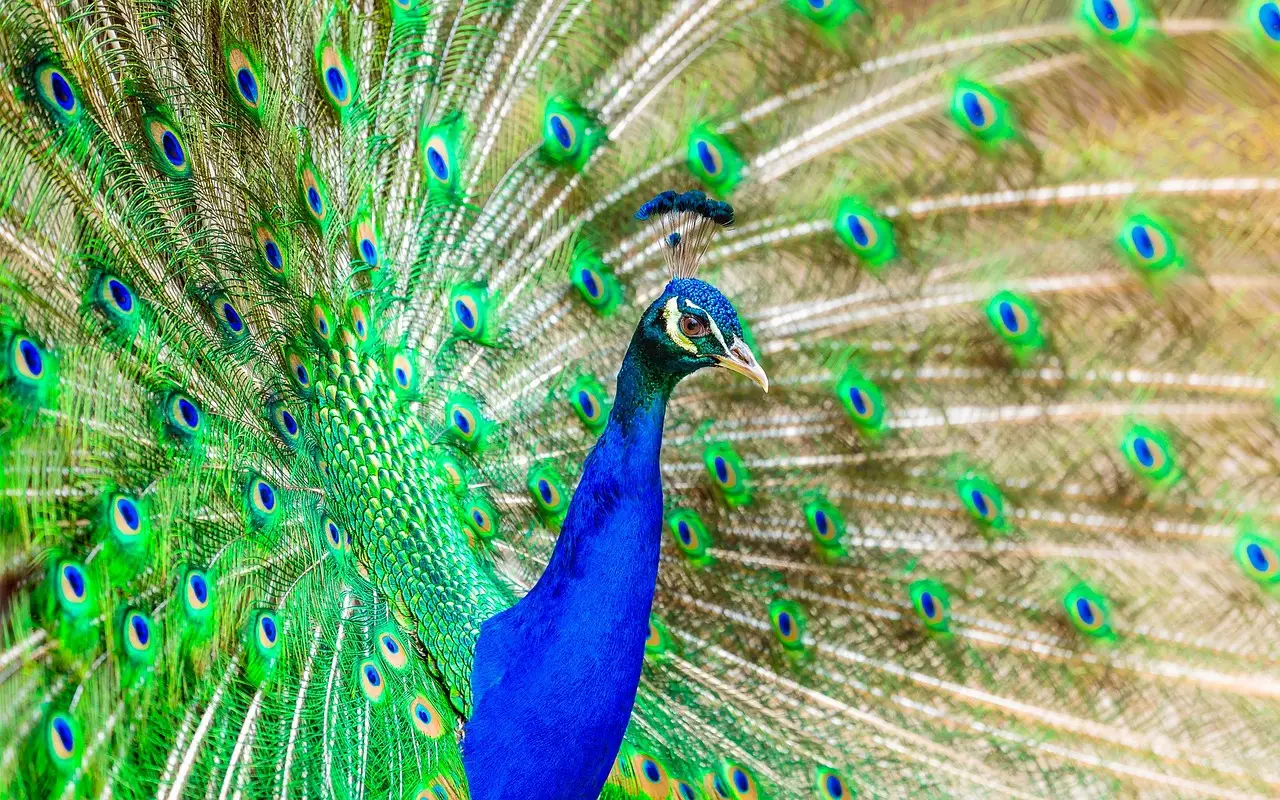
Ornaments evolve at roughly twice the pace of weapons. That's the headline result from a new study of 531 animal species across 10 groups, published in Proceedings of the Royal Society B, which combined a mathematical model with comparative evolutionary data to test a long-standing prediction about sexual selection.
The standardized evolutionary rate estimate came in at 0.129 for ornaments versus 0.064 for weapons. Peacock feathers, courtship calls and expandable throat fans change faster over evolutionary time than tusks, spurs and enlarged canines. The reason, the researchers argue, is that mating preferences in the opposite sex drift unpredictably from generation to generation.
Sexual selection — evolution driven by mating success rather than survival — works through two main channels. Male-male competition favors weapons: physical structures used to overpower or injure rivals. Female mate choice favors ornaments: traits that appeal to a chooser's senses. Biologists have long debated which of the two evolves faster, but nobody had directly tested the question.
Why did researchers expect ornaments to win the race?
The idea traces back to biologist Ronald Fisher and a 1981 mathematical model. When females prefer a flashy male trait, offspring inherit both the father's genes for the ornament and the mother's genes for preferring it. That genetic pairing can trigger rapid, self-reinforcing evolutionary bursts.
"The initial idea came from an excellent paper by Erin McCullough, Christine Miller, and Doug Emlen, 'Why sexually selected weapons are not ornaments,'" said William L. Allen, an associate professor of evolutionary and sensory ecology at Swansea University and one of the study's joint senior authors. "Because the Fisher process — positive feedback between female mating preferences and male ornament traits — does not operate in the same way for weapons, the authors predicted that weapons should evolve more slowly than ornaments. They also noted that this prediction had never been tested."
"We thought this was a fascinating idea because it makes a clear, testable prediction about one of the fundamental differences between two major forms of sexual selection," Allen told PsyPost.
The team — Mohammadali Dashtbali and Jonathan M. Henshaw of the University of Freiburg, Allen, and colleagues — built on the 1981 model to track three inherited traits: male ornament size, male weapon size and female preference strength. The simulation assumed an effective population of 1,000 individuals and incorporated genetic drift, the random shifts in gene frequencies that occur in any finite population.
The model's logic is straightforward. Weapons always pay off in combat, regardless of female tastes, so natural selection anchors them near a stable optimum. Ornaments only help a male if females currently favor them — and female preferences themselves wander over time, creating a moving target that keeps ornaments churning.
The simulations confirmed it. Ornaments fluctuated widely whenever low preference costs allowed drift to move female tastes. Freezing preferences artificially slowed ornaments down to weapon pace. Drifting preferences alone accelerated ornament evolution even without strong genetic coupling. The model did flag exceptions: weapons won the race when strong preferences carried heavy survival costs, or when weapons were much cheaper to grow and maintain.
What did the real-world data show?
The researchers compiled published trait measurements and time-calibrated evolutionary family trees for 531 species across 10 datasets, each ranging from 17 to 103 species. To control for broad biological differences, they matched each weapon-bearing group to its closest available ornament-bearing relative, producing five paired comparisons:
- Leg spine length in leaf-footed bugs vs. eye-stalk span in stalk-eyed flies
- Bite force in anole lizards vs. throat-bone length supporting display fans in agamid lizards
- Leg spur length vs. neck-feather color in landfowl such as pheasants and grouse
- Tusk length in hoofed mammals vs. vocal pitch in carnivorans
- Canine tooth length vs. vocal pitch in primates
After adjusting traits for body size, ornaments evolved faster than weapons in four of the five pairs under both evolutionary models tested. Insects were the lone exception. Combining all pairs under the better-supported stabilizing model — the Ornstein-Uhlenbeck model, which pairs random fluctuations with a pull toward an optimal size — gave the twofold overall gap.
"We observed large differences in the rate of trait evolution in different groups of animals, only some of which was explained by whether the trait was a weapon or ornament," Allen noted. Rates ranged from 0.02 to 0.19 across datasets.
How solid is the evidence?
Early findings, several caveats. The twofold advantage emerged only under the stabilizing model and only after statistically removing body size — a regression-based method the authors acknowledge can introduce bias. Under the alternative random-walk model, or without body-size adjustment, the overall difference wasn't statistically significant. Female preferences also couldn't be measured directly, and two comparisons span vast evolutionary time — the lizard families split roughly 146 million years ago, the insect lineages about 351 million years ago.
The model itself simplifies reality, tracking one ornament and one weapon in a well-mixed population with no representation of combat mechanics. Traits with dual functions, like fiddler crab claws, were excluded entirely.
"More broadly, we think the study illustrates how combining theoretical and comparative approaches can reveal mechanisms that would be difficult to identify from either approach alone," Allen said. "More generally it shows how evolutionary models can help us understand the diversity of animal life in the past and present, and allow us to predict what might happen in the future."
The bottom line: flashy display traits appear to change faster than fighting hardware, and wandering mate preferences are the likely engine — though the size of the gap depends on how you measure it.
via psypost.org (Source)
More from Elena Vasquez
Show full bio
Correspondent covering money, funding and market shifts around general science news at SciBeat.
432 articles
Nearby plates
- Why hybridizing darters use three different sex chromosomes
- Heat Waves Are Aging Wild Fairy-Wrens Faster, DNA Study Finds
- Placental Fish Show Mother-Baby Gene Conflict Seen Before Only in Mammals
- Fish Evolved Schooling 60 Times—and Lost It 320 Times
- Dinosaur-Killing Asteroid May Have Triggered Ants' Rise, Study Finds