Plate Nº 56 · recorded September 29, 2026
Chemistry & MaterialsReported finding
Porous Crystals Could Triple How Long Liquid Hydrogen Lasts in Tanks
Adding porous metal-organic frameworks to liquid hydrogen tanks kept 97% of storage capacity while extending depletion time from 64 to 221 days in models.
By Nathan Brooks4 min read889 words
In brief
- IRMOF-20 kept about 97% of liquid hydrogen's volumetric capacity while extending modeled tank depletion from 64 days to roughly 221 days.
- Inelastic neutron scattering at ILL showed restricted hydrogen rotation in the pores, indicating strong interactions with the framework walls.
- Study leader Hyunchul Oh cautions the calculations represent an idealized upper bound; practical tank performance still needs testing.
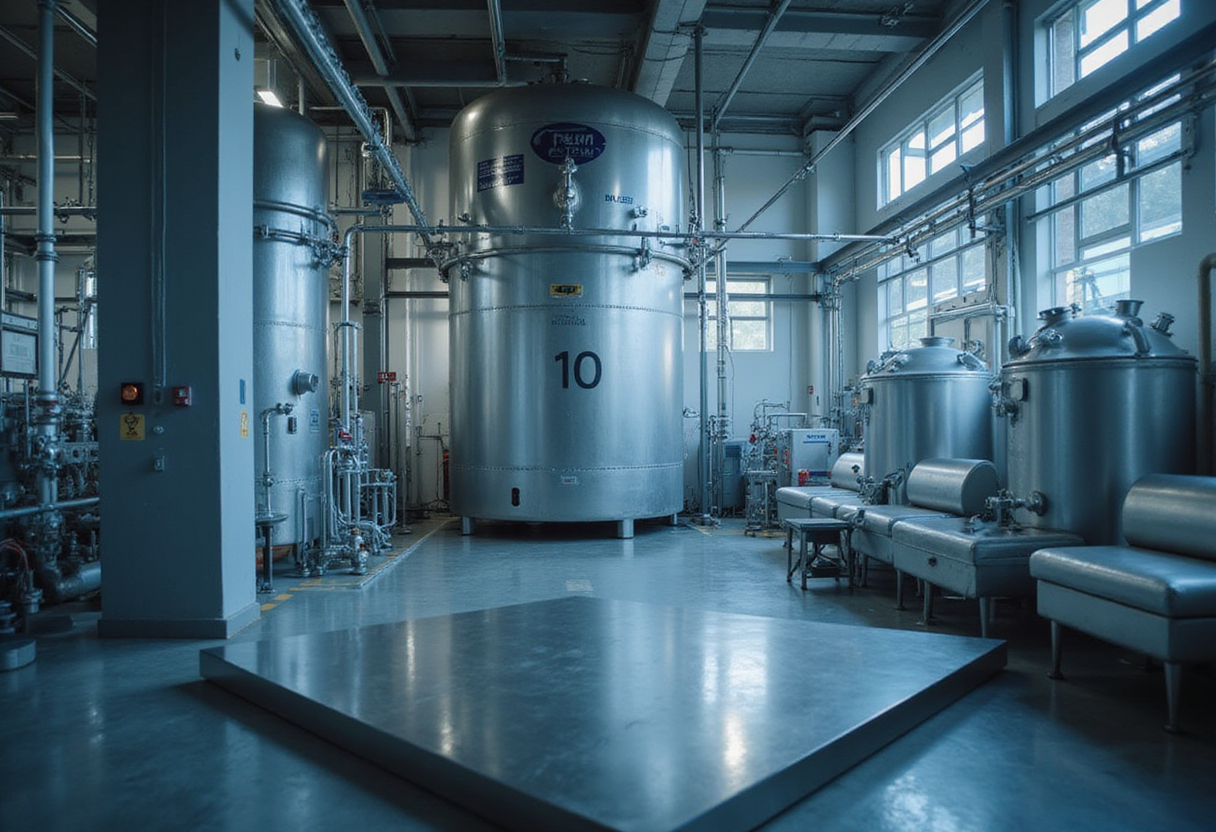
Liquid hydrogen is one of the densest ways to carry energy by volume, which makes it attractive for shipping energy over long distances. But it has an awkward habit: even the best-insulated tanks let some heat leak in. As the liquid warms, hydrogen evaporates, pressure builds, and valuable fuel escapes as boil-off gas.
A research team led by professor Hyunchul Oh of the Department of Chemistry at UNIST, working with professor Hoi Ri Moon of Ewha Womans University, Dr. Jituate T. Park—listed in the study as Jitae T. Park—of the Technical University of Munich (TUM) in Germany, and Dr. Mónica Jiménez-Ruiz of the Institut Laue–Langevin (ILL) in France, has now tested a different way to fight these losses. Their approach uses metal-organic frameworks (MOFs), a class of highly porous crystalline materials, to catch evaporating hydrogen before it leaves the tank. The study appears in the journal Nature Communications.
How the materials work
MOFs contain networks of nanoscale pores that can adsorb hydrogen molecules onto their internal surfaces. (Adsorption means molecules stick to a surface, as opposed to being absorbed into it.) At cryogenic temperatures—the frigid conditions where hydrogen stays liquid—interactions between hydrogen molecules and the pore walls help keep the gas confined, slowing the pressure buildup that drives boil-off.
The strategy complements conventional insulation rather than replacing it. Instead of only trying to keep heat out, it changes how hydrogen behaves once heat gets in.
That raises an obvious trade-off: a porous filler material occupies space that would otherwise hold liquid hydrogen. So the key question is whether the benefit comes at too steep a cost in storage capacity.
Two frameworks, two answers
The researchers compared two MOFs with very different structures. IRMOF-20 is a rigid framework with a large pore volume. MIL-53(Al) is flexible; its pores expand and contract as hydrogen enters and leaves.
IRMOF-20 struck a particularly favorable balance. Once the researchers accounted for the space the material itself takes up, the system retained about 97% of the volumetric capacity of pure liquid hydrogen. Hydrogen packed densely enough inside the pores to compensate for much of the volume occupied by the MOF.
Modeling then showed what this means for a transport-scale tank under mid-vacuum insulation conditions. Neat liquid hydrogen would deplete after about 64 days. With IRMOF-20 inside, that window stretched to roughly 221 days—more than three times as long.
MIL-53(Al) told a different story. It held onto hydrogen more strongly as temperature rose, but its volumetric capacity reached only about 53% of liquid hydrogen's. The contrast highlights a central design choice for cryogenic hydrogen storage: larger pore volume favors capacity, while stronger confinement improves thermal retention.
"By considering pore volume, hydrogen density, and desorption behavior together, we found that porous materials could reduce boil-off while preserving much of the storage capacity needed for liquid hydrogen transport. These calculations represent an idealized upper bound, so further work is needed to determine how closely this performance can be reproduced in practical tank systems," says Oh.
What neutrons revealed
Laboratory measurements offered clues to why IRMOF-20 performed so well. Adsorption data showed that hydrogen confined within its pores reached an effective density higher than that of bulk liquid hydrogen.
Inelastic neutron scattering experiments at the IN1-Lagrange instrument at ILL added a second line of evidence. These experiments, carried out by Park of the Heinz Maier-Leibnitz Zentrum at TUM and Jiménez-Ruiz of ILL, showed that hydrogen molecules could not rotate freely inside the pores—indirect evidence that hydrogen interacts strongly with the framework walls. Together, the results suggest that nanoscale confinement can both pack hydrogen densely and stabilize it against release as temperatures rise.
"Neutrons are particularly well suited to studying the quantum rotational excitations of H₂ because hydrogen has a large neutron-scattering cross section, and inelastic neutron scattering directly probes molecular motion without the optical selection rules that constrain infrared and Raman spectroscopy," explains Park.
The physics behind the probe is well defined. Solid parahydrogen shows a very sharp rotational line at 14.7 meV. When hydrogen interacts with a surface, the position and shape of this line shift depending sensitively on the local environment, turning the rotational transition into a sensitive probe of hydrogen–surface interactions.
"These characteristics make the H₂ rotational transition a sensitive probe of the interaction between hydrogen and its surroundings. In this context, the IN1-Lagrange spectrometer at the Institut Laue-Langevin is particularly well suited to investigating H₂ confined in porous materials. The instrument combines a broad energy-transfer range, high neutron flux, and good energy resolution, enabling changes in the position, shape, and splitting of the H₂ rotational transition to be measured and used as sensitive probes of the H₂–surface interaction," says Jiménez-Ruiz, the ILL scientist responsible for the instrument.
Caveats remain
The tank numbers come from models, not from a working prototype. As Oh himself notes, the calculations represent an idealized upper bound, and real tanks involve engineering details the study does not capture. The findings, published as Jaewoo Park et al. in Nature Communications (2026, DOI: 10.1038/s41467-026-77420-4), make a case that MOFs deserve a place in liquid hydrogen transport—but practical demonstration is still ahead.
via Phys.org Chemistry (Source)
More from Nathan Brooks
Nearby plates
- Palladium Membrane Lets Hydrogen Through and Keeps Water Out
- Iodide Coating on Platinum Boosts Solar Hydrogen Output
- Light-Activated Crystals Destroy DNA in Water, Could Curb Resistance
- Molten Salt Process Turns Plastic Bags Into Gasoline at Oven Temperatures
- US Plan to Overhaul Science Funding Draws Mixed Reactions