Plate Nº 21 · recorded September 29, 2026
Chemistry & MaterialsReported finding
Molten Salt Process Turns Plastic Bags Into Gasoline at Oven Temperatures
Oak Ridge researchers converted polyethylene into gasoline-like fuel with a 60% yield below 200 °C, using cheap aluminum molten salts instead of costly catalysts, solvents, or added hydrogen.
By Marcus Bennett4 min read846 words
In brief
- ORNL's process converts polyethylene into about 60% gasoline-like fuel below 200 °C, versus 450–500 °C for typical pyrolysis methods.
- Cheap aluminum chloride molten salts act as both reaction medium and catalyst, eliminating noble metals, organic solvents, external hydrogen, and chemical initiators.
- A key limitation remains: the salts absorb water, reducing stability; the team is exploring ways to confine them, and industrial scaling is not yet demonstrated.
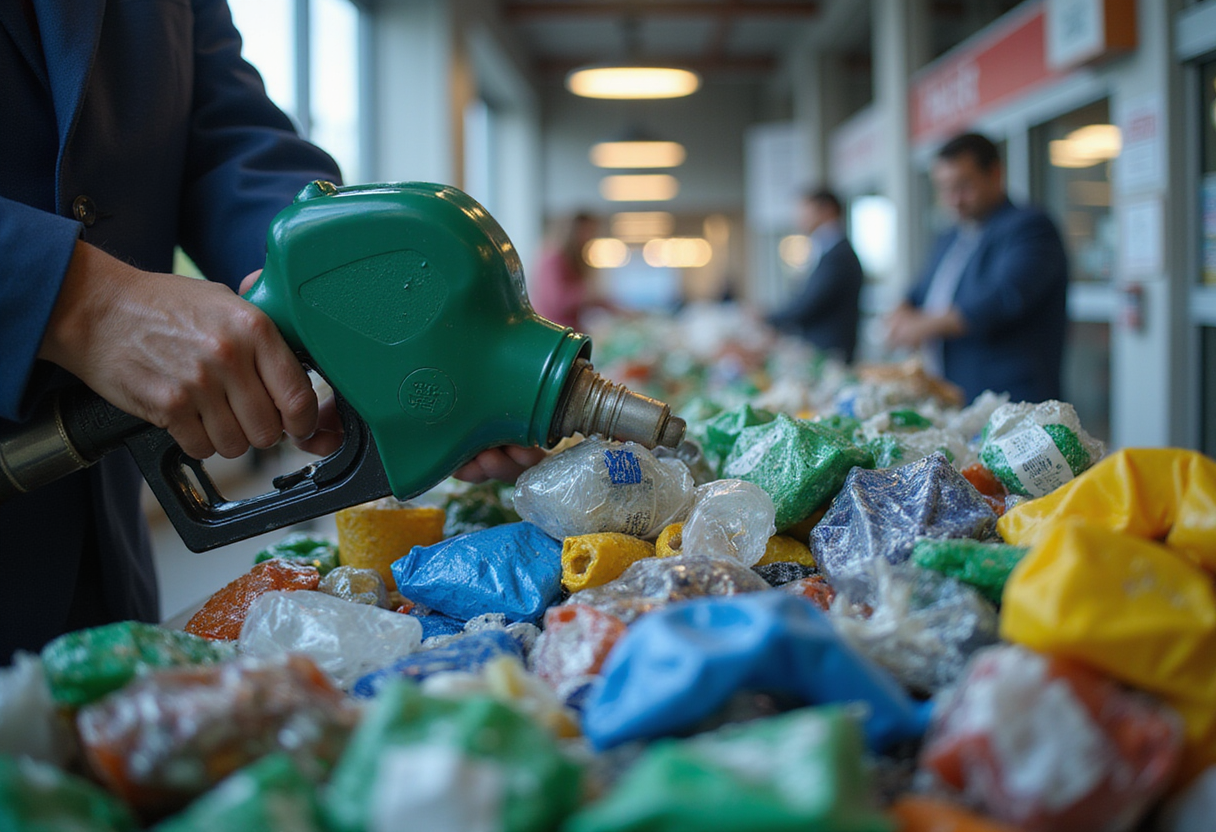
Scientists at Oak Ridge National Laboratory have found a surprisingly simple way to turn polyethylene — the plastic in shopping bags and white cutting boards — into gasoline- and diesel-like fuels. The process converts the waste into roughly 60 percent gasoline-like compounds, and it works below 200 degrees Celsius, a temperature comparable to a kitchen oven.
That figure matters. Conventional plastic-to-fuel methods rely on pyrolysis, which uses intense heat to crack long polymer molecules into smaller hydrocarbons. Those approaches typically demand 450 to 500 degrees Celsius. The new method also skips several ingredients that make existing techniques expensive: noble-metal catalysts, organic solvents, external hydrogen, and a chemical initiator to kick off the reaction.
The findings appear in the Journal of the American Chemical Society, and the team has applied for a patent.
Two jobs for one salt
The heart of the process is a molten salt containing aluminum chloride, an inexpensive inorganic compound. The salt does double duty: it serves as the reaction medium, the liquid environment where chemistry happens, and as the catalyst that drives the conversion itself.
"We converted polymer waste to value-added fuels by using commercially available inorganic salts as the reaction media to provide the catalytic sites," said Zhenzhen Yang, an ORNL staff scientist and co-corresponding author of the paper. "This is the first time molten salts were used as media to produce high-value-added chemicals from waste without any catalytic initiator or solvent and at a temperature below 200 degrees Celsius."
ORNL has studied molten salts for decades. In the 1960s, its Molten Salt Reactor Experiment showed that such mixtures could act as both nuclear fuel and reactor coolant. Building on that history, ORNL Corporate Fellow Sheng Dai proposed an entirely different application: turning discarded polymers into useful fuels.
"The ORNL system solves two fundamental issues," Dai said. "One, for a stable system, the process can be radically easier to scale up. Two, the previous system needed an initiator to kick off catalytic reactions. However, the ORNL system does not need one."
Watching the chemistry atom by atom
To explain why the process works, the researchers tracked the reactions in detail with a battery of analytical tools. Soft X-ray spectroscopy and nuclear magnetic resonance revealed that charged aluminum atoms bind with three neighboring atoms, forming highly acidic catalytic sites. These sites attack the long molecular chains of polyethylene and split them into smaller hydrocarbon molecules.
Experiments with isotopic labeling and neutron scattering showed that the starting polymer's structure shapes the product. Simpler polymer chains tended to yield gasoline-like compounds, while more complex chains produced diesel-like fuels.
Several researchers contributed specialized techniques. Liqi Qiu, a postdoctoral researcher at the University of Tennessee, Knoxville, performed most of the experiments in Dai's ORNL laboratory. Qiu, Yang and Dai tagged positively charged carbon ions — key intermediates in the reaction — with deuterium, a heavy isotope of hydrogen, to follow their fate.
Luke Daemen used neutron scattering at ORNL's Spallation Neutron Source to identify the hydrocarbon products from different polymer chains. "The polymer contains a lot of hydrogen," Dai noted. "Neutrons are ideal at discerning light elements including hydrogen and its isotopes, such as deuterium."
At Lawrence Berkeley National Laboratory's Advanced Light Source, Yang worked with Min-Jae Kim and Jinhua Guo to probe the aluminum sites with soft X-rays. "The aluminum edge shifted to the low-electron-density edge, which means some electron-rich intermediates formed," Yang said. "We compared the findings with other techniques and confirmed an aromatic ring intermediate can coordinate with aluminum and cause a binding-energy change." That shift confirmed the aluminum sites were actively catalyzing the reaction.
Bobby Sumpter ran computer simulations of the reaction's energy changes; Michael Koehler used in-situ X-ray diffraction to follow phase changes in the mixture; Carlos Alberto Steren used nuclear magnetic resonance to study the catalytic sites. Felipe Polo-Garzon analyzed products with gas chromatography-mass spectrometry. Tomonori Saito managed the project, and Tao Wang and Logan Kearney contributed molten salt chemistry expertise and high-density polymer samples, respectively.
"We developed an efficient and selective polyethylene-to-gasoline conversion," Qiu said.
One important limitation
The aluminum-based system is cheap and chemically active, but it has a weakness: it is hygroscopic, meaning it readily absorbs water from its surroundings, which can reduce its stability. The researchers now plan to explore ways to confine the molten salts, potentially with halogens or carbon-based materials, to improve stability and make them easier to separate and reuse.
The results so far come from laboratory experiments, and scaling the process to industrial relevance remains unproven. Still, if it can be scaled, the team suggests the method could contribute to U.S. energy security and industrial competitiveness.
"Polymer source material is abundantly available from consumer waste, and our catalyst system, aluminum molten salts, is very cheap," Qiu said. "This advance may be promising for industry."
The DOE Office of Science primarily supported the research, which used facilities at ORNL and Lawrence Berkeley National Laboratory.
via ornl.gov (Original)
More from Marcus Bennett
Nearby plates
- Porous Crystals Could Triple How Long Liquid Hydrogen Lasts in Tanks
- Palladium Membrane Lets Hydrogen Through and Keeps Water Out
- Iodide Coating on Platinum Boosts Solar Hydrogen Output
- US Plan to Overhaul Science Funding Draws Mixed Reactions
- Underwater Umbrellas Helped Florida Corals Survive Record Heat Stress