Plate Nº 94 · recorded September 30, 2026
Chemistry & MaterialsReported finding
Light-Activated Crystals Destroy DNA in Water, Could Curb Resistance
Titanium dioxide crystals with engineered defects convert ordinary dissolved oxygen into reactive 'singlet' oxygen that cuts DNA base pairs, fully degrading DNA-like molecules in lab tests.
By Priya Raman4 min read700 words
In brief
- Light-activated titanium dioxide crystals with 'oxygen vacancy' defects convert ordinary triplet oxygen into highly reactive singlet oxygen.
- Singlet oxygen oxidizes DNA base pairs, cutting them apart and destroying genetic information that could spread antibiotic resistance.
- Lab experiments showed complete degradation of DNA-related molecules in water, but safety testing and real-world validation remain outstanding.
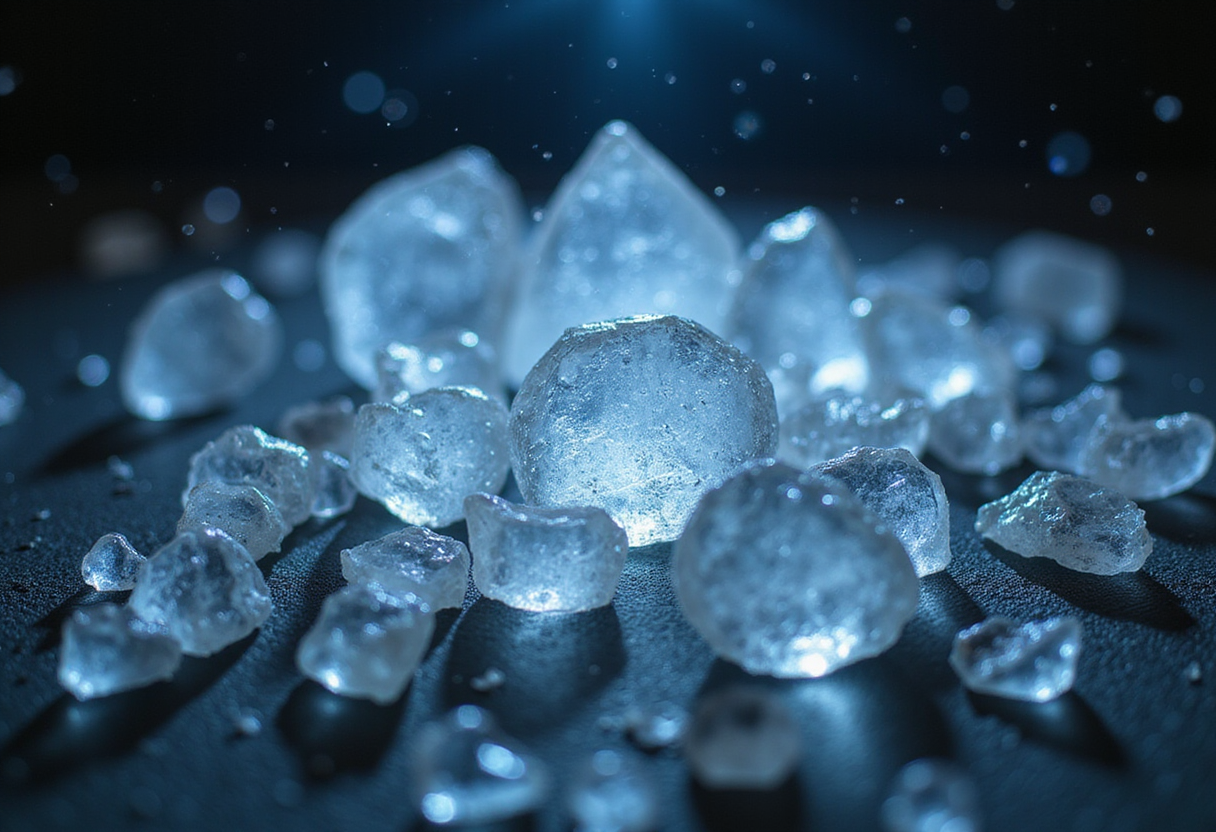
Engineers have built a new kind of crystal that, when exposed to light, breaks down DNA-like molecules floating in water — a capability that could one day keep antibiotic-resistance genes out of drinking water supplies.
The study, published in the journal Chem Catalysis, describes crystals made from titanium dioxide, a common compound already used in products from sunscreen to paints. These particular crystals carry tiny structural defects called "oxygen vacancies" — dimple-like imperfections on their surfaces. When light hits the crystals, ordinary oxygen molecules dissolved in water interact with those defect sites, and the crystals catalyze a series of chemical reactions that rapidly convert the oxygen into a much more reactive form.
Here is the chemistry in plain terms. The oxygen we breathe, called "triplet" oxygen, is chemically stable. Its rarer cousin, "singlet" oxygen, is nearly identical but far more reactive. Singlet oxygen has a strong tendency to grab electrons from its surroundings. That makes it drawn to electron-rich molecules — including the base pairs, the informational building blocks, of DNA. When singlet oxygen meets DNA, it strips electrons from those base pairs in a reaction called oxidation. The base pairs are cut in two, and the genetic information they encode is destroyed.
Why target DNA, not just bacteria?
The study tackles a growing global problem: bacteria and other pathogens have evolved resistance to common antibiotics at an alarming rate in recent decades. Scientists have tried various ways of killing these microbes in water, including intense ultraviolet light. But those techniques share a major drawback. They kill bacteria yet leave behind something potentially just as dangerous: their DNA.
"The persistence of this genetic material is an environmental concern because extracellular DNA can be taken up by other microorganisms, potentially leading to the spread of antibiotic resistance," says co-author Boxia Liu of North Minzu University in China.
In other words, dead bacteria can still pass on their genes to living microbes. Destroying the genetic material itself closes that route.
Defects as a feature, not a flaw
A central insight of the work is that the crystal defects do the crucial work. "Catalyst defects should not simply be considered as imperfections in a material structure," says co-author Zhi Song of North Minzu University. "When properly engineered, defects can actively regulate how molecules interact with catalyst surfaces and determine the pathways through which chemical reactions proceed."
The approach also differs from conventional disinfection in how it gets its raw material. "Unlike conventional disinfection approaches that may require continuous addition of chemical oxidants, this system uses oxygen naturally available in the environment to disinfect water," says co-author Xinjian Shi of Henan University in China.
What the experiments showed
The researchers tested the concept in a series of laboratory experiments. They added molecules related to DNA to water along with their titanium dioxide catalysts, then activated the system with light. The catalysts completely degraded the DNA-related molecules.
That result is promising, but it comes with clear limits. The team tested DNA-like molecules rather than full water systems, and laboratory success does not guarantee performance in a real treatment plant, where water contains a complex mix of organic matter and other contaminants. The experiments also did not directly demonstrate the destruction of resistance genes inside intact bacteria.
What comes next
The researchers hope the method could eventually fight the spread of antibiotic-resistance genes on a large scale, helping cities keep resistant bacteria from reaching kitchen faucets. But substantial work remains before these crystals appear in water treatment facilities. Scientists will need to evaluate the technology's safety for the environment and for people — for instance, whether the reactive oxygen species affect other dissolved compounds in unintended ways.
There is reason for cautious optimism on that front. Because the system activates oxygen in a controlled manner, it may prove safer than technologies that require constantly adding chemical oxidants to water.
For now, the findings establish a proof of concept: carefully engineered defects on titanium dioxide surfaces can convert everyday oxygen into a precise DNA-cutting agent. Whether that chemistry can scale from the lab bench to the water plant is the question the team, and the field, must now answer.
via Phys.org Biology (Source)
More from Priya Raman
Show full bio
Senior reporter covering industry trends and analytics at SciBeat.
57 articles
Nearby plates
- Ultrafast X-Rays Solve 50-Year Mystery of How Azobenzene Switches Shape
- Iodide Coating on Platinum Boosts Solar Hydrogen Output
- Crew-12 Heads Home After Months of Station Science
- Porous Crystals Could Triple How Long Liquid Hydrogen Lasts in Tanks
- Ancient Ocean Chemistry Kept Earth Breathing, Study Finds