Plate Nº 22 · recorded November 16, 2026
Biology & EvolutionReported finding
Living Light: How Ocean Creatures Glow Without Electricity
Up to 90 per cent of deep-sea creatures make their own light. From 540-million-year-old octocorals to algae engineered to glow for 25 minutes, here is how bioluminescence works.
By Marcus Bennett3 min read572 words
In brief
- Up to about 90 per cent of deep-sea creatures can generate their own light, especially below 1,000m.
- A 2024 study traced the first bioluminescent organisms to octocorals roughly 540 million years ago.
- Bioluminescence has evolved independently more than 90 times.
- In 2026, University of Colorado Boulder researchers made bioluminescent algae glow continuously for up to 25 minutes.
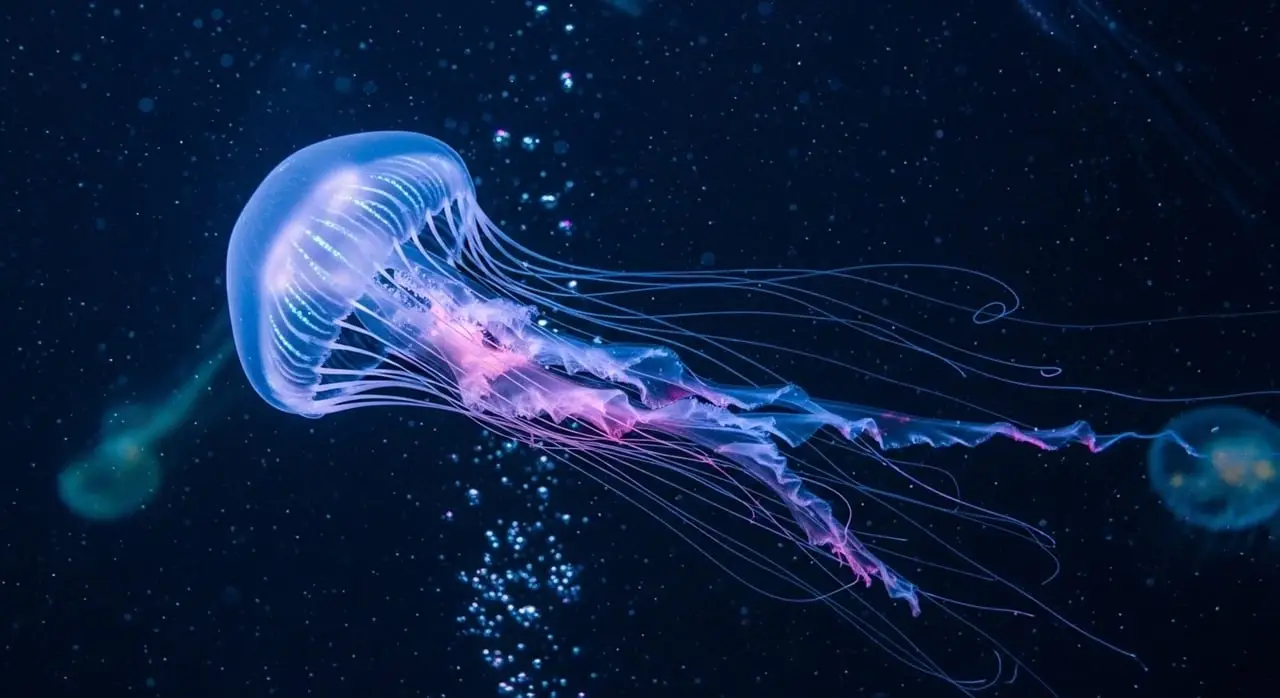
Roughly 90 per cent of deep-sea creatures can generate their own light — a chemical trick that predates every human lamp by hundreds of millions of years, and one that scientists have now learned to control in the laboratory.
Before electric lighting arrived in the 19th century, humans made artificial light by burning wood, wax, oil or gas for hundreds of thousands of years. Life on Earth, however, beat us to it: for hundreds of millions of years, organisms have produced light through chemistry, in a process called bioluminescence.
The mechanism is elegant. A light-emitting compound called luciferin reacts with an enzyme called luciferase. The enzyme attaches an oxygen molecule to luciferin, pushing it into an excited state. When the oxygen molecule is released, light comes out. Different species carry their own versions of this chemical duo, but the underlying process stays the same.
Who makes the light?
Some animals build their own glow. Others outsource it. The Hawaiian bobtail squid, for instance, hosts bioluminescent bacteria in a specialised light organ and controls when and where those bacteria switch on, suiting the light to its needs.
In the open ocean, single-celled creatures called dinoflagellates produce glittering light shows on the surface when disturbed. Watch the water from the bow of a ship at night and, with luck, you can see the display yourself.
The best shows, though, sit below the surface. Creatures living deeper than 1,000m (3,281ft) inhabit the 'midnight zone', where no sunlight reaches. There, bioluminescent organisms shine in blue and green hues — the wavelengths that travel furthest through water.
How old is living light?
Very old indeed. A 2024 study found that the first bioluminescent creatures on Earth were marine invertebrates called octocorals, which lived some 540 million years ago. Since that origin, bioluminescence has evolved independently more than 90 separate times — a striking case of evolution reinventing the same solution.
What do animals use it for?
The applications range from defence to dinner:
- Camouflage. The bobtail squid lights up its underside — a strategy called counterillumination — erasing its silhouette against the light above so predators below cannot see it.
- Hunting. Anglerfish dangle a bioluminescent lure that draws unsuspecting prey close.
- Vision. A few deep-sea fish emit red light from their own bodies, making their prey easier to spot in the dark.
- Mating and defence. Other species use flashes of light to attract partners or to startle attackers.
What does this mean for human research?
For practitioners, bioluminescence is already a working tool. The enzyme luciferase is commonly used in genetic engineering and biomedical imaging, where its light signals reveal where genes are active or how diseases progress inside living tissue.
The newest development pushes that toolkit further. In 2026, researchers at the University of Colorado Boulder tricked bioluminescent algae — which normally emit only short bursts of light — into glowing continuously for up to 25 minutes. For anyone working with luciferase-based assays or algal systems, a sustained glow instead of a blink could simplify measurements and open the door to longer imaging experiments.
The findings remain early-stage, and the Boulder team worked with algae rather than mammalian cells, so laboratory applications will take time to translate. Even so, the trajectory is clear: a 540-million-year-old chemical reaction is steadily becoming an instrument that researchers can tune.
Life invented the lamp long before we did — and we are still learning to borrow it.
via sciencefocus.com (Source)
More from Marcus Bennett
Show full bio
News editor covering regulation, policy and their impact on general science news at SciBeat.
434 articles
Nearby plates
- Light-Activated Crystals Destroy DNA in Water, Could Curb Resistance
- Two Deep-Sea Spider Species Confirmed to Glow With Their Own Blue Light
- Blue Light Kills Every Strain of Chicken Food-Poisoning Bug Tested
- Optogenetics: Light-Controlled Neurons Claim the 2026 Nobel
- Methane-Eating Microbes Grow Nanowires That Carry Electric Current