Recorded November 26, 2026
Space & AstronomyReported finding
Pulsar Racing at 1,400 km/s Found Outside Its Own Supernova Remnant
A pulsar moving at over 1,400 km/s has escaped the shell of the supernova remnant that formed it — only the fifth such case known, found by chance in archival radio survey data.
By Elena Vasquez4 min read727 words
In brief
- The pulsar J1909+0749 moves at over 1,400 km/s (870 mi/s), among the fastest known in the Milky Way.
- Only about five pulsars are known to have escaped their own supernova remnant shells after a core-collapse explosion.
- Astronomers estimate ~2,000 supernova remnants should exist in the Milky Way; only ~400 have been found.
- The study, accepted by Astronomy & Astrophysics, used two decades of radio survey data, including MeerKAT images.
- Supernova remnants dissipate into interstellar space within roughly 100,000 years of the explosion.
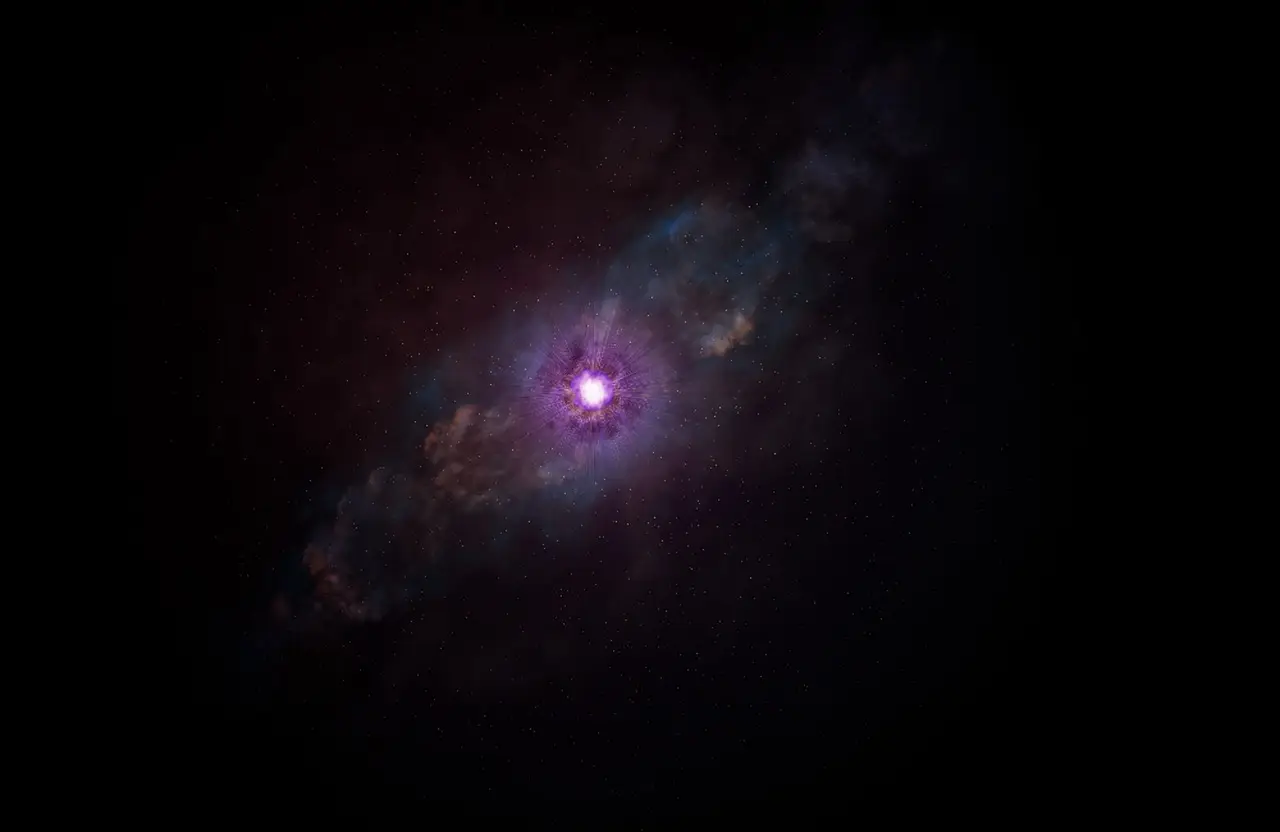
Astronomers have found a pulsar tearing through the Milky Way at more than 1,400 kilometers per second — over 870 miles per second — after escaping the expanding cloud of debris from the supernova that created it. The discovery, accepted for publication in Astronomy & Astrophysics, adds a fifth case to a list of known pulsars outrunning their own supernova remnants.
The team, led by Rohit Dokara, formerly of the Max Planck Institute for Radio Astronomy, made the find by accident while combing through archival survey data. A preprint is available now on the arXiv server.
What is a runaway pulsar?
A pulsar is a highly magnetized, rapidly rotating neutron star that beams radiation from its magnetic poles. If a beam sweeps past Earth, astronomers see a radio flash pulsing with clocklike regularity — the astronomical equivalent of a lighthouse.
Pulsars are born when the cores of massive stars collapse and explode as supernovae. Those blasts also fling out enormous clouds of gas and dust called supernova remnants, or SNRs, which expand, thin out and dissolve into interstellar space within roughly 100,000 years.
The pulsar itself often gets a kick from the explosion that sends it drifting away from the cloud's center, dragging a comet-like tail of gas behind it. Occasionally the kick is extreme.
"As far as I know, there are four cases where, after a core-collapse supernova explosion, a pulsar has formed moving faster than the diffuse ejecta that eventually becomes a shell," Dokara said. "Such cases offer unique views of some of the fastest compact objects in our galaxy." The new object makes five.
How did the team catch it?
Dokara's team set out to tackle a different puzzle: astronomers predict the Milky Way should host roughly 2,000 supernova remnants, but only about 400 have ever been found. The researchers combined observations from several large-scale radio surveys, gathered by telescopes worldwide over the past two decades across a broad range of frequencies.
Those surveys record radio waves from electrons spiraling through magnetic fields in an SNR's expanding shell, and they can also pick out pulsars and their tails.
From the combined data, the team calculated three key quantities for any pulsar–remnant pair. Measuring how quickly a pulsar's spin slows down — done by precisely timing its pulses — gives its approximate age. Measuring the angular separation between the pulsar and the shell's center shows how far apart they appear on the sky. And comparing arrival delays between higher- and lower-frequency radio waves, which travel differently through sparse interstellar electrons, yields the pair's distance from Earth.
With those three numbers, the researchers could estimate a pulsar's velocity and a remnant's size and evolutionary stage — where it sits on the path from fresh explosion to fully dissipated cloud.
What did the chance discovery reveal?
While reviewing the data, Dokara spotted a link nobody had noticed before. "By chance, I found a new supernova remnant shell and a known pulsar to be well outside this shell, but with its tail very clearly pointing to the center of the shell," he said.
The speed estimate, over 1,400 kilometers per second in transverse velocity, ranks among the largest ever measured for a Milky Way pulsar. The pulsar, designated J1909+0749, has already burst through the shell of remnant G42.1-0.2 — its tail still pointing back toward the cloud's heart like a smoking gun.
The initial images of the shell and the tail came from MeerKAT, a next-generation radio telescope array in South Africa, which hints at what improved sensitivity and resolution can do.
Why does one escaped pulsar matter?
Dokara believes this is a preview, not a fluke. Newer radio facilities, with their sharper instruments, could turn up similar associations regularly in future large-scale surveys.
"The science potential for each such survey is enormous, and this work is just one small example of combining data from such surveys using standard methods to discover and identify rare associations," he said.
For now, the result is preliminary in the sense that the velocity estimate rests on modeled distances and evolutionary assumptions. But if more runaway pulsars surface, astronomers gain a lever on two stubborn mysteries at once: what gives newborn pulsars their violent kicks, and why the galaxy's supernova remnants are so conspicuously missing.
via phys.org/rss-feed/ (Source)
More from Elena Vasquez
Show full bio
Correspondent covering money, funding and market shifts around general science news at SciBeat.
659 articles
Nearby plates
- Record-Breaking X-Ray Flash May Mark Birth of a Magnetar
- A Dead Star Flashes Every 8 Minutes — and Its Partner Is Nearly the Sun
- Astronomers Find the Lightest Double Neutron Star System Ever Measured
- Lattice search finds gamma-ray pulsar a million times faster
- White dwarf pair sends radio pulses to Earth every eight minutes