Plate Nº 17 · recorded November 17, 2026
Biology & EvolutionReported finding
Rice Blight Bacteria Hit a Barrier at the Root — Then Shape-Shift Into Leaves
Two 2026 studies from Heinrich Heine University Düsseldorf show rice blight bacteria likely can't travel root-to-shoot, but form multicellular filaments to invade leaf tissue.
By Nathan Brooks4 min read733 words
In brief
- Two 2026 studies in Phytopathology and BMC Microbiology map how Xoo spreads inside rice plants.
- A barrier at the coleoptile nodes likely blocks Xoo from moving from infected roots to shoots.
- Xoo forms filamentous, multicellular cells to cross from the xylem into leaf tissue.
- The pathogen hijacks SWEET sugar transporters to drain nutrients from rice cells.
- Filament formation may offer a new target against the disease, per Dr. Wolf B. Frommer.
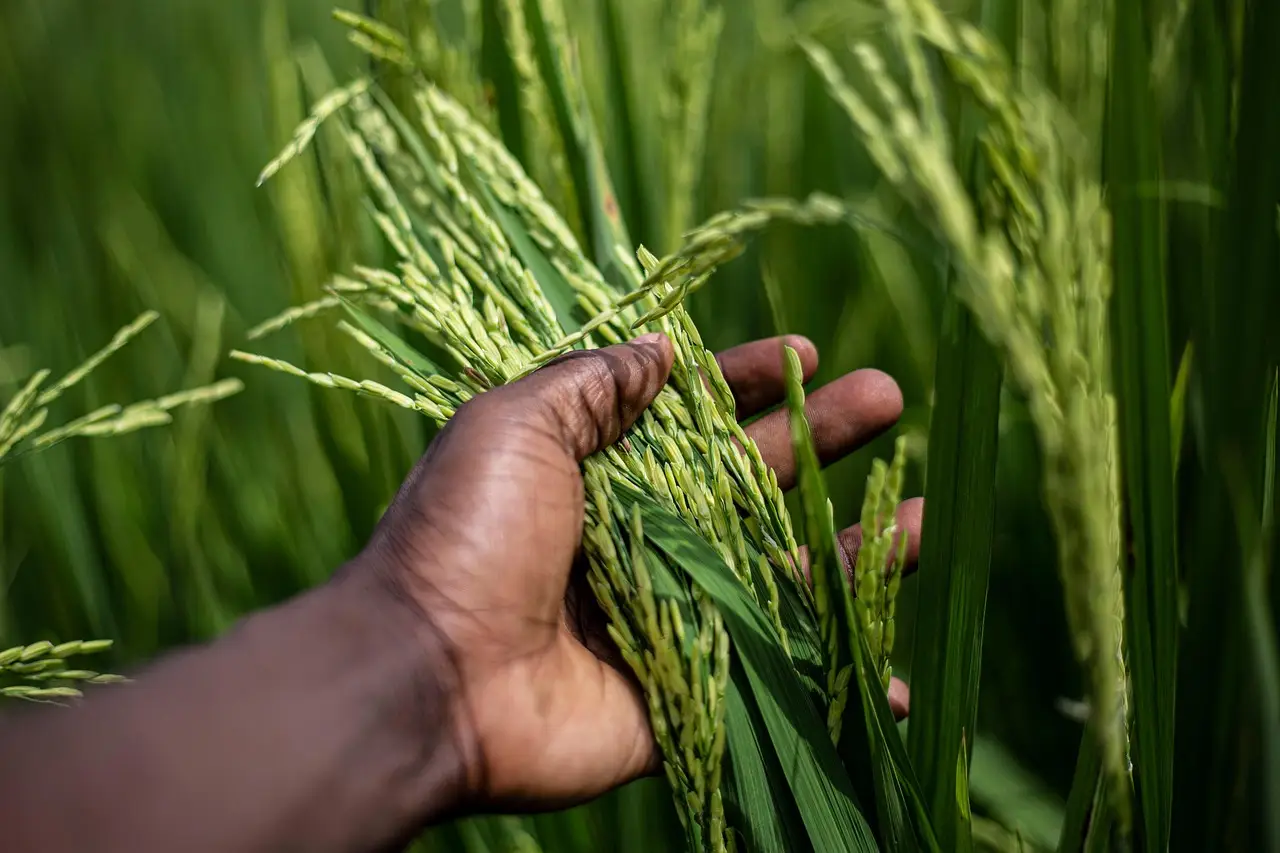
Rice blight bacteria almost certainly cannot travel from an infected root to the shoot, according to new research from Heinrich Heine University Düsseldorf (HHU) published in 2026. The same team reports a second discovery: the pathogen shape-shifts into filamentous, multicellular forms to break out of the plant's plumbing and colonize leaf tissue.
Both studies, led by Laura Redzich, a former member of HHU's Institute for Molecular Physiology, appeared in the journals Phytopathology and BMC Microbiology in 2026. The institute is headed by Dr. Wolf B. Frommer.
Why does this disease matter?
The culprit is Xanthomonas oryzae pv. oryzae, or Xoo, which causes bacterial blight in rice and triggers substantial yield losses. Scientists already knew the general infection mechanism: Xoo injects proteins called TAL effectors into plant cells, where they bind to the host genome and switch on genes for sugar transporters from the "SWEET" family.
Those transporters then push large amounts of sugar out of the plant's cells, feeding the bacteria. The rice loses valuable nutrients, the leaves wither and dry out, and the plant ultimately dies.
What nobody knew was how the pathogen spreads inside the plant after that first breach. That's the gap the HHU team set out to close.
What stops the infection at the root?
Researchers suspected Xoo infects via the leaves, but they couldn't rule out a root route — say, bacteria riding contaminated irrigation water at the germination stage and climbing into the shoots. The new findings make that route unlikely.
"In fact, the infection spreads through the root vascular system until the so-called coleoptile nodes," Redzich said. "We traced the induction of the sugar transporters the pathogen hijacks along the root vascular system. We did not find induction of sugar transporters beyond these nodes and the leaves of the young plants also showed no signs of the disease despite having infected roots."
The coleoptile nodes sit at the base of grass seedlings, where the plant's lateral shoots develop. Cells there actively transport substances into the xylem — the plant's water-carrying tissue — and they appear to block the bacteria from passing through, effectively sealing the shoot off from root infection.
"Our findings expand our understanding of Xoo infection routes," Frommer said. "In addition, the method we have developed also provides a valuable tool for resistance testing and pathogen surveillance."
How do the bacteria invade the leaves?
The second paper describes what happens once Xoo reaches a leaf. To colonize the leaf interior, bacteria in the xylem must overcome physical barriers, immune responses and the hydraulic flow of the xylem itself.
The team tagged the bacteria with a fluorescent protein and tracked them. The analyses showed Xoo assumes filamentous, multicellular forms and crosses from the xylem into neighboring cells.
"In the laboratory, we noted for the first time that the bacteria can assume a filamentous morphology," Redzich said. "We also found greater numbers of rod-shaped Xoo cells. Both forms were particularly prevalent during the colonization phase."
The rod-shaped cells attach to xylem pits — small openings in the vessel walls — and enter cells from those points. The filamentous form crosses the xylem into bundle sheath cells and, presumably, the mesophyll, the leaf's photosynthetic tissue.
Could filament formation be the weak spot?
The findings reshape how researchers think about the damage Xoo causes. Leaf lesions and cell death probably aren't just the result of the bacteria cutting off nutrient flow through the xylem, Frommer said. The bacteria also appear to damage plant tissue directly, killing cells.
"We thus assume that Xoo differentiation into various forms during host colonization plays a key role for virulence," Redzich said.
Filament formation is known in other pathogens, including human ones such as the plague bacterium Yersinia pestis and the gut bacterium E. coli. But there's a key difference, Frommer noted: in human pathogens, filamentation is a response to antibiotic treatment. In Xoo, the filaments seem to be part of the bacterium's normal developmental program.
"This could be a potential starting point for tackling Xoo dispersion within the plant," Frommer said.
The results are preliminary in the sense that the colonization studies were conducted in laboratory settings, and the mesophyll route remains presumed rather than proven. Still, the work hands plant breeders both a new surveillance tool and a concrete target: the biological switch that tells Xoo to grow into filaments.
via phys.org/rss-feed/ (Source)
More from Nathan Brooks
Show full bio
Market editor covering companies, deals and strategy in general science news at SciBeat.
456 articles
Nearby plates
- Plants Can Smell Insect Spit — And Now We Know How
- First U.S. Clone of Tomato Spotted Wilt Virus Built in Texas
- Black and Green Rice Digest More Slowly Than White Rice, Study Finds
- Nutrient Pulses, Not Amounts, Give Invasive Plants Their Edge
- Blue Light Kills Every Strain of Chicken Food-Poisoning Bug Tested