Plate Nº 69 · recorded October 9, 2026
Biology & EvolutionReported finding
Scientists Build the First Million-Cell Family Tree of a Developing Mouse
Two HHMI teams independently traced millions of cells in developing mice back to a single fertilized egg, using DNA marks that record each division — the most complete mammalian lineage maps yet.
By Priya Raman4 min read749 words
In brief
- Researchers reconstructed cell lineage maps spanning millions of cells in developing mice, published in Science in 2026.
- Weissman's PEtracer, unveiled in 2025, installs heritable DNA marks at more than 100 genome sites using prime editing.
- Shendure's DNA Typewriter, developed in 2022, logs each cell division on a DNA ticker tape.
- A mouse embryo grows from one fertilized egg to hundreds of millions of cells in just a few weeks.
- The human body contains roughly 37 trillion cells, all descended from a single fertilized egg.
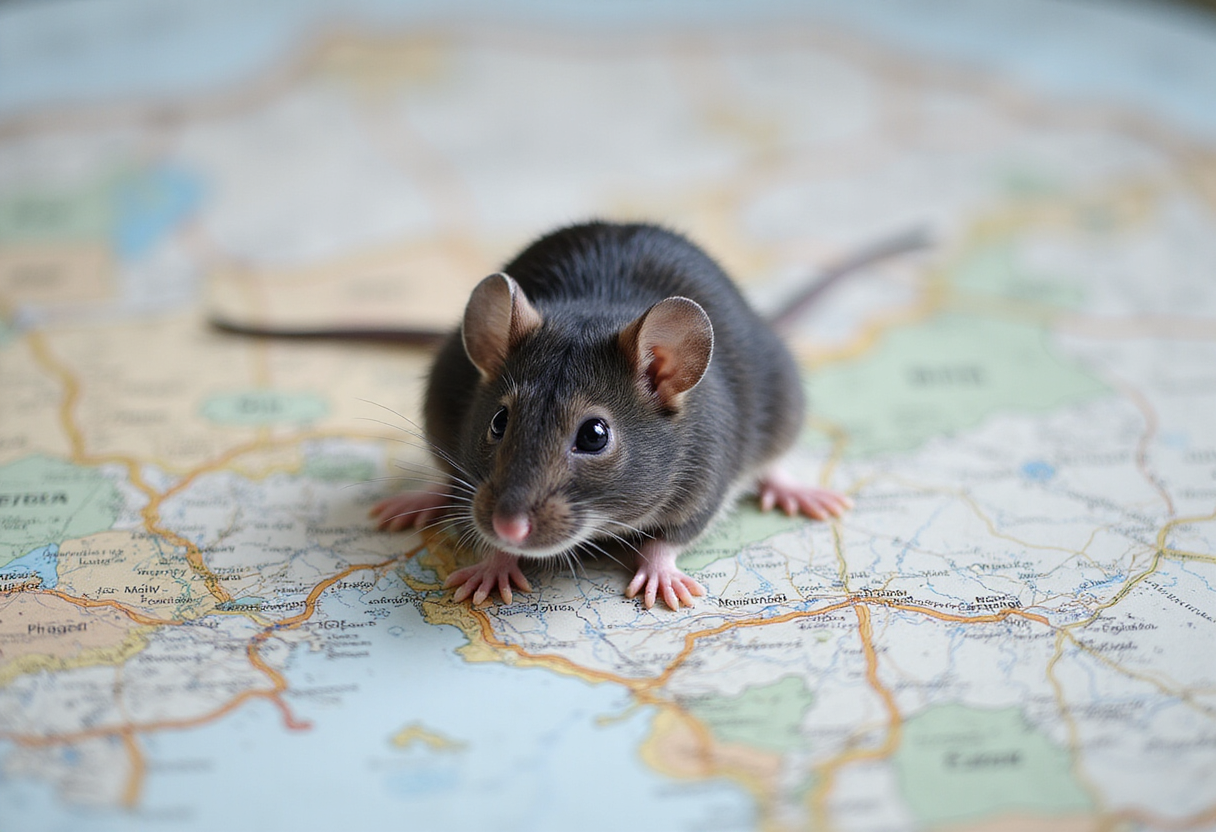
For the first time, researchers have reconstructed cellular family trees spanning millions of cells in developing mice — the most complete lineage maps ever made for a mammal. HHMI investigators Jonathan Weissman of the Whitehead Institute and Jay Shendure of the University Washington and their teams achieved the feat independently, and both published their results in the journal Science in 2026.
Every one of the roughly 37 trillion cells in a human body descends from a single fertilized egg. Biologists have long wanted a complete map of that ancestry — a family tree of cells — but until now they could only build one for simple, transparent animals such as roundworms.
"It's really proof of principle that we can do what was done with the roundworm in 1983, but for mammals like you and me," Weissman said.
Why is a mammalian cell map so hard to build?
A roundworm embryo is transparent, so scientists can watch every single cell division under a microscope. A mouse embryo develops inside its mother, hidden from view, and grows from one fertilized egg to hundreds of millions of cells in just a few weeks. Real-time observation over that period is simply impossible.
"Most biological measurements are based on either live imaging, which is limited by the fact that most animal tissues are not transparent, or genomics, which is destructive and only measures a single time point," Shendure explained. "Recording techniques like the ones in these studies enable measurements over time, including in settings that we can't directly visualize."
How do cells write their own history?
Instead of watching development happen, the researchers made cells record it in their own DNA. The trick works like this:
- Each time a cell divides, it adds a small, permanent mark to its genome.
- Both daughter cells inherit that mark.
- The daughters add new marks when they divide in turn.
- Sequencing each cell at the end reveals the full chain of marks — and with it, the cell's complete ancestry.
Because researchers read the marks by sequencing individual cells, the same experiment shows both what a cell became — its type and the genes it is expressing — and where it came from.
"The cell divides and each of the sisters gets a mark, and those are inherited by their daughters, and they get additional marks, and so on and so forth," Weissman said. "And so, by looking at the end at the marks in this DNA, we're able to reconstruct what this relationship is."
What tools did each team use?
Weissman's team unveiled a technique called PEtracer in 2025. It uses prime editing — a precise genome-editing method — to install heritable marks at more than 100 sites in the genome. The researchers engineered mouse stem cells carrying these marks and injected them into an embryo. As the embryo developed in utero, the marks spread into nearly every cell it produced.
Shendure's team developed a related technology in 2022 called DNA Typewriter, which also uses prime editing to log each cell division onto a string of DNA, like entries on a ticker tape. In the new work, his team injected the DNA Typewriter components directly into a fertilized mouse egg, and the marks accumulated as the embryo's cells divided.
By analyzing the resulting records, both teams traced how cells commit to their fates as the animal develops — the moment, for example, when a cell's descendants are locked into becoming muscle, nerve, or blood.
What could the maps be used for?
The new lineage maps open several research directions:
- Understanding normal development, including how cells differentiate to build tissues.
- Identifying where and when a developing embryo is most vulnerable to environmental or genetic stressors.
- Studying how tumors initiate, grow, spread, and become resistant to therapies.
- Training AI models of embryogenesis, with the long-term goal of building a "virtual embryo" that can predict developmental outcomes.
"There are so many key things that happen during development or during the evolution of a tumor that are happening at a time when we can't observe them directly, so if we can record that information in the DNA, then we can infer and reconstruct exactly how it's happening," Weissman said.
He added that the tools could yield "unknown unknowns" — discoveries nobody can anticipate, much as the roundworm cell map of the 1980s led to unexpected biological insights. "That was just by understanding the process and getting at the underlying molecular mechanisms that led to those discoveries," he said.
via Phys.org Biology (Source)
More from Priya Raman
Show full bio
Senior reporter covering industry trends and analytics at SciBeat.
76 articles
Nearby plates
- Crawling Motion May Be Far Older Than Complex Life Itself
- 3D genome reshuffling may explain cephalopod brain complexity
- OpenFISH Maps Genes and Metabolites in One Tissue Slice
- Animals May Have Evolved 200 Million Years Earlier Than Fossils Show
- Three Timed Signals Turn Blood B Cells Into Antibody Factories