Plate Nº 37 · recorded October 9, 2026
Space & AstronomyReported finding
SPHEREx Finds Thousands of Brown Dwarfs With Star-Like Weather
NASA's SPHEREx telescope found water, methane and carbon gases in 37 brown dwarfs — rogue worlds too small to be stars — with thousands more now under analysis.
By James Calloway5 min read913 words
In brief
- SPHEREx analyzed 37 nearby brown dwarfs ranging from about 4,000 F to minus 10 F (2,200 C to minus 20 C).
- The telescope measures brightness in 102 colors, from deep red to infrared wavelengths blocked by Earth's atmosphere.
- NASA launched SPHEREx in March 2025; it takes about 3,600 unique images per day to map the entire sky.
- Findings published in The Astrophysical Journal show atmospheres with water, CO2, carbon monoxide and methane.
- Only a few dozen brown dwarfs had been studied in detail before; thousands more SPHEREx detections await analysis.
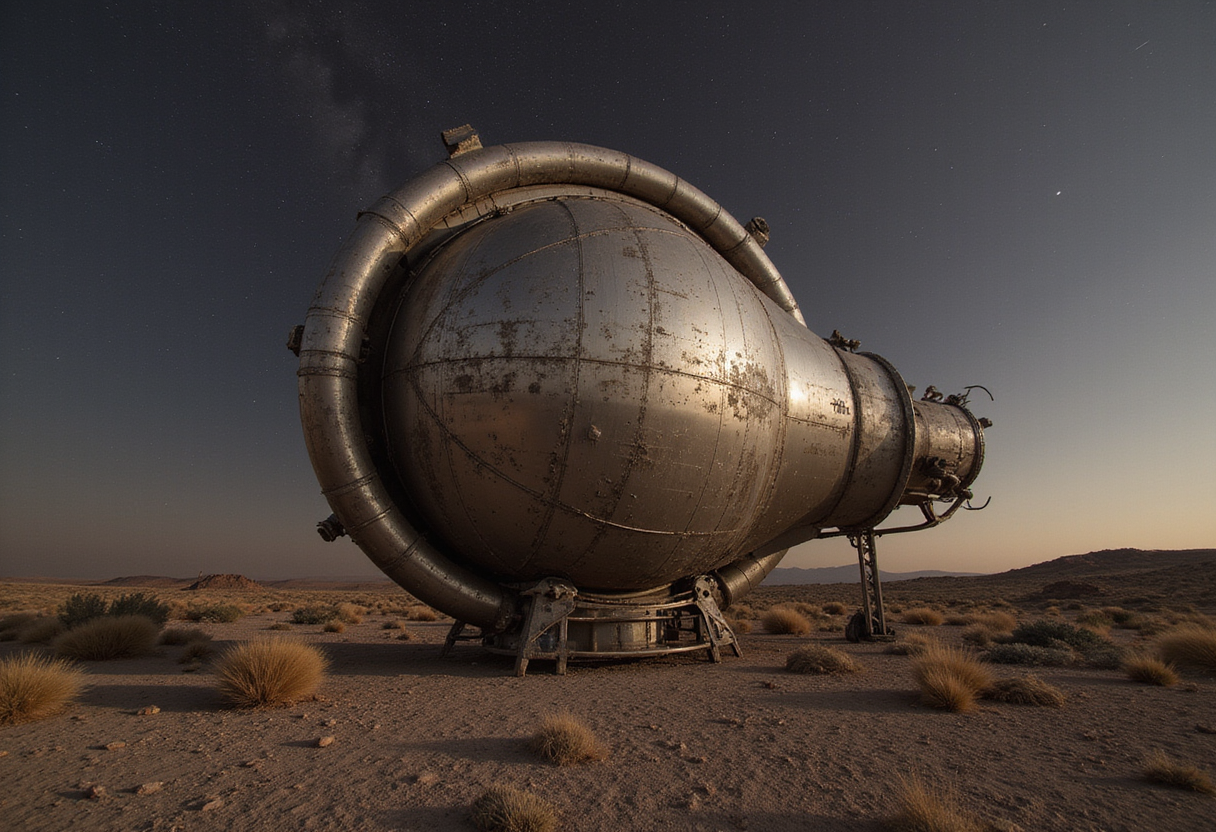
NASA's SPHEREx space telescope has analyzed 37 nearby brown dwarfs and found chemically rich atmospheres containing water, carbon dioxide, carbon monoxide and methane — gases strikingly similar to those in the giant planets of our own solar system. The findings, published in The Astrophysical Journal, come from a telescope that is, in the process, cataloguing thousands more of these dark, drifting worlds.
Brown dwarfs are celestial objects that blur the line between stars and planets. They form from collapsing clouds of gas, just as stars do, but they lack the mass to sustain hydrogen fusion in their cores. Instead, these dimly glowing balls of warm gas drift through the darkness, free-floating and ungoverned by any host star, heated entirely from within.
"They're kind of goth," said Zafar Rustamkulov, lead author of the study and a scientist at IPAC, Caltech's science and data center in Pasadena, California. "Unlike exoplanets, free-floating brown dwarfs are completely independent celestial objects that will fade into eternity alone. We're still learning how complex they are."
What did SPHEREx actually see?
First discovered in the 1990s, brown dwarfs remain poorly understood. Only a few dozen have been studied in detail with space-based telescopes, and much of what scientists know about their makeup, storminess and evolution comes from theoretical models rather than direct observation.
Enter SPHEREx — short for Spectro-Photometer for the History of the Universe, Epoch of Reionization, and Ices Explorer. NASA launched the infrared telescope in March 2025, and the agency's Jet Propulsion Laboratory in Southern California manages it.
The study team analyzed observations of 37 nearby brown dwarfs spanning the objects' full temperature range: from about 4,000 degrees Fahrenheit down to minus 10 degrees Fahrenheit (2,200 to minus 20 degrees Celsius). SPHEREx measured each object's brightness in 102 different colors, from the deepest red visible to the human eye into the invisible heat of infrared light, producing a spectrum — essentially a chemical fingerprint of the light an object emits.
Those spectra revealed the molecular signatures of water, carbon dioxide, carbon monoxide and methane.
"We're seeing the signatures of these molecules and how they change from object to object across the entire temperature regime," said study coauthor J. Davy Kirkpatrick, also a scientist at IPAC. "Our paper concentrated on just three dozen, but we have thousands more that we are in the process of analyzing. I really want to see what bounds the universe places on the variety of brown dwarfs."
Why can't ground telescopes do this?
The answer lies in Earth's own air. "From orbit, SPHEREx sees wavelengths of light that are basically impossible to see with telescopes on the ground because water in Earth's atmosphere absorbs them," Rustamkulov said. "We are picking up light from the deep, red clouds of brown dwarfs all over the sky."
SPHEREx occupies a sweet spot in the electromagnetic spectrum — the span of deep red and infrared wavelengths where molecules carve distinct absorption patterns into the light radiating from a brown dwarf's atmosphere. Those patterns shift as brown dwarfs age and cool. Some of the objects SPHEREx observed sit in a dynamic life stage where exotic clouds thin out and methane-rich atmospheres take over.
Other observatories, including NASA's James Webb Space Telescope and the retired Spitzer Space Telescope, have spotted brown dwarfs before. But SPHEREx's spectral coverage is now imaging thousands of them for the first time in this particularly fruitful wavelength range.
Do the findings match the models?
Only partly — and that is the interesting part.
"The state-of-the-art models are capturing the general chemical trend, but when it comes to these cloudy transitions, the models are struggling to match the data," Rustamkulov said. "No two brown dwarfs are alike. Even at the same temperature, their spectra look quite distinct."
That mismatch is a preliminary result from a sample of just 37 objects, and the authors themselves caution that thousands more await analysis. Still, the discrepancies suggest theorists will need to refine their pictures of brown dwarf atmospheres as the data grow.
Kirkpatrick framed the work as an open invitation: "The findings are a call to action to explore even more of these dark worlds. This journey has turned many of us into accidental meteorologists. We know how hard it is to predict weather on our own planet, and we realize it's going to be just as challenging to explain the phenomena we see in these bizarre, cold objects."
What else does SPHEREx do?
Finding brown dwarfs is something of a side project. The telescope takes about 3,600 unique images per day and stitches them into maps of the entire sky. Those maps will help scientists reconstruct what happened in the first billionth of a trillionth of a trillionth of a second after the Big Bang by charting the distribution of hundreds of millions of galaxies. The mission also searches for the chemical ingredients of life and for interstellar ice that could one day seed oceans on distant worlds.
The mission's broader organization:
- JPL manages SPHEREx for NASA's Astrophysics Division in Washington
- BAE Systems built the telescope and spacecraft bus
- Scientists at 13 institutions across the U.S., South Korea and Taiwan analyze the data, led by principal investigator Jamie Bock of Caltech and project scientist Olivier Doré of JPL
- IPAC at Caltech processes and archives the data, which is freely available to scientists and the public
via iopscience.iop.org (Original)
More from James Calloway
Nearby plates
- SPHEREx Telescope Finds Water and Methane on Dozens of Brown Dwarfs
- Webb Telescope Witnesses Planet-Smashing Collisions Around Young Stars
- Astronomers Find First Stellar Stream Beyond the Milky Way
- Strong magnetic fields can push white dwarfs past the Chandrasekhar limit
- Simulations Trace First Stars to Chemical Clues in Today's Universe