Recorded November 20, 2026
Space & AstronomyReported finding
Star-Eating Black Holes Could Reveal Dark Matter, MIT Study Says
MIT-led simulations show an atom-sized primordial black hole would devour a sunlike star from within and trigger jets that explode it within seconds — a flash telescopes could catch.
By Elena Vasquez4 min read813 words
In brief
- Simulations show an asteroid-mass, atom-sized primordial black hole would consume ~1% of a sunlike star's mass within several million years, then destroy it in dozens of seconds.
- The study appears in The Astrophysical Journal (2026), DOI 10.3847/1538-4357/aeb7e1.
- The predicted explosion would emit X-rays and gamma rays first, then optical, infrared and radio light detectable by current telescopes.
- A single star cannot capture a primordial black hole; a companion star or planet is needed for efficient trapping.
- Asteroid-mass primordial black holes would weigh about a millionth of Earth's mass and could form a significant component of dark matter.
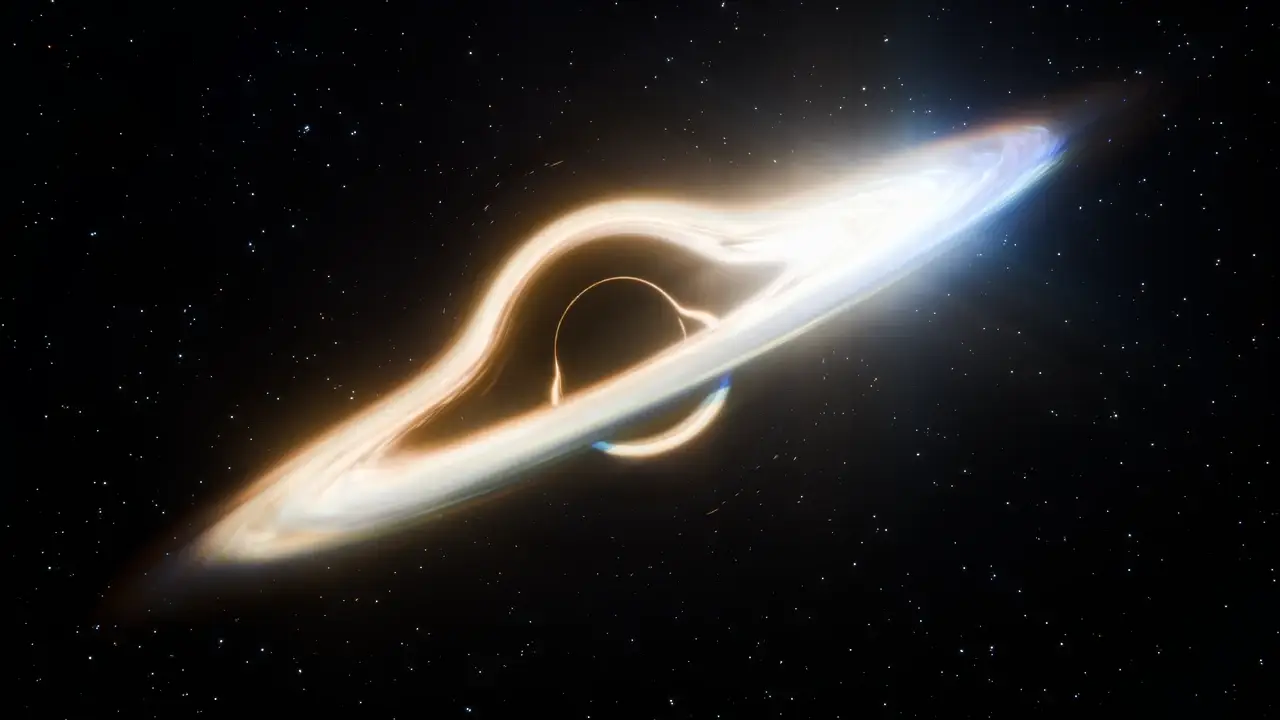
A tiny black hole caught by a sunlike star should devour it from the inside and blow it apart within seconds, producing a flash of light that today's telescopes can see. That's the conclusion of a new study by physicists at MIT and collaborating institutions, published in The Astrophysical Journal, which lays out a concrete way to detect primordial black holes — hypothetical objects that could make up a significant share of dark matter.
Dark matter is the invisible substance that accounts for most of the universe's matter. Scientists have long hypothesized that in the fraction of a second after the Big Bang, minute black holes may have formed inside tiny, dense pockets that collapsed under their own gravity. Nobody has ever confirmed one exists. Now there's a search strategy.
"There is hope for us to probe primordial black holes through interactions with stars," lead author Ore Gottlieb, an assistant professor of physics at MIT, said. "We expect this to be visible, and it's something we should look into."
What did the simulations show?
The team ran theoretical calculations and three-dimensional simulations, drawing on equations from general relativity, hydrodynamics, stellar evolution and particle physics. Their target scenario: an atom-sized primordial black hole with the mass of an asteroid — roughly a millionth of Earth's mass — captured by a modern, sun-sized star.
The picture that emerged is dramatic. The black hole falls into the star's core and starts feeding. After several million years it would have consumed about 1% of the star's mass. At that critical point, if the star spins fast enough, its gas can no longer fall straight into the black hole. Instead it piles up in a rotating disk of stardust around a black hole that is only a few meters across, hidden at the heart of the star.
"Inside the star, you have a black hole with a disk," Gottlieb said. "The black hole is also spinning, and it's twisting space and time."
Then the end comes fast. The spinning black hole twists and pulls on the disk's magnetic field, launching powerful jets of matter from its poles. "These jets will just explode the star, within a few dozen seconds," Gottlieb said. "It's very fast. Once you have a disk, you are done."
Or, as he put it more bluntly: "Once the disk forms, this is essentially a death sentence for the star."
How does a star catch a black hole?
Not easily, it turns out. The researchers found that the gravitational pull of a single star is not enough to trap a passing primordial black hole. But a three-body setup — the black hole encountering a star that has a companion, such as a second star or a planet — can capture one efficiently.
Once trapped, the black hole experiences friction as it passes through the stellar material. Repeated passages gradually shrink its orbit. Over thousands to millions of years — nearly instantaneous on cosmic timescales — it sinks into the star's center.
The team also found that most of the energy released as the black hole heats the surrounding gas is carried into the black hole itself. That lets it grow faster than previously thought.
Why did the lightest ones vanish?
Only the heavyweights remain. The smallest, lightest primordial black holes would have evaporated by now through Hawking radiation — a quantum effect proposed by Stephen Hawking, in which black holes radiate energy and shrink very slowly over cosmic time. Larger ones, asteroid-mass and atom-sized, should still be around. Those lingering relics are what the study targets.
What would the flash look like?
The researchers estimated the color and intensity of the explosion's light across the electromagnetic spectrum. "We would initially detect some X-rays and gamma rays, then over time optical and infrared emissions, and later on radio emissions," Gottlieb said. "This is something we could potentially detect, if it's not happening too far from us. It could be many galaxies away, not just in our backyard."
One flash won't settle the question. Other astrophysical phenomena can produce similar signals, so astronomers would need to combine the light with other clues — for example, a star of a mass that shouldn't explode on its own. "It must be something that is happening inside that is a sort of parasite that is consuming the star from the inside," Gottlieb said.
The broader payoff, he noted, is that observations like these could place constraints on primordial black holes and their contribution to dark matter. The finding rests on simulations and theoretical modeling, not observation, so the scenario remains unconfirmed until someone catches a star dying this way.
The study's co-authors are Matteo Cantiello of the Flatiron Institute, Cameron Norton and Matthew Kleban of New York University, and Ken Van Tilburg of Stanford University.
via phys.org/rss-feed/ (Source)
More from Elena Vasquez
Show full bio
Correspondent covering money, funding and market shifts around general science news at SciBeat.
613 articles
Nearby plates
- Asteroid-Mass Black Holes Inside Stars Could End in Seconds-Long Explosions
- Atom-Sized Black Holes Could Blow Up Stars, Simulations Show
- JWST Finds Black Holes Too Big Too Early, Rattling Galaxy Origins
- Webb's Little Red Dots May Be Newborn Giant Black Holes in Gas
- Quiet Deaths: Some Massive Stars May Collapse Without Exploding