Recorded November 22, 2026
Space & AstronomyReported finding
Atom-Sized Black Holes Could Blow Up Stars, Simulations Show
MIT-led 3D simulations show an atom-sized primordial black hole trapped in a fast-spinning sunlike star could trigger jets that tear the star apart, producing a light flash telescopes might record.
By Marcus Bennett3 min read550 words
In brief
- Simulations show an atom-sized, asteroid-mass black hole could destroy a fast-spinning sunlike star.
- The study was published in The Astrophysical Journal by MIT and collaborating institutions.
- The predicted explosion would emit blue/UV light, high-energy X-rays and gamma rays.
- Primordial black holes, formed just after the Big Bang, have never been confirmed to exist.
- No observation exists yet; the work is a theoretical prediction from 3D computer models.
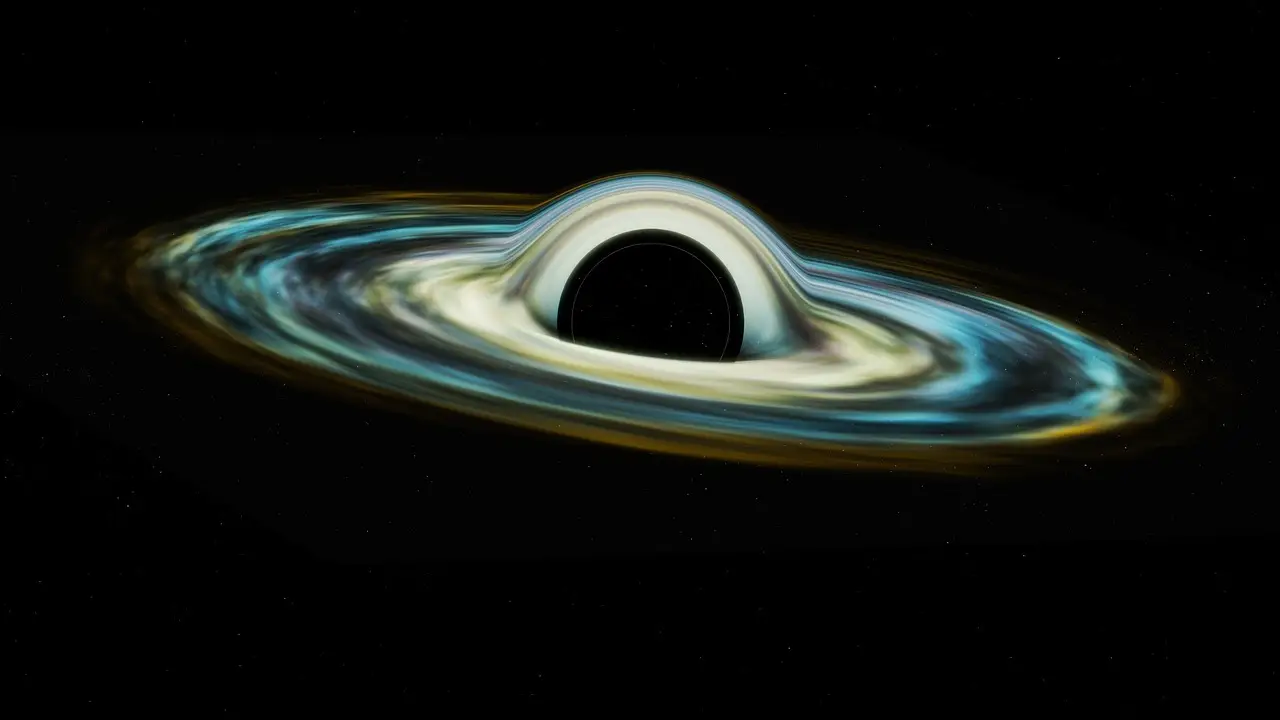
A black hole the size of an atom but as massive as an asteroid could destroy a sunlike star from the inside, according to new three-dimensional computer simulations from MIT and collaborating institutions. If it happens, the death would flash blue and ultraviolet light plus high-energy X-rays and gamma rays across enormous distances — a signal telescopes already in use could record.
The study, published in The Astrophysical Journal, proposes a concrete way to hunt for primordial black holes: objects that, unlike the stellar-collapse black holes astronomers know, may have formed shortly after the Big Bang when some regions of the young universe were extremely dense. No one has ever confirmed one exists.
Why does anyone want to find primordial black holes?
The invisible material known as dark matter affects galaxies through its gravity, and scientists have never identified what it is. Primordial black holes are one candidate explanation, which makes any observational handle on them valuable.
Most known black holes form when massive stars collapse. Primordial black holes, by contrast, would have appeared in the universe's first moments, when density fluctuations could have condensed directly into black holes of vastly smaller mass.
The takeaway: this work aims at two puzzles at once — the existence of primordial black holes and the nature of dark matter.
What do the simulations actually show?
The researchers modeled what happens when a sunlike star captures a primordial black hole of roughly asteroid mass.
- Gravity draws the black hole toward the star's center.
- Once there, it starts pulling in surrounding stellar material.
- The outcome hinges on how fast the star rotates.
- In a sufficiently fast-spinning star, the infalling material forms a swirling disk around the black hole.
- That disk generates powerful jets that burst outward and tear the star apart.
The predicted explosion would produce a bright flash in blue and ultraviolet light, together with high-energy X-rays and gamma rays — a combination that existing telescopes could in principle catch.
The takeaway: spin decides the fate — only fast rotators channel the black hole's feeding into destructive jets.
Has anyone seen this happen?
No. The study is a theoretical prediction built from calculations and three-dimensional computer models, not an observation. The authors state plainly that no primordial black hole has been detected destroying a star.
Real stars have complicated structures, and several cosmic events can produce bright flashes that overlap with this signature. Exploding stars and material falling onto black holes both generate similar bursts. Astronomers routinely watch the sky for sudden flashes, but attributing each one to a specific cause is difficult.
The takeaway: this is a search template, not a discovery.
What would a convincing detection require?
A solid claim would need observers to compare the timing, color and energy of a candidate event against several competing explanations, not just match one feature. The study's stated next challenge is to identify which combination of signals would make a black-hole-driven explosion stand out from other kinds of stellar death.
If future observations match the predicted pattern, astronomers gain a new window onto both primordial black holes and the mysterious material that outweighs the visible universe's stars.
The takeaway: match the full fingerprint — timing, color, energy — before calling it a primordial black hole.
via knowridge.com (Source)
More from Marcus Bennett
Show full bio
News editor covering regulation, policy and their impact on general science news at SciBeat.
584 articles
Nearby plates
- Asteroid-Mass Black Holes Inside Stars Could End in Seconds-Long Explosions
- Star-Eating Black Holes Could Reveal Dark Matter, MIT Study Says
- Primordial black holes could shift into five dimensions, math suggests
- JWST Finds Black Holes Too Big Too Early, Rattling Galaxy Origins
- JWST's Little Red Dots May Be Black Holes Older Than Stars