Recorded November 22, 2026
Space & AstronomyReported finding
Sunlight may explain the odd acceleration of asteroid 1998 KY26
A new study says photons from the sun could push the 36-foot object 1998 KY26 off its predicted orbit. At -47°C, it's also too warm to be a comet.
By Nathan Brooks3 min read683 words
In brief
- 1998 KY26 is about 36 feet (11 meters) across and orbits between Earth and Mars.
- A peer-reviewed study in Icarus, published October 28, 2026, attributes its odd acceleration to solar photons and the Yarkovsky effect.
- The object's surface temperature of -47°C is too warm for ice, ruling out a comet.
- Japan canceled a planned 2031 Hayabusa2 flyby this month due to engine problems.
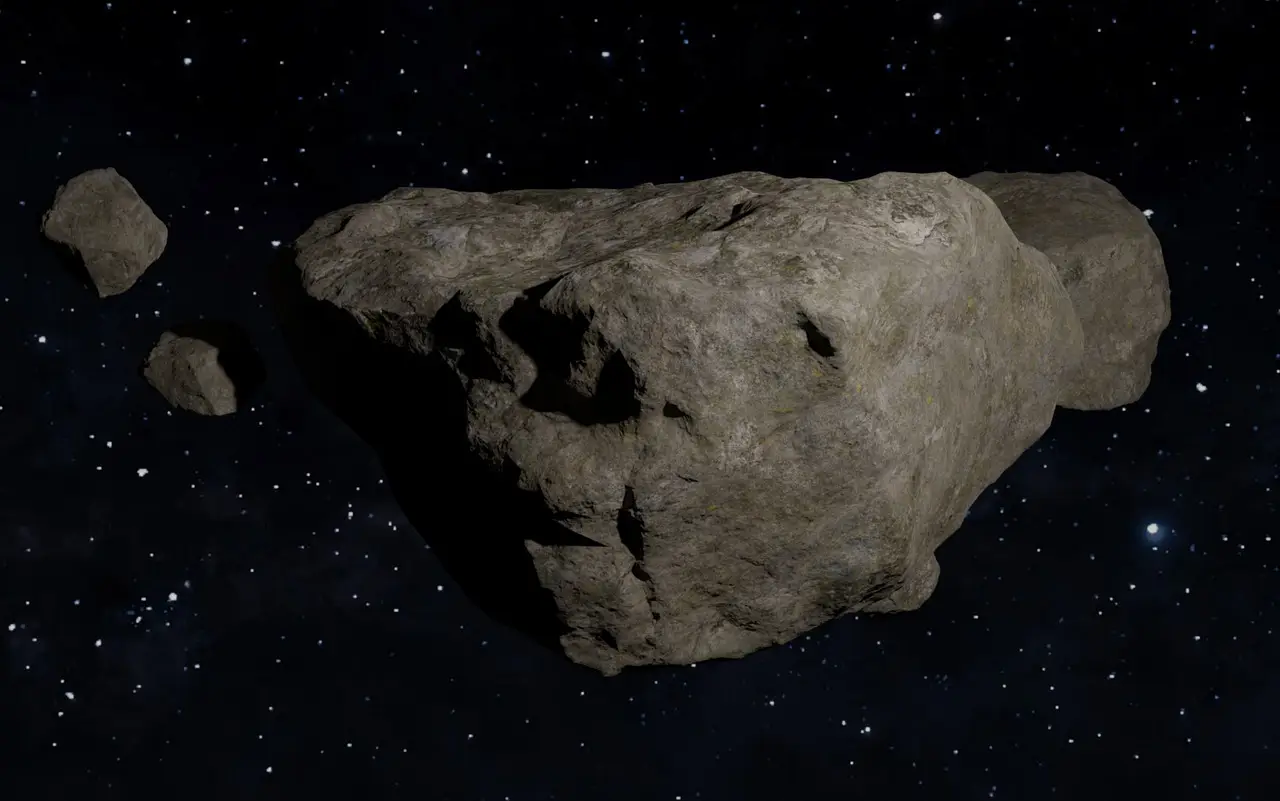
Sunlight, not gravity, may be what's shoving the mystery object 1998 KY26 around its orbit. That's the conclusion of a peer-reviewed study published in the journal Icarus on October 28, 2026, by Korbin Hansen and Masatoshi Hirabayashi at the Georgia Institute of Technology.
The object itself is small: roughly 36 feet (11 meters) across, circling the sun between Earth and Mars. And it has a genuine puzzle attached. Its accelerations deviate from the neat, predictable orbit that Johannes Kepler's laws of planetary motion demand. Something besides gravity appears to be pushing it.
What is 1998 KY26?
Scientists have floated three candidate answers over the years: comet, asteroid, or a defunct human-made spacecraft. The new study lands firmly on asteroid.
The comet hypothesis took the biggest hit. 1998 KY26 shows no tail, which would normally rule a comet out — except that so-called dark comets don't grow tails either. Temperature settles the question, though. The object sits at -53 degrees Fahrenheit (-47 degrees Celsius), which sounds frigid but is too warm for ice to survive in space.
Darryl Z. Seligman of Michigan State University put it bluntly in The New York Times on November 16, 2026:
If something has ice, then it's a comet. But no ice means no comet. The surface of KY26 is too warm.
Why is it so hard to study?
Near-Earth Objects like this one should be easy targets — they're close by cosmic standards. In practice, their size defeats observers. As Seligman noted:
There's not tons of data on very Near-Earth Objects. They're super small and faint.
One 2025 paper made the problem worse, in a useful way: it showed 1998 KY26 is actually one-third the size scientists had assumed. A smaller object means weaker gravitational dominance — and more room for tiny non-gravitational forces to matter.
Could the sun be doing the pushing?
Davide Farnocchia, a navigation engineer at NASA's Jet Propulsion Laboratory in Pasadena, California, proposed the leading idea. Photons — the smallest possible packets of electromagnetic energy — carry momentum. When enough of them strike a small body, that pressure can physically move it. The phenomenon is called radiation pressure.
David Jewitt, director of the Institute for Planets and Exoplanets at the University of California, Los Angeles, explained the arithmetic:
Light photons carry momentum; it's very small per photon, but there's a hell of a lot of photons. That pressure is enough to push bodies around if they're not too big.
A second force may be pitching in. The Yarkovsky effect occurs when an object absorbs sunlight and then radiates that energy back out as heat, producing a gentle recoil. Hansen and Hirabayashi suggest the combination of radiation pressure and the Yarkovsky effect could account for 1998 KY26's strange accelerations. It's a preliminary explanation, and the data behind it remains thin.
Is it the lost Phobos 1 probe?
A very different theory has a familiar author. Avi Loeb of Harvard University — best known for suggesting the interstellar object 'Oumuamua might be an alien spacecraft — doesn't think this one is a spaceship. In a paper he co-authored, first proposed last May, he argues 1998 KY26 could be the Soviet Phobos 1 probe, launched toward Mars and never heard from again.
The skepticism has been pointed. NASA Administrator Jared Isaacman said there's no evidence it's:
… anything but an asteroid.
Bryce T. Bolin of Eureka Scientific Inc. added:
There's all sorts of space junk out there, but this object is way too heavy, way too dense.
What happens next?
A close-up visit was on the schedule. Japan's Hayabusa2 spacecraft was supposed to reach 1998 KY26 in 2031. Earlier this month, the Japanese space agency canceled that plan over reported engine problems — so the object will keep its secrets for now.
For the record, the tally of known near-Earth asteroids passed 40,000 recently, and 1998 KY26 remains one of its strangest entries: a small, warm, accelerating rock that sunlight may be quietly nudging off course.
via sciencedirect.com (Original)
More from Nathan Brooks
Show full bio
Market editor covering companies, deals and strategy in general science news at SciBeat.
563 articles
Nearby plates
- Simulations weaken the dark-comet case for asteroid 1998 KY26
- Asteroid 1998 KY26 Is Too Warm for Ice, Study Finds
- Asteroid 1995 BJ4 Grew a Tail — and It May Be the Largest Main-Belt Comet
- Hayabusa2 Abandons Mysterious 'Dark Comet' 1998 KY26 for New Target
- 2026 QQ8: Earth's Temporary Mini-Moon Through December