Plate Nº 81 · recorded November 5, 2026
Space & AstronomyReported finding
Twin ESCAPADE Probes Slingshot Past Earth November 7 and 9
NASA's twin ESCAPADE probes, Blue and Gold, fly past Earth on November 7 and 9, 2026, firing engines for a 1,000-mph boost toward a September 2027 Mars arrival.
By Marcus Bennett4 min read774 words
In brief
- Blue flies past Earth on November 7, 2026; Gold follows on November 9, 2026.
- Engine burns at closest approach add more than 1,000 mph; Mars arrival is set for September 7 and 9, 2027.
- The twin spacecraft cost under $80 million, about 10% of a typical Mars mission.
- New Glenn launched ESCAPADE on November 13, 2025 — only the rocket's second flight.
- Blue should be brightest over the western U.S. between midnight and 1 a.m. PST on November 7.
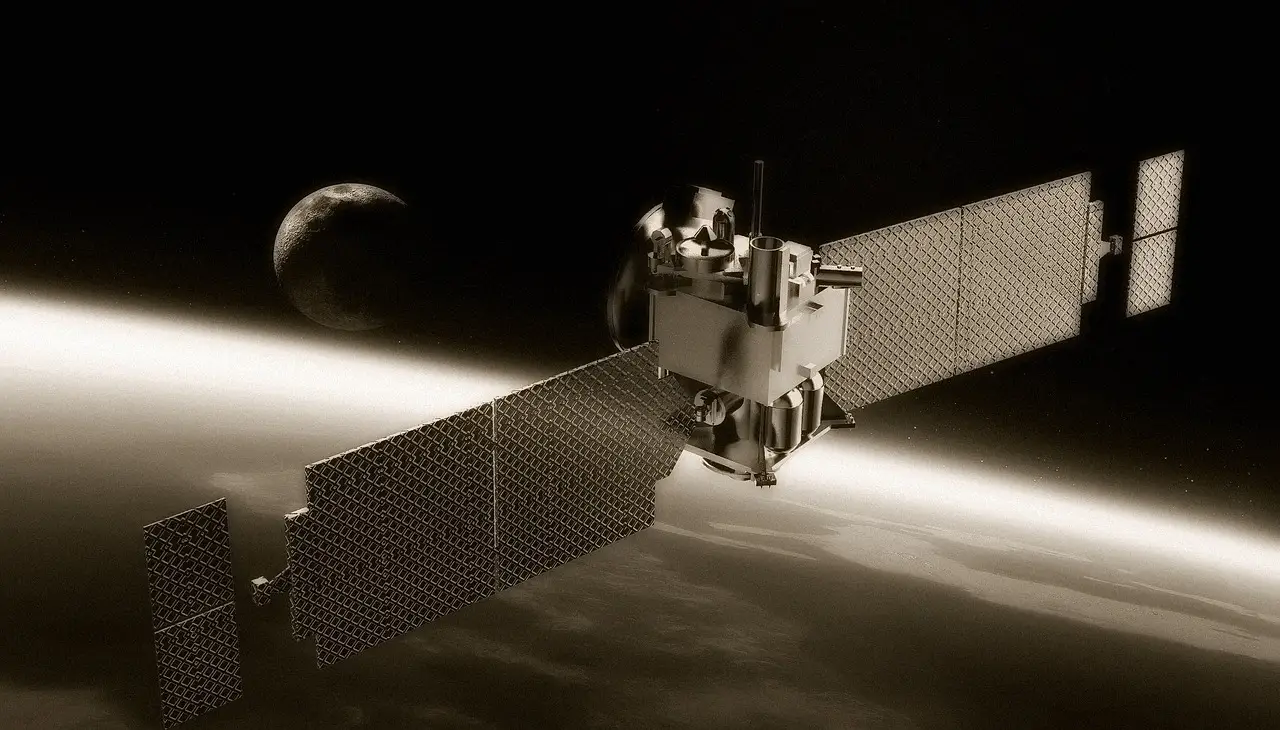
On November 7 and 9, 2026, NASA's twin ESCAPADE spacecraft will fly past Earth — one probe per day — and fire their engines to slingshot toward Mars, gaining more than 1,000 miles per hour in the process. The maneuver, called a trans-Mars injection burn, sets the two probes on course to arrive at the red planet on September 7 and 9, 2027.
The mission launched nearly a year ago, on November 13, 2025, aboard Blue Origin's New Glenn rocket from Launch Complex 36 at Cape Canaveral Space Force Station in Florida. ESCAPADE — short for Escape and Plasma Acceleration and Dynamics Explorers — carries two refrigerator-size spacecraft nicknamed Blue and Gold, after the school colors of UC Berkeley, which led the mission's design.
Why swing past Earth to reach Mars?
Spacecraft often borrow gravity instead of fuel. To reach Mars efficiently, Blue and Gold first traveled outward, then looped back toward Earth. At closest approach, each probe fires its engines for an extra push on top of the gravitational assist. Blue swings past first, on November 7; Gold follows two days later.
The payoff: arrival at Mars in September 2027, where the probes will study how charged particles from the sun interact with the planet's magnetic environment. In short, Earth's gravity is doing work the spacecraft's fuel tanks could not do alone.
Can you see the flyby?
Maybe — but you will likely need a telescope. Both probes will fly higher than most Earth-orbiting satellites and will move slowly across the sky, taking a few hours to travel from east to west.
- Western U.S.: Blue should appear brightest between midnight and 1 a.m. PST in the early morning of November 7. Gold should be brightest between 1 and 2 a.m. PST on November 9.
- Southern Australia: Observers can watch during the engine burns. Blue's burn begins at 8:51 p.m. Australia Eastern Daylight Time on November 7; Gold's begins at 9:51 p.m. AEDT on November 9.
NASA said: "[Blue] will likely be brightest for the western U.S. between midnight and 1 a.m. PST in the early morning of November 7, and the second one [Gold] will be brightest between 1 and 2 a.m. PST on November 9." Star charts are available through NASA's Scientific Visualization Studio.
A bargain-price Mars mission
ESCAPADE's twin spacecraft cost under $80 million in total — roughly 10% of what a typical Mars spacecraft costs. The November 2025 launch was only the second flight of Blue Origin's New Glenn heavy-lift rocket, following its debut in January 2025. The reusable booster returned and landed safely on a platform, drawing loud cheers from the Blue Origin team on the company's live feed.
What will ESCAPADE study at Mars?
Mars lacks the planet-wide magnetic field that Earth generates with its molten, convecting iron core — a mechanism scientists call a dynamo. Earth's global field creates a strong magnetosphere that shields the planet from the solar wind, the steady stream of charged particles flowing from the sun.
Mars tells a different story. Billions of years ago it apparently had a global field. When the planet's smaller, cooler core lost its heat, the dynamo shut down and the global field collapsed. But iron-bearing rocks that solidified while the field still existed kept their magnetization. These frozen-in patches, called remnant magnetizations, still generate small regional magnetic fields — some surprisingly strong, especially in Mars' southern highlands.
The result is a hybrid magnetic environment: partly solar-induced, like Venus' magnetosphere, created by the solar wind interacting with the Martian atmosphere, and partly intrinsic, driven by crustal magnetism. NASA described the mission's goals this way:
"ESCAPADE will analyze how Mars' magnetic field guides particle flows around the planet, how energy and momentum are transported from the solar wind through the magnetic environment and what processes control the flow of energy and matter into and out of the Martian atmosphere."
Why two spacecraft instead of one
Blue and Gold will orbit Mars in complementary paths, taking simultaneous measurements from different locations. That geometry lets scientists watch the real-time response of Mars' magnetic environment as the solar wind buffets it. Researchers expect the data to clarify how Mars lost most of its atmosphere — and its magnetosphere — over billions of years.
The bigger questions ride along: Was Mars once habitable for some form of life, and could it support a human population in the future? If the twin probes survive their Earth slingshots this week, they will get their chance to answer in 2027.
via science.nasa.gov (Original)
More from Marcus Bennett
Show full bio
News editor covering regulation, policy and their impact on general science news at SciBeat.
294 articles