Plate Nº 32 · recorded November 18, 2026
Space & AstronomyReported finding
Two Flaring Red Dwarfs Weighed With Record Precision
Eighteen years of VLBA radio tracking reveal the masses, orbit and 59.3-light-year distance of the flaring red dwarf binary DG CVn — and constrain its possible planets.
By Priya Raman4 min read812 words
In brief
- DG CVn's two red dwarfs orbit each other every 4.511 years, passing within 0.59 Earth-sun distances at closest approach.
- The stars hold 39% and 36% of the sun's mass; the system lies 59.3 light-years away.
- Researchers combined 2007-2010 archival data with seven 2023-2025 VLBA sessions, yielding 27 precise position measurements.
- A stable planet around one star would need an orbit under ~23 days; one circling both stars would need at least ~36 years.
- The study appears in Astronomy & Astrophysics (2026), DOI 10.1051/0004-6361/202661940.
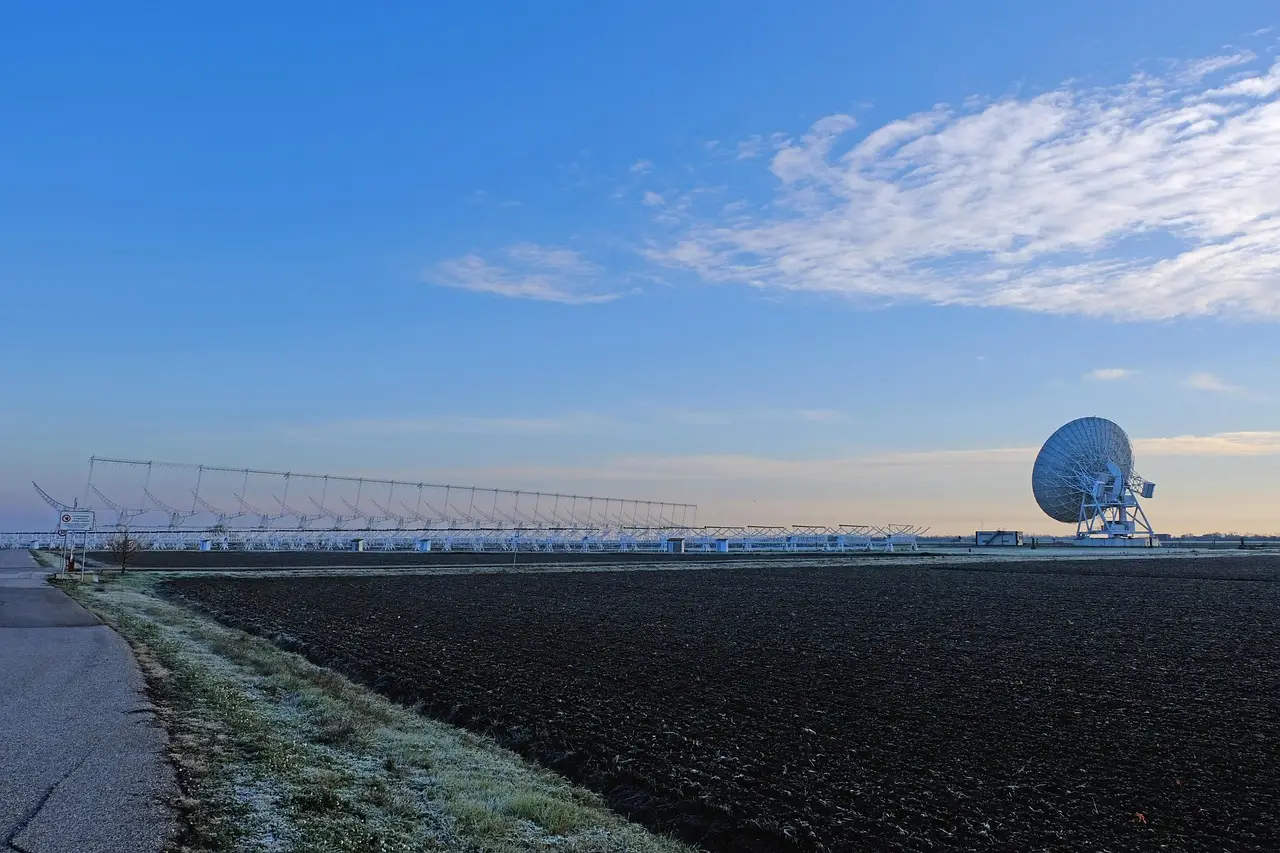
Astronomers have measured the orbit, masses and distance of the flaring binary star system DG CVn with extraordinary precision, using 27 position measurements gathered over 18 years. The results, published in the journal Astronomy & Astrophysics, represent one of the most precise dynamical measurements yet obtained for a binary system of this kind.
The system lies 59.3 light-years from Earth and consists of two red dwarfs — small, cool stars less massive than the sun — orbiting each other once every 4.511 years along a stretched, elliptical path. At their closest approach, the stars pass within about 0.59 times the distance between Earth and the sun. The team determined that the larger star, DG CVn A, holds about 39 percent of the sun's mass, while DG CVn B holds about 36 percent.
A team led by Paul Boven, a network system engineer at the Joint Institute for Very Long Baseline Interferometry ERIC (JIVE) and a Leiden Observatory Ph.D. student, made the measurements with the U.S. National Science Foundation's Very Long Baseline Array (NSF VLBA), a network of 10 radio telescopes spread across North America that work together like a single instrument thousands of miles across. The observations combined archival data from the NSF VLBA and the NSF Green Bank Telescope, taken between 2007 and 2010, with seven new VLBA sessions conducted between 2023 and 2025.
Why did both stars come as a surprise?
Most stars, including our sun, produce only faint natural radio emission. Some rapidly rotating red dwarfs are different: the churning motion inside them generates powerful magnetic fields and intense activity, including flares that emit strong radio and X-ray light.
DG CVn, a young system between 30 and 150 million years old, contains at least one such fast-rotating flare star, whose radio emission has been observed to surge after powerful X-ray outbursts. It also harbors a complex periodic variable (CPV) star — one showing persistent rhythmic variations in its visible light. Which star displays which behavior remains an open question.
When Boven's team examined the system, they expected radio waves from one star. They found two.
"We were really lucky to hear about this object when we had developed tools with which we could explain these motions," Boven said. "But the real surprise came when we also detected the second radio-loud dwarf in the observations we did to confirm our model. It really allowed us to measure the system very precisely."
Because the stars appear so close together in the sky, conventional optical telescopes struggle to tell them apart. The VLBA's ability to pinpoint radio emission let researchers track each star separately, like following two runners circling a track from a distant grandstand.
"DG CVn is a beautiful example of what precise radio astrometry can reveal," said Jay Blanchard, an NSF NRAO astronomer and co-author. "By following these two stars over many years, we can see their orbital motion directly and use that motion to determine properties that would otherwise be extremely difficult to measure."
How do you weigh a star?
The team measured the system's distance using parallax — the tiny apparent shift in a nearby star's position as Earth orbits the sun. Knowing the distance and the stars' mutual motion allowed the researchers to calculate the masses with unusual accuracy.
The system first drew attention during a search for planets around nearby stars. Astronomers were hunting for a star's subtle back-and-forth motion betraying an orbiting planet's gravitational pull; instead, DG CVn showed larger, more complicated motion, eventually traced to the two stars circling each other.
What does the tight orbit mean for planets?
Stars form surrounded by disks of gas and dust that supply the raw material for planets. Because DG CVn's stars repeatedly pass within about 0.59 astronomical units of each other, their gravitational interactions would have significantly limited the size of those disks.
The researchers estimate a planet orbiting one star would need to complete an orbit in less than about 23 days to remain stable, while a planet circling both stars would need an orbit of at least about 36 years.
The study also demonstrates the power of very long baseline interferometry (VLBI), the technique of combining far-flung radio telescopes for precise position measurements — precise enough, in principle, to detect the small "reflex" motion a planet induces in its star.
Future facilities such as the Next Generation Very Large Array (ngVLA) and the Square Kilometre Array (SKA) could extend such measurements to many more, more distant stars.
"And in the future, we hope to make measurements precise enough to detect planets in orbit around such radio-loud dwarfs," said Huib van Langevelde, JIVE chief scientist and Leiden Observatory professor.
The flares of DG CVn will keep burning; now, at last, their source has a precise address.
via phys.org/rss-feed/ (Source)
More from Priya Raman
Show full bio
Senior reporter covering people, launches and day-to-day practice in general science news at SciBeat.
476 articles
Nearby plates
- Euclid telescope spots Fornax-7, an ultra-faint 170-solar-mass system
- Hidden Star Siwarha Appears to Plow Through Betelgeuse's Atmosphere
- Betelgeuse's Atmosphere Has Recovered — and a Companion Star May Be Sculpting It
- Rubin Observatory Finds Candidate for Solar System's Sixth Dwarf Planet
- Ripples in Space-Time Could Expose a Hidden Population of Exoplanets