Recorded November 19, 2026
Space & AstronomyReported finding
Voyager 1 reaches one light-day from Earth after nearly 50 years
Voyager 1 has crossed a symbolic one-light-day threshold, reaching 26 billion kilometers from Earth after nearly 50 years while its cameras remain switched off.
By James Calloway3 min read672 words
In brief
- Voyager 1 reached one light-day from Earth on Wednesday, about 26 billion kilometers (16 billion miles) away.
- Launched in 1977, Voyager 1 has traveled through space for nearly 50 years.
- Earth-to-probe messages and probe-to-Earth replies each take about 24 hours.
- Voyager 1 and Voyager 2 are the only spacecraft to have reached interstellar space.
- Voyager 1's cameras have been switched off to save power, while instruments continue studying magnetic fields and material between stars.
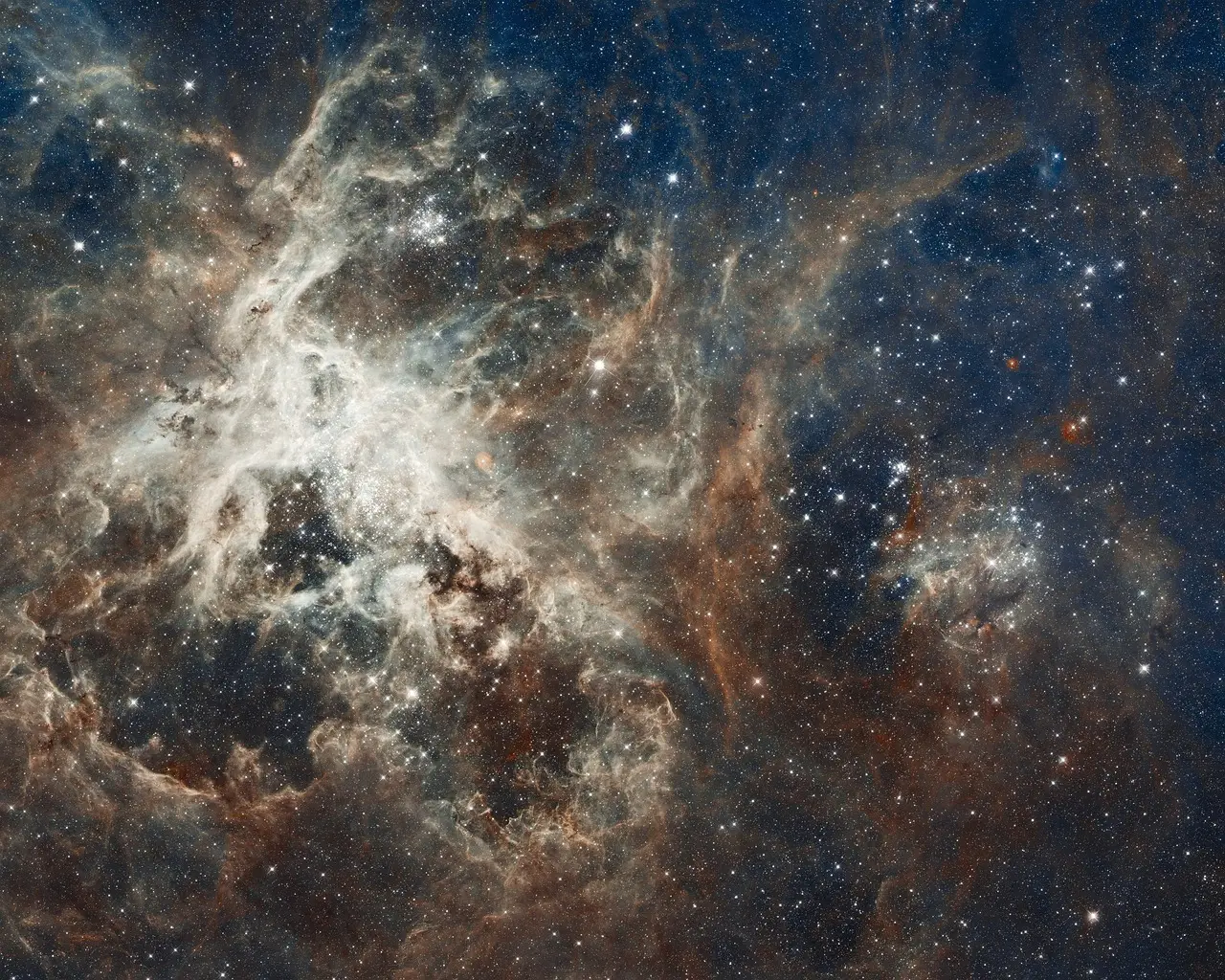
Voyager 1 has reached a distance of one light-day from Earth—about 26 billion kilometers (16 billion miles)—after nearly 50 years in space, NASA said Wednesday. The probe remains the most distant human-made object in the universe. The milestone marks distance, not a new destination or a newly discovered phenomenon.
NASA scientist Tiffany Kataria called the distance the best illustration of just how vast space is. She then said: “So much of what we dream about is traveling to other stellar systems. And it took Voyager 1 nearly 50 years to get to just the edge of our own solar system, let alone to only a light-day.”
Many exoplanetary systems—planetary systems around other stars—are at least several light-years away. The comparison supplies scale rather than a precise travel plan: it names no particular system and gives no exact distance for one.
What does one light-day mean?
A light-day is the distance a particle of light travels in 24 hours. Applied to Voyager 1, that everyday unit makes the separation both finite and astonishingly large.
- NASA's distance estimate: about 26 billion kilometers, or 16 billion miles.
- Travel time for light: 24 hours.
- Time for a message from Earth to reach Voyager 1: about 24 hours.
- Time for Voyager 1's response to reach Earth: about 24 hours.
A request and its answer therefore work on a roughly two-day timescale. The milestone does not change that delay: reaching one light-day does not make the spacecraft more convenient to command.
What is Voyager 1 studying now?
Some Voyager 1 equipment, including its cameras, has been remotely switched off to save power. The probe still studies invisible phenomena such as magnetic fields, Kataria said.
Its measurements help researchers examine the gas, the dust, and other material between stars, including the space between the Sun and other stars. Put plainly, Voyager 1 remains an instrument for studying the material in the gaps between stellar systems, although it no longer returns the kind of imagery that once made its planetary work famous.
Both Voyager craft carry “Golden Records,” 30-centimeter (12-inch), gold-plated copper disks intended to convey the story of Earth to extraterrestrials. Their purpose is clear, but the milestone announcement says nothing about whether any recipient has found one. No such discovery should be inferred from the distance record.
What did the Voyagers teach scientists?
Voyager 1 and its twin, Voyager 2, launched in 1977. They are the only spacecraft to have reached interstellar space, the region beyond the solar system, and both continue to explore it.
Before and during that work, the Voyagers explored the outer solar system, where the giant planets lie:
- Jupiter
- Saturn
- Uranus
- Neptune
Images of Jupiter taken by Voyager 1 first revealed the existence of rings around the gas giant. They also helped scientists understand the extremely strong vortices, or swirling currents, and extreme weather in Jupiter's atmosphere.
Kataria said the broader legacy was substantial: the two spacecraft enabled many findings that improved scientists' understanding. She offered a blunt summary: “You could find so many things that both of these spacecraft have really enabled in our understanding.”
What does this milestone change?
For scientists and mission controllers, the announcement changes little about the probe's immediate work. It reports no new instrument, experiment, or scientific conclusion tied to crossing one light-day; it records the distance reached after a nearly 50-year journey.
The communication constraint stays severe. Teams wait about 24 hours to send information and another 24 hours to receive a reply, so one light-day represents both a scientific distance and a two-way operating delay.
For anyone thinking about reaching another stellar system, the milestone offers a sobering benchmark: many exoplanetary systems are at least several light-years away, while Voyager 1 needed nearly 50 years just to reach one light-day. The achievement is impressive as navigation and endurance, not as evidence that interstellar travel is close at hand.
via phys.org/rss-feed/ (Source)
More from James Calloway
Show full bio
Staff writer covering regulation, policy and their impact on general science news at SciBeat.
595 articles
Nearby plates
- Voyager 1 reaches 1 light-day from Earth on Wednesday, Nov. 18
- Voyager 1 to reach 1 light-day from Earth in November 2026
- Voyager 1 Will Hit One Light-Day From Earth in November 2026
- Voyager 1 Hits One Light-Day From Earth — 49 Years After Launch
- Voyager 1 Reaches One Light-Day From Earth After 49 Years