Recorded November 18, 2026
Space & AstronomyReported finding
Black Hole 'Ringdown' Could Test Einstein's Gravity, Review Finds
A 70-strong international review says the fading vibrations after black hole mergers could one day test Einstein's gravity and hint at dark matter or quantum physics.
By Nathan Brooks3 min read655 words
In brief
- Review published in Classical and Quantum Gravity, led by the University of Birmingham with Johns Hopkins and the University of Lisbon
- More than 70 researchers from Europe, North America, Asia and South America contributed
- First direct gravitational-wave detection came in 2015
- The review reports no new detection; it maps what future, more sensitive detectors must measure
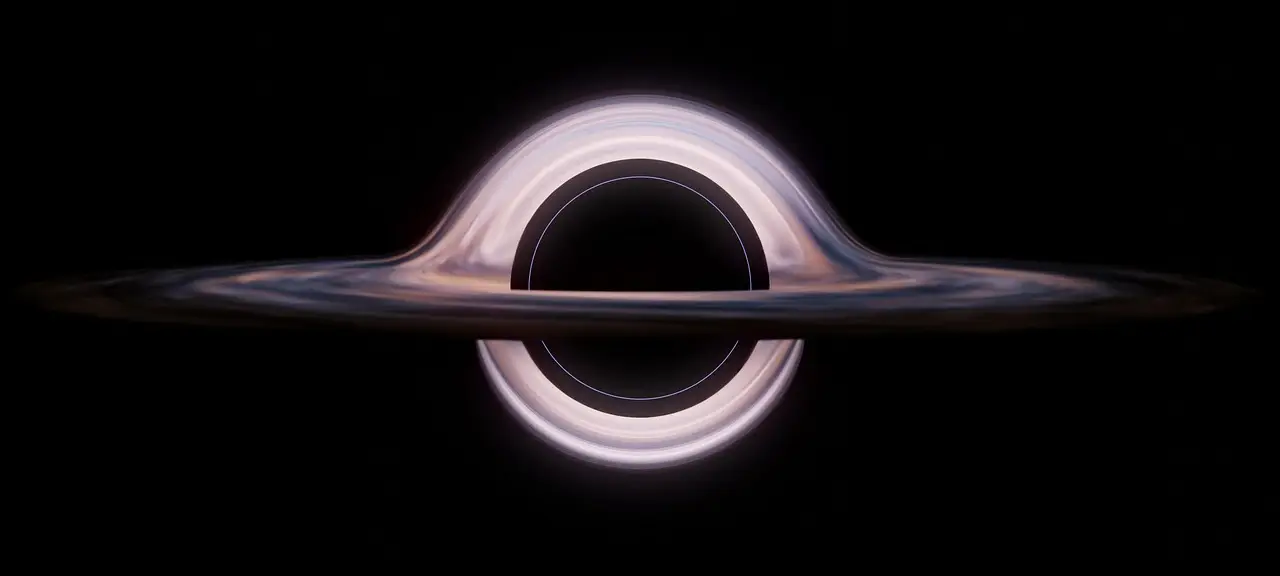
More than 70 researchers from four continents have published a major review arguing that the fading vibrations of colliding black holes could become a laboratory for testing Einstein's theory of gravity. The paper appeared in the journal Classical and Quantum Gravity and was led by the University of Birmingham, with colleagues at Johns Hopkins University and the University of Lisbon.
The signals in question are called the "ringdown." When two black holes merge, they shake the fabric of space and time, producing gravitational waves — ripples in space and time itself. After the collision, the newly formed black hole settles down and emits a fading series of vibrations, like a struck bell losing its tone.
To be clear, these aren't sounds travelling through space. They're tiny distortions of space and time that sensitive detectors on Earth can measure directly.
What is black hole spectroscopy?
The field's nickname borrows from music. Just as the different notes of an instrument reveal something about its shape and materials, the frequencies and fading patterns of a black hole's vibrations may reveal its mass, spin and other properties. Scientists call this approach black hole spectroscopy.
Einstein's general relativity — his theory describing gravity as the curvature of space and time — makes precise predictions for how these vibrations should behave. By comparing those predictions with real gravitational-wave observations, researchers can hunt for signs the theory needs extending or replacing.
Why haven't we heard the full song yet?
The first direct detection of gravitational waves came in 2015, opening a genuinely new channel for studying the universe. Observatories have since recorded many black hole mergers. The problem is volume: the quieter details of the ringdown remain difficult to measure with current instruments.
That should change. Future gravitational-wave detectors are expected to be far more sensitive, giving scientists a better chance of detecting several ringing patterns in a single event — the equivalent of hearing multiple notes at once rather than a single tone.
Repeated observations could then test whether different black holes follow the same rules, as general relativity says they must.
What unusual effects are on the checklist?
The review catalogues several possibilities that could matter as detectors improve:
- Multiple vibration patterns. Some black holes may produce several at once, much like an instrument playing chords.
- Interacting patterns. Different modes could interact or evolve in complicated ways.
- Degenerate behaviour. In unusual situations, different vibrations can behave almost identically, making them hard to tell apart.
- Signal "tails." Long-lasting echoes that linger after the main ringing has faded.
These effects matter for a practical reason: they could help scientists separate ordinary black hole behaviour from genuinely new physics. They might also reveal whether nearby matter or environmental conditions influence the waves on their way to Earth.
One goal stands out. Researchers hope precise ringdown measurements might eventually help investigate dark matter — the invisible mass that makes up much of the universe — or quantum effects near black holes, where gravity operates at its most extreme.
What the review does not claim
The authors are careful about limits, and readers should be too. The review reports no new detection of any of these effects. It gathers theoretical predictions and explains what future observations would need to measure before scientists could draw firmer conclusions.
That distinction is important. A signal that looks unusual could reflect measurement noise, gaps in existing models, or an overlooked feature of ordinary gravity — rather than a new law of nature.
The collaboration's reach — spanning Europe, North America, Asia and South America — shows how black hole research now connects astronomy, mathematics and fundamental physics in one effort.
For now, the strongest message is possibility rather than proof. Black hole ringing offers a promising new way to study gravity under the most extreme conditions in the universe. But the most surprising discoveries, the researchers make clear, will depend on clearer signals and careful, repeated testing.
via knowridge.com (Source)
More from Nathan Brooks
Show full bio
Market editor covering companies, deals and strategy in general science news at SciBeat.
563 articles
Nearby plates
- Hidden Symmetry in Black Hole Ringdown Breaks Under String Gravity
- Black Holes May Be Born in Silence When Giant Stars Skip the Fireworks
- Gravitational-Wave Data Point to Black Holes From Failed Supernovae
- Quiet Deaths: Some Massive Stars May Collapse Without Exploding
- Asteroid-Mass Black Holes Inside Stars Could End in Seconds-Long Explosions