Recorded November 18, 2026
Space & AstronomyReported finding
One Million Orbiting Data Centers Could Multiply Space Pollution 100-Fold
A preprint from UCL researchers estimates SpaceX's planned one-million-satellite constellation could multiply rocket emissions 150-fold and vaporize 200,000 tons of spacecraft annually.
By James Calloway5 min read1,036 words
In brief
- SpaceX's FCC filing (January 2026) proposes one million orbital data-center satellites.
- Launch emissions could rise more than 150-fold versus 2025; reentry nitrogen oxides 70–150-fold.
- An estimated 200,000 metric tons of spacecraft material could burn up annually, 200+ times the 2024 amount.
- Roughly 5,000 Starship launches per year (~14 daily) would be needed, versus 330 launches worldwide in 2025.
- The FCC exempted megaconstellation filings from environmental review in September.
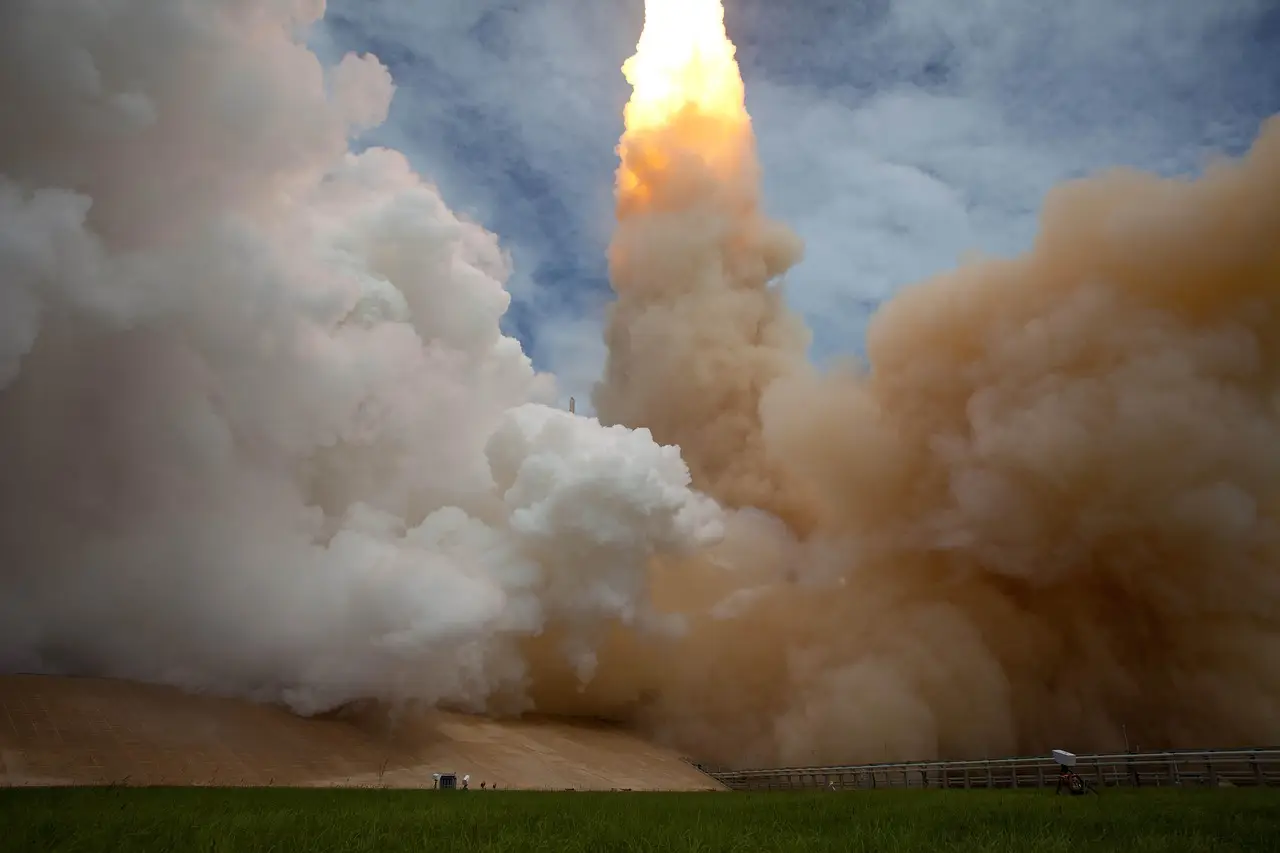
A proposed SpaceX constellation of one million orbital data-center satellites could boost rocket launch emissions more than 150-fold above 2025 levels, according to a new scientific estimate that has not yet completed peer review. The same analysis projects that spacecraft burning up on reentry would generate 70 to 150 times more nitrogen oxides than today's reentering hardware produces.
The numbers come from Eloise Marais and Connor Barker, both at University College London, whose preprint is awaiting peer review for publication in the American Chemical Society's journal Earth and Space Chemistry. Their work examines SpaceX's January 2026 filing to the U.S. Federal Communications Commission, which asked permission to launch the unprecedented megaconstellation.
No environmental assessment of that proposal has been made public. One may never be required: in September, the FCC exempted satellite megaconstellation filings from environmental review, despite growing concern about pollution from launching, maintaining and disposing of vast numbers of spacecraft.
What would actually get burned?
The researchers assumed SpaceX would fly its planned Starship Block 4 rocket, expected to carry at least 200 metric tons to orbit per launch. Meeting the data-center plan would demand at least 5,000 launches a year — roughly 14 every single day. For comparison, the entire world managed about 330 orbital launches in 2025.
Much of the pollution would come from things falling back down. As spacecraft plunge through the atmosphere at hypersonic speeds, the air around them heats enough that nitrogen and oxygen molecules combine into nitrogen oxides — gases that trigger ozone-destroying reactions and weaken Earth's shield against ultraviolet radiation.
With few direct measurements available, Marais and Barker leaned on old NASA space shuttle studies to estimate annual nitrogen oxide production at 233,000 to 507,000 metric tons. That's comparable to the yearly emissions of some European countries. Under their latest figures, these emissions could exceed what meteorites produce naturally each year by at least sixfold.
Then there is the mass of vaporized spacecraft. SpaceX plans to move 80 percent of its satellites into higher "graveyard orbits," parking them permanently out of the way. If the rest burns up, roughly 200,000 metric tons of satellite material would be vaporized in the upper atmosphere annually — more than 200 times the amount from satellites and other objects in 2024. That could be five to 100 times the natural annual influx of meteoritic material.
Why the estimates are shaky
Here's what the authors concede up front: they had to guess a lot. SpaceX has not disclosed basic facts about its rockets and satellites, and the resulting gaps are wide.
- No public data on what the data-center satellites would be made of, so the team could not calculate metal pollution at all. Burning aluminum and other metals forms tiny particles that can supercharge ozone-destroying reactions and create high-altitude hazes that alter sunlight reaching the surface.
- Reentry nitrogen oxide production depends heavily on speed; Starship's reusable Super Heavy booster returns more slowly than the orbiter and should produce less, but no one has measured this precisely.
- Starship burns methane, which produces less soot than the kerosene-fueled Falcon 9. But if SpaceX keeps venting unused methane during fueling and after landing — as it has in test flights — around 60,000 metric tons could escape annually. That's comparable to emissions from major U.S. oil and gas production regions, and methane is a far more potent greenhouse gas than CO2.
"It became apparent [early on in our research] that the kind of information that's needed isn't there," Marais said. Lacking official figures, the pair relied on third-party sources including Wikipedia, space-enthusiast forums and a launch catalog kept by astrophysicist Jonathan McDowell.
"So it really all comes from us injecting chemicals where they're not really supposed to be in the atmosphere," Barker said.
What does this change for oversight?
The practical question is regulatory, and right now the answer is: not much. The Federal Aviation Administration can still require environmental assessments of rocket launches, but those reviews do not necessarily capture the cumulative effects of operating and disposing of enormous constellations — a gap the FCC oversees but has moved to shield from review.
The researchers are calling on companies to disclose:
- type and quantity of rocket fuel used
- the mass returning to Earth per launch
- satellite lifetimes and material composition
- spacecraft reentry speeds
Barker insists this doesn't mean handing over trade secrets. "We're not asking for a full 3D diagram of any satellite," he said. A broad materials breakdown — say, the proportion of aluminum versus titanium — would substantially sharpen the estimates. Aaron Boley of the University of British Columbia, who was not involved in the analysis, suggested trusted intermediaries could handle commercially sensitive data while still enabling independent environmental assessment.
"There's nothing here that's perfect, but there has to be a solution to go forward that can simultaneously respect the proprietary information while also demanding that we know what is being dumped in the atmosphere," Boley said. He also flagged what remains unquantifiable: multiple pollutants interacting in the upper atmosphere form "a whole coupled system," including open questions about clouds forming at altitudes where they rarely occur.
Atmospheric pollution isn't the only worry, either. Megaconstellations could crowd orbit, raise collision risk and disrupt astronomy and naked-eye views of the night sky.
The bottom line
Remember the caveats. This is a preprint, built on assumptions, about a project that exists only as an FCC filing. But the direction is clear, and Barker warns the consequences may not appear until long after deployment. "As soon as you put that mass in orbit, it's there," he said. "We maybe don't see the impacts until later on."
Marais puts the choice bluntly: "Should we really be taking a gamble on increasing the activity to such an extent that we have this potential two orders of magnitude increase in pollutants to the upper atmosphere?"
The study is one project's estimate, not a settled verdict. It is, however, the best number anyone has produced — largely because SpaceX hasn't given the world enough information to make a better one.
via scientificamerican.com (Source)
More from James Calloway
Show full bio
Staff writer covering regulation, policy and their impact on general science news at SciBeat.
570 articles