Plate Nº 34 · recorded November 14, 2026
Space & AstronomyReported finding
Black Holes May Be Born in Silence When Giant Stars Skip the Fireworks
A Caltech-led study of 257 black hole mergers finds a mass peak near ten Suns and a gap at 12-16, patterns consistent with stars collapsing without supernova explosions.
By Elena Vasquez3 min read641 words
In brief
- Researchers analyzed 257 black hole mergers detected over roughly a decade by LIGO–Virgo–KAGRA.
- About three-quarters of the sample involved black holes near a peak of ten solar masses.
- Relatively few black holes appeared in the 12-to-16 solar mass range.
- The study, published in Physical Review D, matches predictions for failed supernovae but does not directly observe any star collapsing quietly.
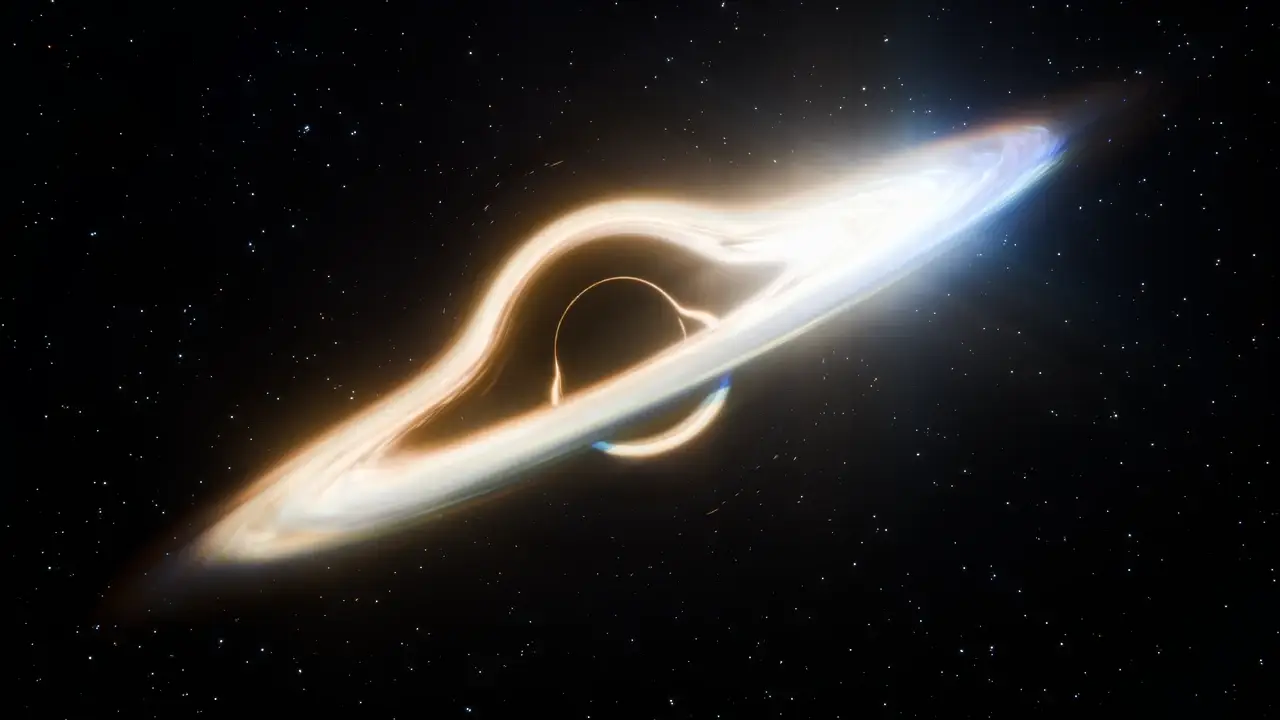
Roughly three-quarters of colliding black holes in a decade of gravitational-wave data cluster near ten times the Sun's mass, and Caltech-led researchers think that pile-up points to a quiet birth: stars that collapsed without exploding.
The finding comes from an analysis of black hole mergers — violent collisions of these ultra-dense objects that send tiny ripples in space-time, called gravitational waves, washing over Earth. The study appears in the journal Physical Review D.
What did the researchers actually find?
The team examined 257 black hole mergers detected by the international LIGO–Virgo–KAGRA network over roughly ten years. That network is a set of giant detectors built to catch gravitational waves, the faint shudders in space itself produced when extremely massive objects accelerate.
Instead of watching the sky for light, the researchers counted. They asked how often black holes of different masses showed up in the observations.
Two patterns stood out. First, a strong peak near ten solar masses — about three-quarters of the sample tied to that cluster. Second, a striking shortage: relatively few black holes in the range of about 12 to 16 solar masses.
The ten-solar-mass group also spun at a narrower range of rates than the broader black hole population. Similar masses, similar spins. To the researchers, that uniformity suggests a shared origin — one common formation process.
The takeaway: the census of smashed-together black holes shows a dominant family with suspiciously matching traits.
Why does this point to failed supernovae?
Massive stars usually die loudly. They end their lives in supernova explosions that hurl material into space, leaving behind collapsed cores. Those cores become neutron stars — city-sized balls of packed matter — or black holes, depending on conditions.
But theory has long predicted a quieter route. Some stars may collapse almost directly into black holes, with little or no visible blast. Telescopes struggle to catch such events precisely because there's barely anything to see. So scientists have hunted for indirect evidence instead.
Here it may be. The study found the observed masses and spins are consistent with theoretical predictions for black holes created by failed supernovae. That's the mechanism: a giant star's core caves in, the envelope follows, and the whole thing vanishes into a black hole without the usual fireworks.
The gap between 12 and 16 solar masses is especially interesting. It may reflect physics inside dying stars — not just the collisions astronomers detect long after the fact.
In short: the data match what quiet-collapse theory expected, though nothing here shows a single star dying silently.
How solid is the conclusion?
Preliminary, and the researchers say so. The analysis does not directly show any particular star collapsing without an explosion. It shows population patterns that fit one explanation among several.
Complications remain. Stellar winds, a star's internal structure, and the way matter falls inward during collapse can all shape the final black hole's mass. Researchers must account for these effects before confidently linking the observed population to a single formation pathway.
So the case is circumstantial. The numbers fit, but the verdict isn't in.
The takeaway: this is a strong hint, not proof, and the team frames it that way.
What comes next?
More data and better models. Further observations from the LIGO–Virgo–KAGRA detectors will grow the sample, and refined stellar-collapse simulations should sharpen the theoretical predictions.
If the failed-supernova origin holds up, the payoff would be significant. It would reveal a major hidden pathway by which massive stars end their lives — deaths invisible to conventional telescopes. It could also help explain why astronomers find different kinds of black holes scattered across the universe.
For now, the silence is suggestive. Hundreds of mergers whisper that some of the universe's biggest stars simply fold into darkness.
via knowridge.com (Source)
More from Elena Vasquez
Show full bio
Correspondent covering money, funding and market shifts around general science news at SciBeat.
428 articles
Nearby plates
- Quiet Deaths: Some Massive Stars May Collapse Without Exploding
- 257 Black Hole Mergers Point to Stars That Died Without Exploding
- Black Holes of All Sizes Fire Jets at the Same 2% Threshold
- Early star collisions may seed supermassive black holes
- Webb's Little Red Dots May Be Newborn Giant Black Holes in Gas