Recorded November 24, 2026
Biology & EvolutionReported finding
0.06-gram tracker records longest hummingbird migration
A 0.06-gram solar tracker logged a rufous hummingbird’s 6,526-kilometer Alabama-to-Alaska flight, the longest migration recorded, while exposing route surprises.
By Elena Vasquez3 min read652 words
In brief
- A male rufous hummingbird traveled 6,526 km from Alabama to Alaska in 38 days.
- The 0.06-gram BlūMorpho tag added no more than 3% of each bird’s body weight.
- Eleven birds tagged in spring 2025 generated 23,784 location points across 23 U.S. states, Mexico and Canada.
- Tracking lasted about 47 days on average and 128 days for the longest deployment.
- One rufous made a 345-km loop, while one ruby-throated moved southeast from Alabama into Florida.
By Elena Vasquez
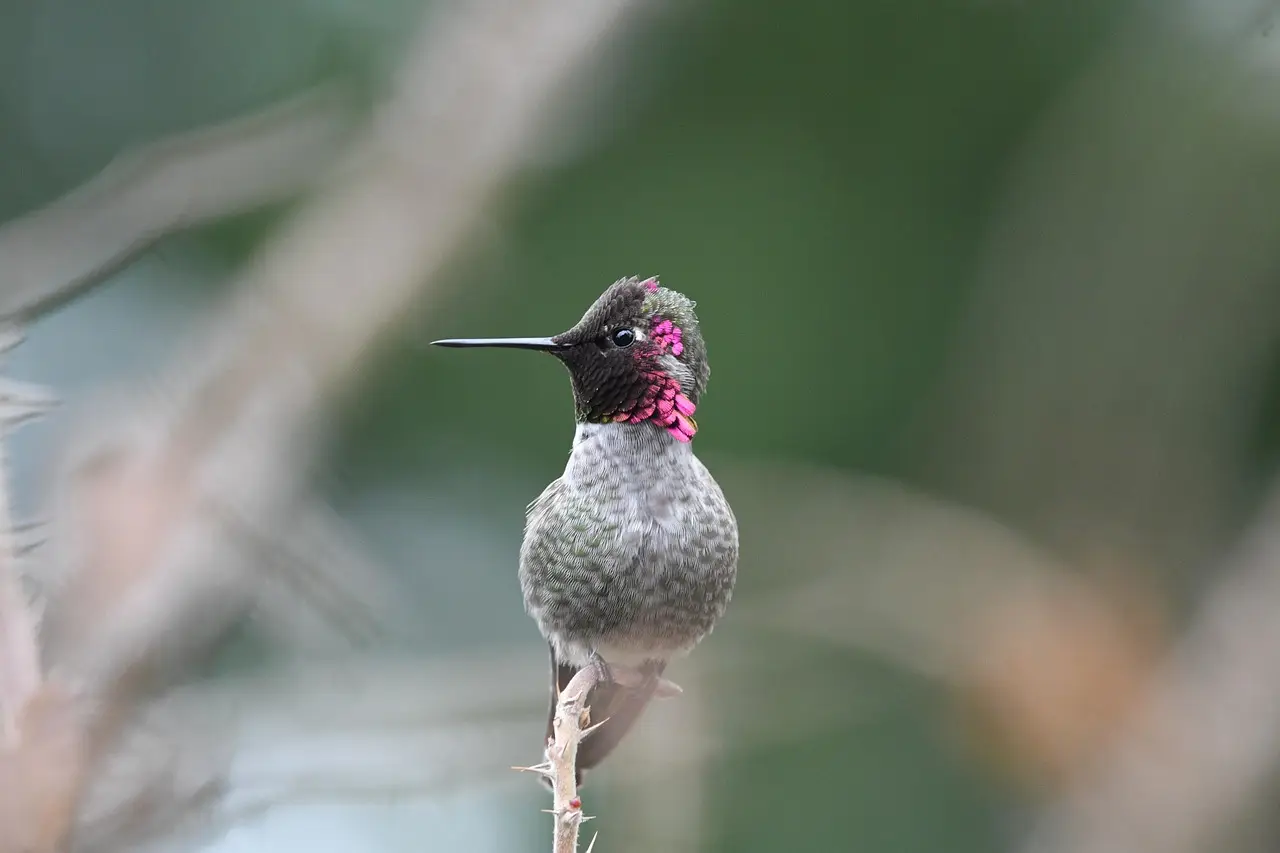
A male rufous hummingbird flew 6,526 kilometers (4,055 miles) from Alabama to Alaska in 38 days, the longest hummingbird migration recorded to date.
Hummingbirds already migrate thousands of miles across countries and continents. This journey set the measured record with help from a tracking tag weighing 0.06 grams.
Emma M. Rhodes of the University of Memphis led the team that reported the finding in the 2026 journal Ecology and Evolution. Their paper, “Ultralight Solar Transmitter Enables Fine-Scale Movement Ecology in North American Hummingbird Migration,” carries the DOI 10.1002/ece3.74624. The finding was reported Nov. 24, 2026.
Emma M. Rhodes and colleagues wrote: “Currently, it is not longevity of the unit itself that is a limitation but retention time on the individual.” In plain terms, the hardware can keep working, but keeping a tag attached to a moving bird is the harder problem.
What did the trackers reveal?
During spring 2025, the team attached tags to four rufous hummingbirds (Selasphorus rufus) and seven ruby-throated hummingbirds (Archilochus colubris) in coastal Alabama and Florida.
The 11 transmitters logged 23,784 location points, or recorded coordinates, across 23 U.S. states, Mexico and Canada. They supplied data for around 47 days on average; the longest tracking period lasted 128 days.
The record journey belonged to a male rufous. Other tagged birds supplied evidence of a large loop and a route that departed from the expected migration direction.
The location records captured individual turns and detours, not just starting and ending points. The study documents a continental record and detailed paths for 11 tagged birds.
How did a 0.06-gram tracker work?
Most existing tracking devices are too heavy for birds weighing less than 5 grams (0.18 ounces), a limit that applies to many hummingbirds.
Rhodes and colleagues developed and tested the BlūMorpho, a solar-powered transmitter weighing 0.06 grams (0.002 ounces). It uses Bluetooth, a short-range wireless connection, to send information to compatible electronics nearby.
They glued each tag to a small patch of trimmed feathers between the bird’s shoulder blades. The added load was no more than 3% of each hummingbird’s body weight.
Every three seconds, a transmitter emits a unique signal. If a compatible smartphone, tablet or computer came within about 200 meters (656 feet), it could automatically and anonymously relay the bird’s location to an online database.
The relays allowed the team to follow tagged birds in near real time, meaning location updates arrived with little delay. A tiny solar tag can turn nearby consumer electronics into a tracking network.
What routes did the birds take?
One rufous headed north before doubling back south, completing a large 345-kilometer (214-mile) loop, and then went east. A ruby-throated flew southeast from Alabama into Florida instead of taking the expected northward or northeastern route.
The report presents these as unexpected migration patterns observed in individual birds. It does not report how often similar routes occur across either species.
Some hummingbirds made sharp turns and detours rather than following the expected line.
What remains uncertain?
The team wants to follow the birds for much longer, but keeping each device attached limits current deployments.
Further research also needs to establish whether wearing transmitters has long-term effects. The authors wrote: “This study was not designed to quantify potential behavioral, physiological, or survival effects of transmitters and attachment.”
The experiment measured movement, not whether attachment altered behavior, physiology, meaning body functions, or survival. The data show where birds went, but leave those effects unresolved.
The project’s public tracking page is www.bandingcoalition.org/humtrack. Longer attachment periods and follow-up on bird health will be needed before researchers can separate the tag’s tracking value from any effects on the wearer.
The trackers show where birds go, but long-term effects and attachment limits still need testing.
via phys.org/rss-feed/ (Source)
More from Elena Vasquez
Show full bio
Correspondent covering money, funding and market shifts around general science news at SciBeat.
617 articles
Nearby plates
- Raptors banded in Europe are dying in West Africa, study finds
- Bogong Moths Navigate 1,000 km Night Migration with Magnetic Compass
- Half a Million Bird Records Show Females Dying Younger
- Outside forests may matter more to birds than habitat within parks
- Two Birds Shatter 120 Decibels — Louder Than a Chainsaw