Recorded November 25, 2026
Space & AstronomyReported finding
A Milky Way Spiral Arm May Be a Giant Star-Forming Shock Wave
A Nature Astronomy study finds a suspected piece of the Norma arm may be a shock front from the galactic bar, birthing stars near the Milky Way's center and reshaping our map of home.
By Priya Raman4 min read771 words
In brief
- A suspected segment of the Norma arm may be a shock front from the galactic bar, per Nature Astronomy
- The simulation reconstructed 4.3 billion years of gravitational interactions
- The Galactic bar spans an estimated 28,000 light-years at roughly 20 degrees to the Sun-center line
- The maser-traced stellar nurseries are less than a million years old
- A 2019 survey mapped about 200 star-forming regions, supporting a four-arm Milky Way
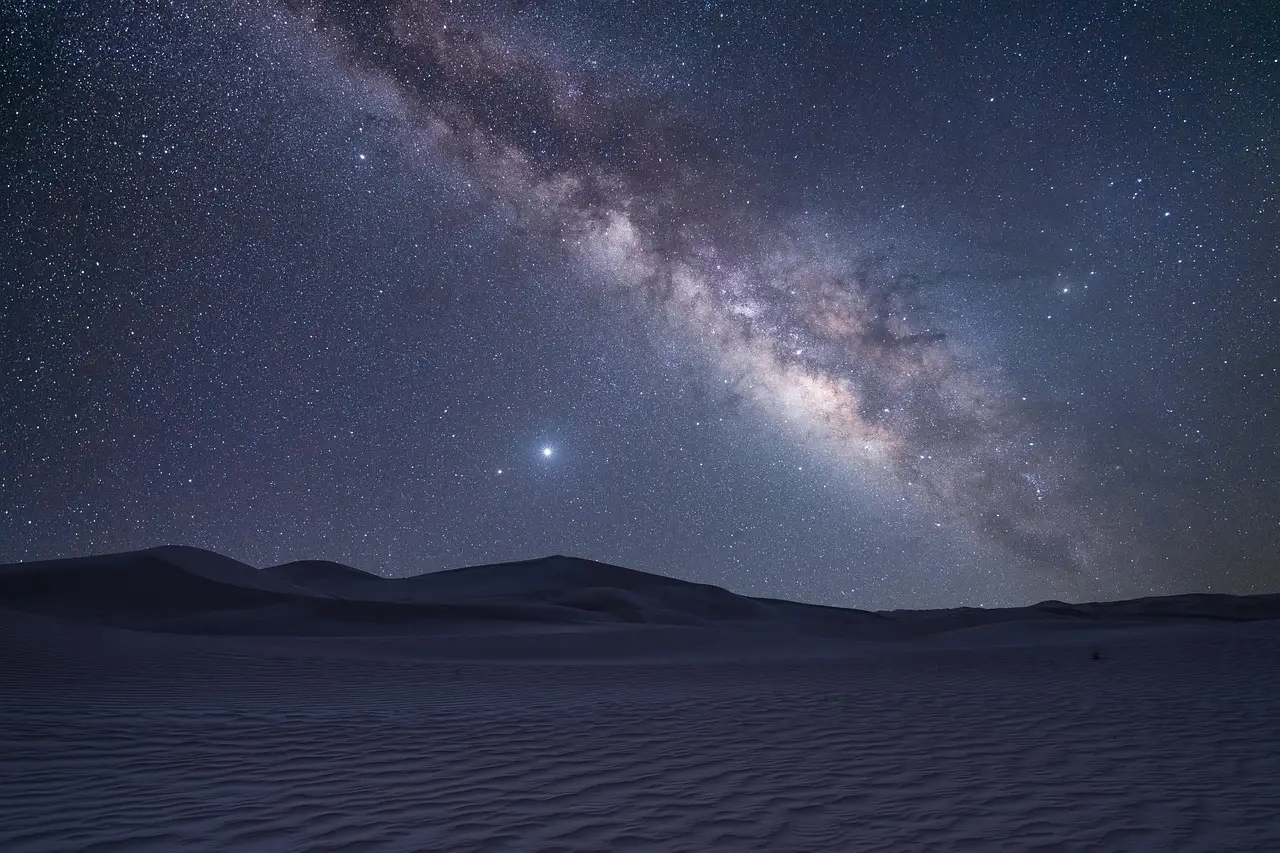
One of the Milky Way's four main spiral arms may be an impostor. A study published in Nature Astronomy finds that what astronomers have long identified as part of the Norma arm could instead be an enormous shock wave — one churning out newborn stars near the heart of our galaxy.
The finding emerged when researchers compared the locations of young, massive stars with computer simulations of the Milky Way. The stars, it turns out, owe their existence not to a spiral arm but to the gravitational forces exerted by our galaxy's central bar, an elongated concentration of stars at the galactic center from whose vicinity spiral arms extend outward.
"In most similar galaxies, star formation very commonly occurs along spiral arms," said study lead author Hillary Davis, who recently completed her PhD at the University of Sydney. "What's extraordinary is seeing this happen in a different region of our Galaxy, where shocks are usually so strong that star formation is often suppressed."
Why is mapping our own galaxy so hard?
Unlike distant galaxies, which astronomers can photograph in their entirety, the Milky Way must be mapped from within. Enormous clouds of dust obscure much of its central region, hiding potential landmarks from ordinary telescopes.
Astronomers do know the Milky Way belongs to a family of galaxies called barred spirals. As the central bar rotates, its gravity redirects streams of gas toward the galactic center. Along the bar's leading edges, gas encounters powerful shocks that abruptly change its speed and compress it, producing dense ribbons of gas and dust.
These dense pockets sound like ideal conditions for making stars, which form when gas collapses under its own gravity. In many galaxies, though, the turbulence generated by such shocks prevents that collapse — which is precisely why the new findings surprised Davis and her colleagues.
How did the researchers trace the newborn stars?
The team followed the fingerprints of stellar nurseries. Inside clouds of gas where massive stars are born, molecules such as water and methanol can naturally amplify microwave radiation, producing powerful signals known as masers (so named because they work like lasers, except they emit microwaves instead of visible light).
Unlike visible light, these microwave signals penetrate the thick dust clouds. By measuring tiny shifts in the apparent positions of masers as Earth orbits the Sun, astronomers can calculate their distances with remarkable precision.
In 2019, researchers mapped approximately 200 such regions, producing one of the most detailed maps of the Milky Way's spiral structure and strengthening the case for four main spiral arms. Davis suspected some of those stellar nurseries had been assigned to the wrong structure.
She and her colleagues compared the observations with sophisticated simulations reconstructing the gravitational interactions of stars, gas and dark matter over approximately 4.3 billion years. The positions and velocities of masers attributed to a segment of the Norma arm closely matched those expected along one of the bar's shock fronts. Independent observations of carbon monoxide and atomic hydrogen provided supporting evidence.
A crucial detail: these masers trace stellar nurseries less than a million years old. Their youth means they have had little time to drift from the gas clouds in which they formed, making them reliable markers of where star formation actually occurred.
What does this change about the Milky Way's shape?
The study builds on a 2025 paper suggesting that some young stars thought to belong to the Norma arm were instead traveling along elongated orbits that give the Galactic bar its shape. The new research offers a different explanation: the stars were born along a shock front generated by the bar itself.
By adjusting their simulation to match the observations, the researchers estimated that the Galactic bar stretches approximately 28,000 light-years from end to end and sits at an angle of about 20 degrees relative to the line connecting the Sun and the galactic center. Their results favor a relatively long, slowly rotating bar — and research published earlier in 2026 found that slowly rotating bars tend to support greater star formation along their length, potentially explaining the unusual activity.
The verdict on the Norma arm remains open. The findings do not necessarily mean the entire arm is missing; more observations are needed to determine whether other parts of it belong to a genuine spiral arm.
Still, caution is warranted — this is one simulation-based interpretation of preliminary mapping data. What astronomers once read as a sweeping spiral arm may instead be evidence of an entirely different mechanism for creating stars, powered by the gravitational machinery at the very heart of our galaxy.
via zmescience.com (Source)
More from Priya Raman
Show full bio
Senior reporter covering people, launches and day-to-day practice in general science news at SciBeat.
589 articles
Nearby plates
- Milky Way's Norma Arm May Partly Be a Bar Shock Front
- Milky Way's Norma Arm May Not Be a Spiral Arm at All
- NASA’s 16-image gallery maps black holes, star births and collisions
- Hubble Images Gravitational Lens to Prepare for Roman Telescope
- Milky Way Among Best Places for Life, Supercomputer Simulation Finds