Recorded November 22, 2026
Space & AstronomyReported finding
ALMA Catches a Dying Star's Final Nuclear Heartbeat, Frozen in Gas
ALMA has imaged the first known gas shell from a dying star's final thermal pulse: a ring blown 6,500 years ago around IRAS 06530, with an hourglass nebula only 700 years old inside it.
By Marcus Bennett4 min read853 words
In brief
- ALMA imaged IRAS 06530-0213, a transitioning star about 12,000 light-years away in Monoceros.
- A gas shell about half a light-year across was blown off roughly 6,500 years ago — the first direct evidence of a final thermal pulse at this stage.
- The hourglass nebula and surrounding gas doughnut formed within about the last 700 years.
- ALMA found no dust disk; any disk would be over 50 times fainter than in cases like the Red Rectangle.
- The study, led by JPL's Raghvendra Sahai, was published in The Astrophysical Journal (2026).
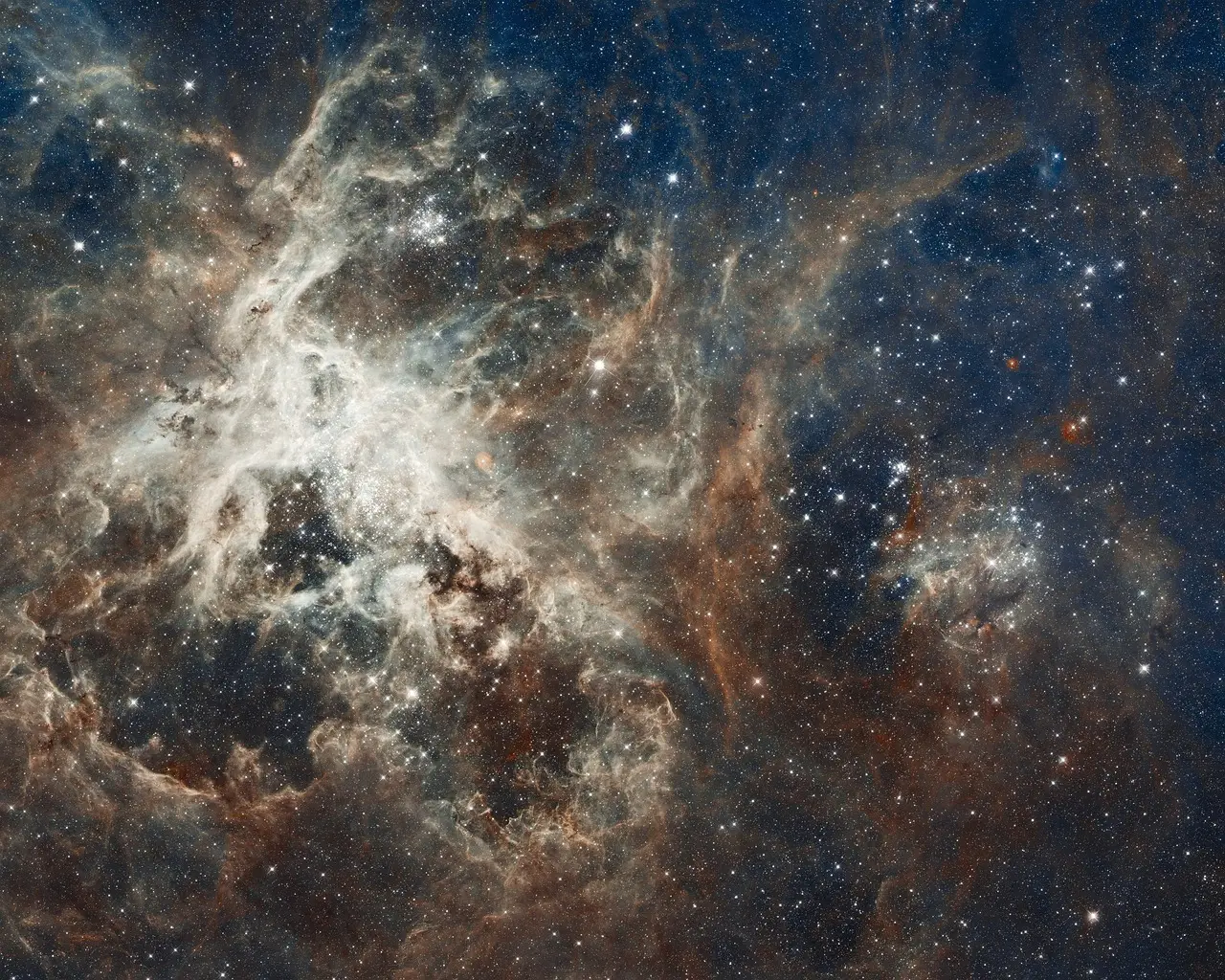
Astronomers using the Atacama Large Millimeter/submillimeter Array (ALMA) have captured, for the first time, the gas shell left behind by the last thermal pulse of a Sun-like star already in its final transformation. The target, IRAS 06530-0213, sits about 12,000 light-years away in the constellation Monoceros, and the new images show a half-light-year-wide ring of gas encircling an hourglass-shaped nebula that began forming only within the last 700 years or so.
A team led by astronomers at NASA's Jet Propulsion Laboratory published the observations in The Astrophysical Journal (2026), DOI: 10.3847/1538-4357/aeab9a, with Raghvendra Sahai, senior research scientist at JPL, as lead author.
"Most of us think of stars as unchanging points of light, but this is a real-time snapshot of a star's death throes," Sahai said. "It's the brief, violent transition between a bloated red giant and a glowing planetary nebula, frozen mid-action."
Why catching this star matters
Stars like our Sun do not die quietly. They swell into red giants, shed their outer layers into space, and leave behind a glowing, often strikingly sculpted cloud of gas called a planetary nebula. Theorists estimate this transformation takes only a few thousand years — a blink in a star's lifetime — so catching one mid-change is rare.
Late in life, such a star burns hydrogen and helium in shells around its core. Every so often, the helium shell flares up in a brief burst of nuclear burning called a thermal pulse, which jolts the star and flings material outward. Theorists have long predicted that these pulses leave behind shells of gas, and observers have spotted similar shells around other aging stars. But nobody had seen one around a star that had already begun its final transformation.
In IRAS 06530, ALMA resolved a thin, spherical shell that appears as a ring roughly half a light-year across in the sky. From the gas's outward speed, the team dates the shell to a blow-off about 6,500 years ago. That makes it the first direct evidence of the last thermal pulse before a star of this type enters its final phase, the team says.
"It's essentially a physical snapshot of an event that, until now, we've mostly inferred from theoretical models," Sahai said. "We've caught, for the first time, a star's final nuclear heartbeat, frozen in gas."
What happened after the pulse?
The images lay out a sequence. After the pulse, the star's mass loss dropped off for roughly 2,000 years. Over the following 1,000 years or so, mass loss rose sharply again, and the star shed a thick, lumpy shell now visible as a tangle of curved filaments around it.
Inside that tangle, the star has begun carving a bipolar, hourglass-shaped nebula plus a dense doughnut of gas around its middle. The team estimates these youngest structures formed within just the last 700 years — meaning the star crossed out of its red-giant phase very recently, in astronomical terms.
The curved filaments also appear to form part of a spiral pattern. Astronomers usually attribute such spirals to an unseen companion star orbiting the dying one, stirring the outflowing gas as it goes.
Where the story gets complicated
Two findings break from the textbook picture.
First, the chemistry is strange. Isotopes — versions of an element with slightly different weights — appear in unexpected proportions. In the dense gas near the star, the team found more than predicted of the rare, heavy forms of carbon, oxygen and nitrogen. That pattern does not match standard models of how stars like this manufacture and mix their elements. A few other odd objects show similar fingerprints, and some researchers have proposed that bursts of explosive nuclear burning might explain them.
Second, the expected disk is missing. Dying stars known to have companions typically sit inside a compact disk of dust — a miniature version of the disks that form planets. Such disks serve as indirect evidence of ongoing mass transfer from a close companion, the mechanism usually invoked to explain jet-sculpted hourglass shapes.
ALMA sees no such disk around IRAS 06530. Any disk there would be more than 50 times fainter than those around well-known cases such as the Red Rectangle. One possibility the team raises: a disk existed briefly, powered a short burst of high-speed jets that helped sculpt the hourglass, and then faded away.
"Dying stars so often have hidden companions that reshape their ejected material into intricate, bipolar or multipolar forms instead of simple spheres," Sahai said. "IRAS 06530 shows that the story is more complicated than the tidy explanation we've been using."
For observers of stellar evolution, the result offers a dated, step-by-step record of a Sun-like star's final millennia — and a caution against assuming a companion-built disk every time an hourglass appears. The findings rest on a single object, so the interpretations of the missing disk and the odd isotope mix remain preliminary until more transitioning stars yield comparable images.
via phys.org/rss-feed/ (Source)
More from Marcus Bennett
Show full bio
News editor covering regulation, policy and their impact on general science news at SciBeat.
584 articles
Nearby plates
- Astronomers watch a dying star engulf its companion
- Andromeda giant’s October 2025 eruption points to stellar merger
- Astronomers Catch a Star Swallowing Its Companion for the First Time
- Betelgeuse's Atmosphere Has Recovered — and a Companion Star May Be Sculpting It
- A Giant Star Flares Every 113 Days. Chandra May Have Found Why