Recorded November 20, 2026
Space & AstronomyReported finding
Astronomers watch a dying star engulf its companion
A 2.5-million-light-year collision in Andromeda gave astronomers the first real-time view of a dying star swallowing its companion and forming one remnant.
By Nathan Brooks4 min read703 words
In brief
- Astronomers observed the merger’s climax in October 2025, about 2.5 million light-years away in Andromeda.
- The engulfed system’s larger star was an asymptotic giant branch star with roughly seven times the Sun’s mass.
- Historical observations showed the star brightening from 2018; the team found it in 2023 with WINTER and NEOWISE.
- NASA’s SPHEREx telescope captured the dimming and October 2025 eruption in visible and near-infrared light.
- The team expects the remnant system to cool and settle within a few years to some decades.
By Nathan Brooks
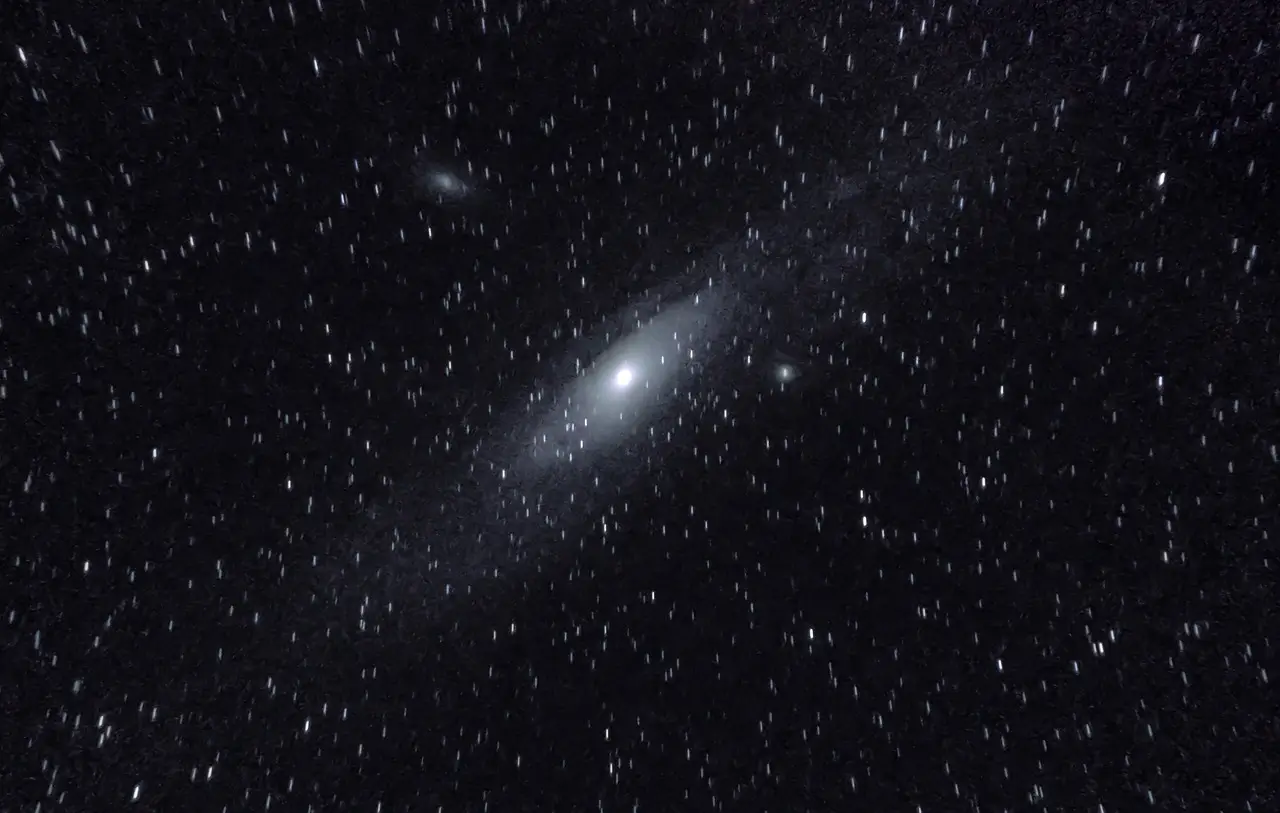
Astronomers observed a dying star engulf a smaller companion in October 2025, about 2.5 million light-years from Earth in the Andromeda galaxy. The event, described in a new paper in Nature, provides the first real-time view of an older star swallowing another near the end of its life.
Such collisions can offer astronomers clues to some of the universe’s most cataclysmic events. Viraj Karambelkar, a NASA Hubble Fellow at Columbia University and one of the study’s co-authors, said the discovery confirms ideas that previously existed only in theory.
What did astronomers see before the merger?
Researchers first noticed the unusual, brightening source in 2023 while studying Andromeda with the Wide-Field Infrared Transient Explorer telescope at Palomar Observatory and NASA’s Near-Earth Object Wide-Field Infrared Survey Explorer space telescope. When they checked historical observations, they found that the brightening had continued since 2018, a relative blink compared with the lifetime of a star.
A stellar engulfment occurs when one star orbits another while taking in its mass and energy. The data identified the larger star as an asymptotic giant branch, or AGB, star: a very bright, relatively cool star that has burned nearly all of its nuclear fuel.
With roughly seven times the Sun’s mass, the AGB star was feeding on its much smaller neighbor. Its expanding outer envelope had brought the two-star system closer together.
How did the collision unfold?
“Both of these stars initially started off pretty small, and then the more massive star eventually expanded, and that expansion caused its envelope to become very blobby and very puffy, and also this physical expansion brought the binary stars close to each other,” Karambelkar says. As they swirled closer, they were set on a collision course.
The team then monitored the star with NASA’s SPHEREx space telescope, which captures light in the visible and near-infrared ranges. They watched the star, known as WNTR23bzdiq/WTP19aalzlk, begin to dim.
Just a few months later, in October 2025, the astronomers spotted a “dramatic eruption.” Their observations indicate that the stars’ orbits had brought them so close that they collided. The smaller companion plunged into the larger star’s core, leaving a single, fused remnant.
Why was this merger different?
The odds of catching such an event during a star’s lifetime were extraordinarily low. “That’s what makes this discovery very special,” Karambelkar says. “That’s one of the reasons why it’s been very, very challenging to catch this process of stellar engulfment in real time, because it is just literally a blip on the timescales of these stars.”
Stellar collisions have been documented before, but most known crashes involved two fairly young stars. This was the first observed case involving an older, dying star, and it captured one of the outcomes astronomers had long proposed.
Unlike younger stars, which are dense and compact, AGB stars have large, blobby envelopes around them. Astronomers had theorized that a companion entering that envelope would either trigger a stellar merger or receive enough energy to be blasted out, leaving the two stars tightly orbiting. The observed fusion produced the merger outcome for this system.
What happens to the remnant?
The collision’s violence caused it to eject massive amounts of material, forming hot space dust. That dust now obscures the star’s view in the near-infrared, but it should cool rapidly. Karambelkar plans to continue monitoring the system to see what remains after the dust disperses.
“We expect the system to cool and settle down on the timescale of a few years to some decades,” he says. “The jury’s still out. We still don’t know how exactly how much time it will take, but it’s not cosmological timescales.”
Karambelkar believes the outcome will be a single, rejuvenated star, though its exact appearance remains unknown. “It should have a very high magnetic field, perhaps,” he says. “Perhaps it should have weird chemical compositions. It should have weird temperatures and weird luminosities, just because it’s had this new burst of fuel that has been injected into it, but we have a few several years to go until that happens.”
via scientificamerican.com (Source)
More from Nathan Brooks
Show full bio
Market editor covering companies, deals and strategy in general science news at SciBeat.
563 articles
Nearby plates
- Two Stars Merged Into One in Andromeda — Webb Caught It Early
- Webb Catches Star Merger 47 Days After Eruption — A First
- Webb Telescope Catches a Giant Star Swallowing Its Companion
- Andromeda giant’s October 2025 eruption points to stellar merger
- Astronomers Catch a Star Swallowing Its Companion for the First Time