Recorded November 19, 2026
Space & AstronomyReported finding
Webb Catches Star Merger 47 Days After Eruption — A First
Webb observed a first-of-its-kind merger just 47 days after peak eruption: a sun-like star plunged into a supergiant 18,000 times the sun's brightness, on Andromeda's outskirts.
By Elena Vasquez4 min read805 words
In brief
- Webb observed the merger 47 days after peak eruption — the earliest follow-up of such an event ever
- The supergiant primary was 7 times the sun's mass, 350 times its radius and 18,000 times its brightness
- The merger took about 7 years (7 orbits), versus thousands of orbits for smaller-star mergers
- The eruption was detected October 17, 2025; Webb observed on December 24, 2025
- The study, led by Viraj Karambelkar, was published in Nature (DOI: 10.1038/s41586-026-11221-z)
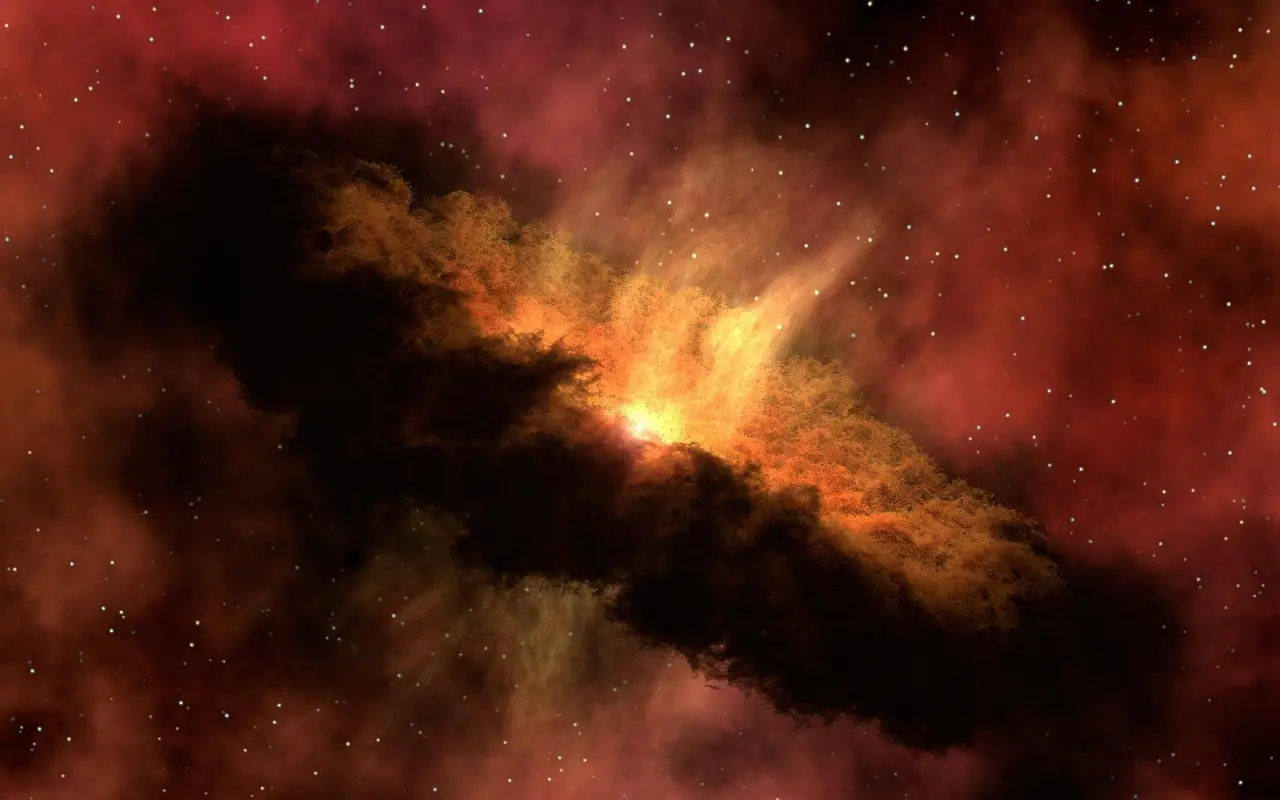
NASA's James Webb Space Telescope observed a never-before-seen stellar merger just 47 days after the eruption peaked — the earliest follow-up of such an event on record. Astronomers announced that a star slightly less massive than the sun spiraled into and merged with a bloated supergiant on the outskirts of the Andromeda galaxy, our nearest large galactic neighbor. They've nicknamed the resulting single star Bao.
The discovery, published in Nature and led by NASA Hubble Fellow Viraj Karambelkar of Columbia University, marks the first confirmed merger between a supergiant and a smaller sun-like star. "Stellar mergers are very, very difficult to observe in real time because they are hard to predict," Karambelkar said. "However, we noticed something unusual was going on in 2023 and continued to monitor the system to see what it would do. Then, in 2025, it erupted."
Webb's data, he added, "helped us characterize what the system looked like before, during and immediately after the merger, which is absolutely mind-blowing." The formal designation is AT 2025abao.
What did the two stars look like before the crash?
For millennia, the two stars orbited each other peacefully as a binary pair. Then the smaller star touched the giant's surface. The merger took just seven orbits — roughly seven years. Other known binary mergers, involving two smaller stars, happened only after thousands of orbits.
"We thought an outburst from such an extended star would take years," said co-author Nadia Blagorodnova of the University of Barcelona. "One day, its brightness started rising and within a week, it peaked."
The team's simulations, matched against Webb's mid-infrared observations of centuries of shed dust, reconstructed the pair:
- "Big Bao," the primary: seven times the sun's mass, 350 times its radius, 18,000 times its brightness
- "Little Bao," the companion: about 0.7 solar masses, slightly smaller and fainter than the sun
"It was an absolute beast of a star, completely outshining its companion in the data," said Karambelkar's colleague Karel Temmink, a Ph.D. student at Radboud University in the Netherlands who led the modeling. Early modeling hinted the smaller star might escape. Further analysis showed it was dragged into the giant's core. The encounter was "almost like a bomb exploding inside a living star," said co-author Kishalay De of Columbia.
How does a merger actually unfold?
The process has a name: common envelope evolution. When the companion grazes the primary's outer surface, it produces a slow brightening — which the team clearly saw in Bao's data, according to De. As the companion keeps orbiting, it peels off the primary's outer layers, and that gas streams into surrounding space.
The shared gas layer is the "common envelope." The smaller star spiraled through it, losing orbital energy to drag, until the giant engulfed it completely. Webb's data confirmed a true merger — though survival was possible. In other systems, both stars make it through, shedding mass but staying in tight orbits. Such pairs can later become neutron stars and black holes, explode as supernovae, generate gravitational waves (ripples in space-time), or form millisecond pulsars.
What the merged star looks like now — how its heft settles — remains unknown. Future observations will tell.
How did astronomers catch it?
The chase began in February 2023, when the team spotted an unusual variable star in data from NASA's retired NEOWISE infrared mission. Before 2018, the object's brightness had been steady.
The timeline then accelerated:
- September 2024: The WINTER telescope showed Bao brightening and spewing dust
- July 2025: NASA's SPHEREx survey saw Bao fade in visible light and brighten in infrared — a flag for unusual activity
- October 17, 2025: The Zwicky Transient Facility detected the eruption itself, watching the stars brighten and heat up rapidly
- November 2025: NASA's retired Neil Gehrels Swift Observatory and NOIRLab's Gemini North telescope in Hawaii delivered fast-turn observations
- December 24, 2025: Webb observed Bao through a Director's Discretionary Time program
The team published a first paper right before the 2025 eruption.
Why does Bao matter for future research?
Because the team watched the merger in real time, they could directly measure how much mass was ejected and how efficient common envelope evolution is. Most other studies of such events must reverse-engineer processes that unfolded hundreds to millions of years ago.
The timing is fortunate. NASA's new Nancy Grace Roman Space Telescope will soon run large public surveys, including the Galactic Bulge Time-Domain Survey, expected to flood astronomers with new transient events. "There's going to be a large influx of similar discoveries just ahead," Karambelkar said.
The takeaway: real-time watching of a stellar merger gives astronomers a measuring stick for a process that shapes neutron stars, black holes and gravitational waves.
via phys.org/rss-feed/ (Source)
More from Elena Vasquez
Show full bio
Correspondent covering money, funding and market shifts around general science news at SciBeat.
592 articles