Recorded November 19, 2026
Space & AstronomyReported finding
Webb Telescope Watches Star Swallow Companion in Andromeda
A supergiant star 18,000 times brighter than the Sun swallowed its smaller companion in just seven orbits, observed by Webb 47 days after the eruption peaked — a first for the Andromeda galaxy.
By Priya Raman3 min read638 words
In brief
- Webb observed the merger AT 2025abao 47 days after its October 2025 eruption peak — the earliest follow-up of such an event.
- The primary star, Big Bao, was 7 solar masses, 350 times the Sun's radius and 18,000 times its brightness.
- The two stars merged in only seven orbits, about seven years; typical small-star binary mergers take thousands of orbits.
- The eruption expelled 0.1-0.2 solar masses of material.
- The study, led by Dr. Viraj Karambelkar of Columbia University, appears in Nature 659, 628-633.
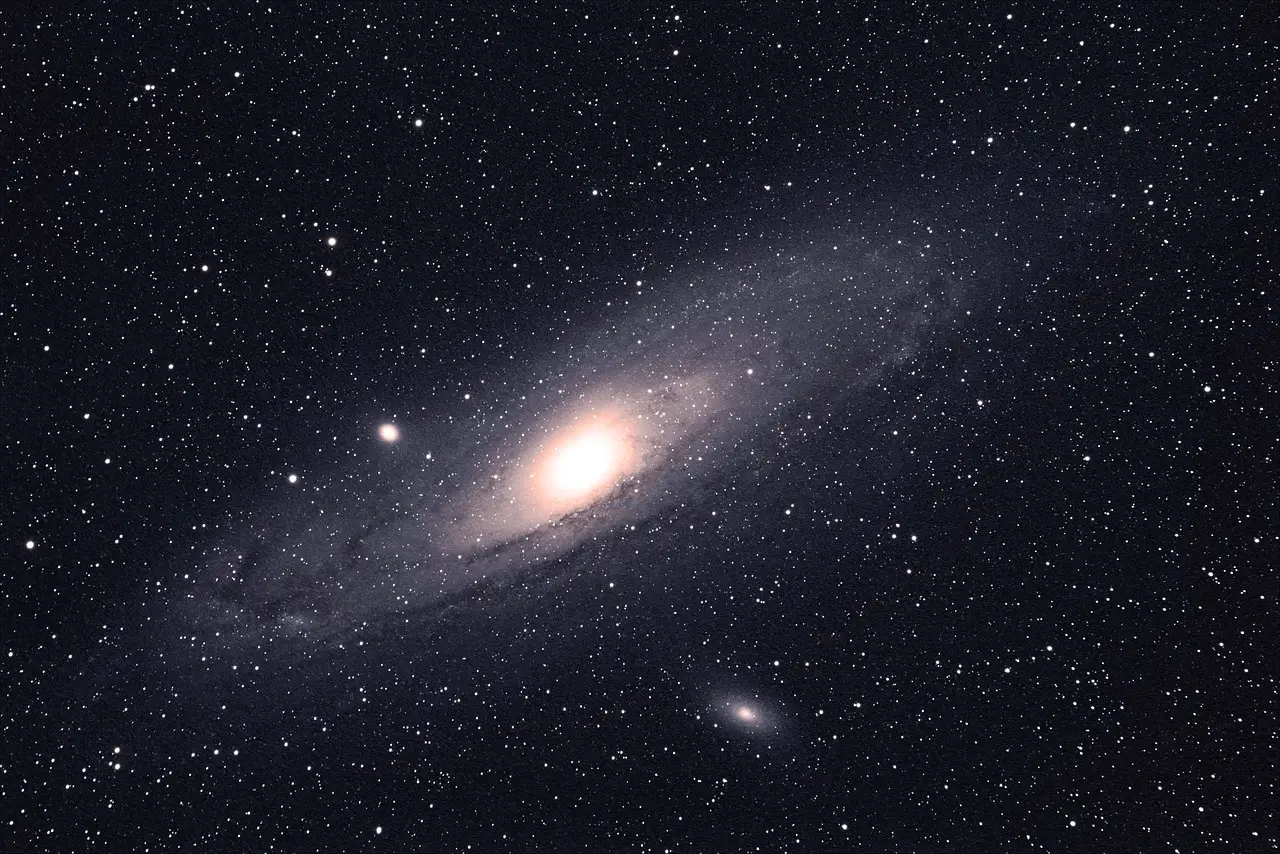
Just 47 days after a stellar eruption reached its peak, the James Webb Space Telescope captured something astronomers had never seen before in the Andromeda galaxy: a giant star in the act of swallowing a smaller companion.
The event, formally designated AT 2025abao and nicknamed Bao, erupted in October 2025. Webb's early look represents the earliest follow-up of such an event ever achieved, according to Dr. Viraj Karambelkar, an astronomer at Columbia University and lead author of the study published in the journal Nature.
"Webb observed Bao only 47 days after the stars' eruption peaked, the earliest ever follow-up of an event like this," Karambelkar said. "The telescope's data helped us characterize what the system looked like before, during, and immediately after the merger, which is absolutely mind-blowing."
The findings appear in Nature 659, 628-633 (doi: 10.1038/s41586-026-11221-z).
What did astronomers actually see?
The story began in 2023, when the system first stood out in data from NASA's NEOWISE mission, an infrared survey telescope. "Stellar mergers are very, very difficult to observe in real time because they are hard to predict," Karambelkar said. "However, we noticed something unusual was going on in 2023 and continued to monitor the system to see what it would do."
"Then, in 2025, it erupted!" he added.
The patience paid off. Because researchers had years of prior observations, Webb could capture the system before, during, and immediately after the merger — a complete sequence astronomers almost never obtain for such events.
How does one star eat another?
Modeling of the system suggests the primary star, nicknamed Big Bao, was a supergiant: seven times the Sun's mass, 350 times its radius, and 18,000 times its brightness. To picture that scale, if the Sun were a marble, Big Bao would be a large beach ball.
Its companion, Little Bao, was a modest star of about 0.7 solar masses — slightly less massive than the Sun.
The mechanism at work is called common-envelope evolution (the stage in which one star spirals inside the outer layers of its swollen companion, sharing a single envelope of gas). Once the smaller star touched the giant's surface, the two stars merged in only seven orbits, roughly seven years.
That pace astonished the researchers. Binary mergers of smaller stars typically take thousands of orbits to complete.
The eruption was also unusually messy. The event expelled between 0.1 and 0.2 solar masses of material into space.
What does this mean for stellar physics?
The observations carry consequences beyond a single dramatic event. The data suggest that standard models may not capture all the ways energy is redistributed during common-envelope evolution, a process long considered central to how many binary stars evolve and die.
There is an important caveat. The evidence for the merger, while strong, remains preliminary in one respect: future observations will be needed to confirm conclusively that the two stars merged. What astronomers currently have is a detailed before-and-after picture consistent with a merger, not a direct visual of two stellar cores fusing.
If confirmed, the merger may leave a lasting mark on Bao itself. Astronomers suggest the newly single star could be "rejuvenated" by the collision, meaning it gains fresh material and appears younger than its true age.
More discoveries should follow soon. "There's going to be a large influx of similar discoveries just ahead," Karambelkar said, as surveys improve and astronomers learn to spot the warning signs that appeared in Bao's data two years before its eruption.
For now, Bao stands as the first real-time observation of a stellar merger in Andromeda — our galactic neighbor — and a reminder that the lives of stars can end not with a whimper, but with a slow, seven-year swallow.
via sci.news (Source)
More from Priya Raman
Show full bio
Senior reporter covering people, launches and day-to-day practice in general science news at SciBeat.
549 articles