Plate Nº 23 · recorded November 9, 2026
Earth & ClimateReported finding
Ancient Peru shows no climate-driven rise in violence
A 3,000-year skeletal record from Peru’s Lambayeque Valley found no link between El Niño instability and violence, despite ritual sacrifice around the Moche and Sicán collapse.
By Marcus Bennett5 min read980 words
In brief
- Researchers analyzed 1,633 people from 30 sites across more than 3,000 years in Peru's Lambayeque Valley.
- Evidence of violence appeared in 25 people (1.6%); accidental trauma appeared in 77 (5.1%).
- Across 3,000 years, neither violence nor accidental trauma showed a link to ecological instability.
- The study found no association between a person's sex and violence.
- The 2026 study could resolve long-term associations but not brief events because not every individual could be radiocarbon dated.
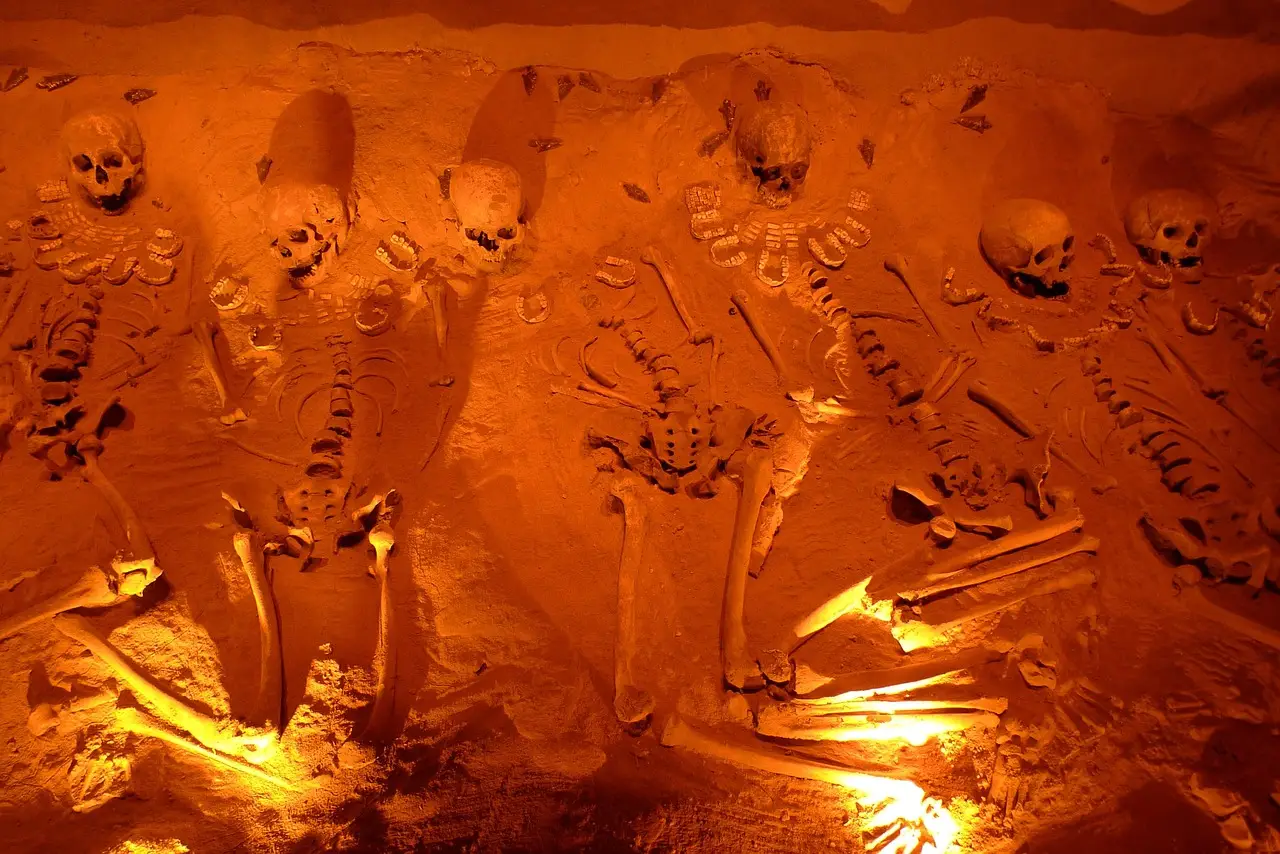
Only 25 of the 1,633 individuals—1.6%—in a 3,000-year Peruvian skeletal record showed evidence of violence, and recorded violence did not track the ecological instability caused by El Niño. The finding challenges the idea that climate scarcity automatically produces broad social violence, while documenting a narrower pattern: mass human sacrifice around the collapse of the Moche and Sicán political systems.
What did 3,000 years of skeletons show?
Researchers from New York University and George Mason University used the Lambayeque Valley Biohistory Project's skeletal record from 30 sites. They selected 1,633 individuals with relatively clear dates of death and placed their injuries in context with models that estimate past rainfall and water availability.
- Violence: 25 people, or 1.6% of the sample, showed evidence of violence.
- Accidental trauma: 77 people, or 5.1%, showed evidence of accidental trauma.
- Ecological conditions: Neither violence nor accidental trauma showed a link with ecological instability.
- Sex: The study found no association between a person's sex and violence.
The team tracked cranial trauma, meaning injuries to the skull that usually indicate violence, and postcranial trauma, meaning injuries to bones outside the skull that usually indicate accidents. Neither category increased when environmental conditions deteriorated.
Dr. Thomas Snyder of New York University, a co-author in Frontiers in Environmental Archaeology, said:
"The main thing that jumped out at us was just how few cases of interpersonal violence we observed outside ritualized contexts."
Snyder said this absence of widespread violence shows that social breakdown is not a predetermined response to climate change. The result differs from other Andean sites, where cranial trauma is much more common, particularly during climatic upheaval.
Takeaway: The long-term Lambayeque record shows severe ecological stress without a broad increase in recorded violence.
How did El Niño destabilize Lambayeque?
Lambayeque normally had little rainfall, but it benefited from rivers and seas full of life. El Niño events killed off fish stocks and flooded the valley with torrential rain, throwing local food-production systems into crisis.
Mass ritual sacrifices along the desert coast of northern Peru have been linked to catastrophic flooding caused by El Niño. That connection prompted the study's central question: did climate pressure turn ritual killing into a broader rise in violence?
Leaders of the Moche and Sicán appear to have held power partly through claims to act as intercessors with the natural world. Large-scale human sacrifice just before their political systems collapsed appeared to be an attempt to restore balance by offering their most precious lives to the supernatural. The valley's most extensive evidence of violence occurs in these ritual episodes.
Dr. Haagen Klaus of George Mason University placed the skeletal result within a longer cultural history:
"In Lambayeque there are 6,000 years of creative adaptations to El Niño and longer-term changes in climate, and widespread violence wasn't one of them."
The quote refers to the valley's wider sequence of cultural adaptations; the analyzed skeletal series spans more than 3,000 years. Klaus concluded that violence and social breakdown were not inevitable. He also cautioned that ancient Lambayeque people probably differed from modern societies, even though their daily lives, economies and responses to environmental crises resembled ours in broad ways.
Takeaway: El Niño could trigger famine and ritual sacrifice in Lambayeque without making widespread violence the usual response.
Why did ritual sacrifice not spread into daily life?
The researchers hypothesized that if large ritual killings reflected an underlying crisis, they might extend into people's everyday experience. The skeletal series did not support that extension: interpersonal violence outside ritualized contexts remained rare, and neither violence nor accidents tracked ecological instability.
The authors offer two possible explanations, neither established by the survey. Access to the sea may have reduced resource scarcity, while different forms of social organization may also have limited violence. The findings suggest that a society's resources and institutions can shape how it responds to environmental pressure.
Takeaway: Climate stress did not erase Lambayeque's social order, although the study cannot identify exactly why violence stayed rare.
What can the study tell us with confidence?
The authors describe their results as estimates. They used skeletal proxies for violence and accidents, which can conceal some injuries because wounds do not always affect bone. Their long-term trends may also miss brief episodes of conflict.
Snyder said radiocarbon dating every individual was not feasible given the sample size. He would prefer to date the entire collection to detect trends the available chronology might have missed. Radiocarbon dating estimates age by measuring carbon-14 in remains. The current analysis therefore establishes long-term associations, or their absence, rather than precise patterns around individual events.
Takeaway: The study provides strong evidence against a long-term violence link, but it cannot rule out short, poorly preserved episodes.
What does this mean for climate responses?
Snyder said archaeological research can help answer how people dealt with crises similar to those facing modern societies. The Lambayeque record supports a restrained planning lesson: ecological stress can coexist with strong social order, and climate change does not select one inevitable social response.
For practitioners and policymakers, the study does not offer a universal formula for resilience. Sea access and social organization may have mattered in this particular valley, and other Andean regions have produced different trauma patterns. Researchers can use such contrasts to identify local conditions that either amplify or buffer climate stress without treating one region as a universal model.
The results appear in the 2026 Frontiers in Environmental Archaeology article "Pax Lambayeque? Trauma, Interpersonal Violence, and Environment over 3,000 Years in the Lambayeque Valley Complex, Peru," with DOI 10.3389/fearc.2026.1889466.
Takeaway: Climate crisis does not make violence inevitable; the Lambayeque record shows that societies can choose different responses, though one valley cannot set a rule for all.
via phys.org/rss-feed/ (Source)
More from Marcus Bennett
Show full bio
News editor covering regulation, policy and their impact on general science news at SciBeat.
370 articles
Nearby plates
- Ancient Peru's mass sacrifices were rare, study finds
- Climate Memory Resets Every 33 Years, Study of Chinese Archives Finds
- US Wildfire Building Losses Could Nearly Triple by 2060
- Nearly half of injury patients in poorer countries die or face disability
- Climate Change Tripled Iberia's Record 2025 Fire Burned Area