Plate Nº 91 · recorded October 30, 2026
Earth & ClimateReported finding
Arctic winter sea ice loss may exceed forecasts by 1 million
Climate records from a warmer Arctic 6,000 years ago suggest winter ice cover could be 1 million km² lower than earlier projections, with some uncertainty ranges cut by 85%.
By James Calloway5 min read995 words
In brief
- Future Arctic winter ice coverage may be about 1 million km² lower than earlier projections.
- The method reduced uncertainty ranges by as much as 85% in some projections.
- Researchers compared 6,000-year-old sediment evidence with 27 climate models.
- Arctic maximum winter sea-ice extent hit a record low in March 2025 and matched it in 2026.
- The study appeared in Nature Geoscience in 2026.
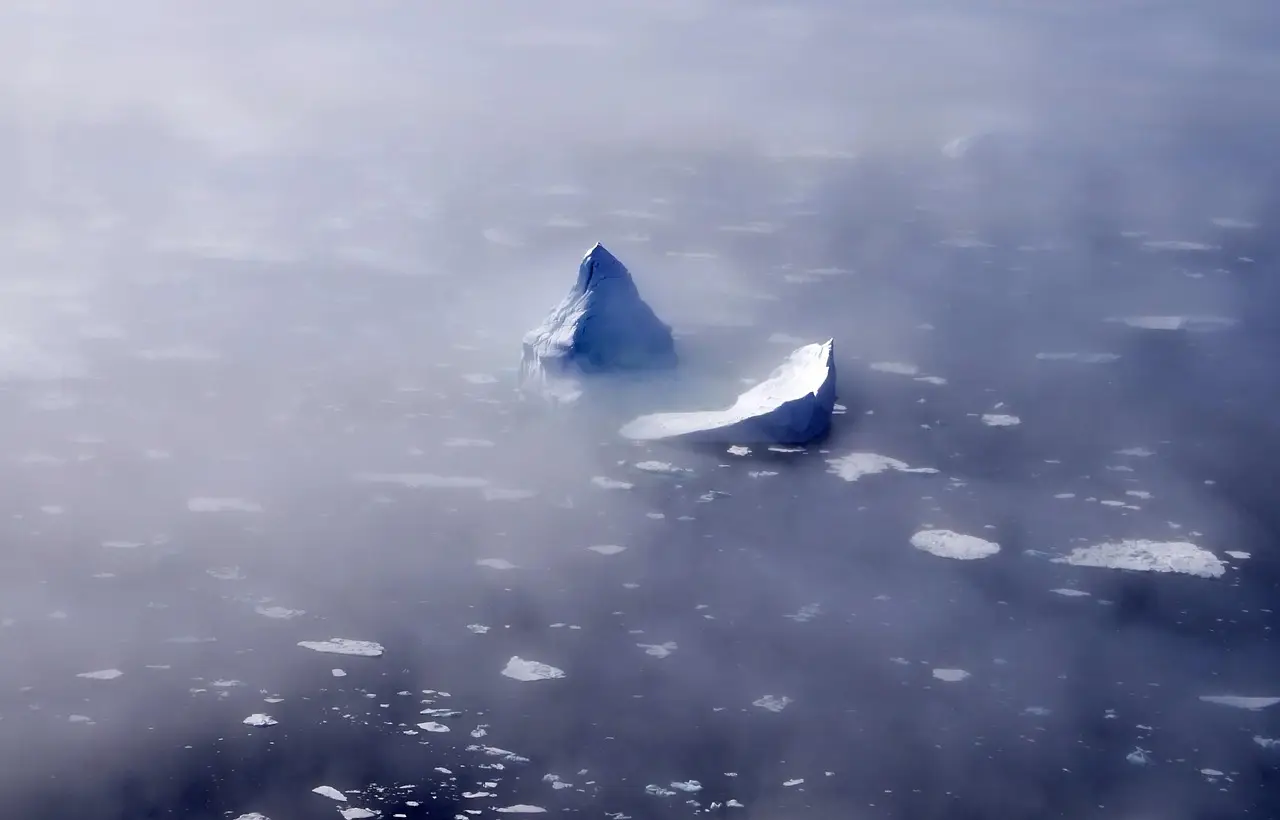
Arctic winter sea ice may cover roughly 1 million square kilometers less than earlier climate projections indicated, according to a 2026 Nature Geoscience study that used climate evidence from a warmer Arctic 6,000 years ago.
Researchers at the University of Cambridge and Mexico’s Centro de Investigación en Matematicas (CIMAT) say the method narrows uncertainty in some projections by as much as 85%. The result revises the scale of possible ice loss while retaining a range of possible outcomes.
The headline numbers
- Revised future winter ice coverage: about 1 million km² smaller than earlier estimates.
- Uncertainty: possible ranges narrowed by as much as 85% in some projections.
- Model comparison: reconstructions tested against 27 climate models.
- Evidence base: sediment cores from the mid-Holocene, about 6,000 years ago.
A 6,000-year-old climate test
The team assembled what it describes as the largest database of its kind for a chemical marker, IP25, which algae living within sea ice produce. They extracted it from sediment cores deposited during the mid-Holocene.
During that period, small changes in Earth’s orbit helped create a warmer Arctic with less extensive ice. The team treated those conditions as a test of how sea ice responds to warming and whether models capture that response.
IP25 acts as a chemical fingerprint of ice-associated algae. Researchers paired its concentrations with other chemical markers left by organisms living in open water, allowing them to reconstruct past ice conditions.
They compared those reconstructions with simulations from 27 climate models for the same ancient period. Bayesian weighting then favored models that matched the evidence more closely and gave weaker matches less influence on the final result.
The team applied those weights to simulations of both the recent past and the future. That step rests on an assumption: the basic physical processes controlling sea ice remain consistent across different climates.
Collectively, the models had a positive bias during the mid-Holocene. In plain terms, they predicted more winter ice than the ancient evidence supported.
Lead author Crystal Fu, from Cambridge’s Scott Polar Research Institute, said: “When we apply the model weights to historical simulations, we completely eliminated the positive bias. The future projections similarly end up being lower than previous estimates, by about a million square kilometers.”
That correction means the earlier model set projected too much future winter ice. It does not establish that every individual model performed badly; the mismatch emerged across the ensemble.
Fu also stressed the distinction between cause and response. Although orbital changes warmed the ancient Arctic rather than human activity, she said warming melts sea ice under the same basic physical principles.
Paleoclimate records contain their own uncertainties, and future simulations contain others. Fu said linking the two had long been difficult because uncertainty sits at both ends. The weighting approach reduced the span of some possible outcomes by up to 85%.
Co-author Marco Aquino-López of CIMAT said: “By using evidence from the past, we can now produce more reliable maps of where Arctic winter sea ice is likely to disappear. These give us a much clearer picture of what the Arctic might look like in the coming decades, and how much uncertainty remains.”
Why winter ice matters
Winter sea ice regulates how much heat and moisture escape from the Arctic Ocean into the atmosphere. As ice retreats, the ocean can release more of both, and declining ice cover has been associated with colder winters and heavier snowfall in the UK, northern Europe and North America.
Summer ice has attracted more attention, even though climate models disagree most strongly about how much ice will cover the Arctic in colder months. That makes the winter record especially useful for testing model behavior.
In March 2025, winter sea ice reached its lowest annual maximum extent since modern monitoring began. The Arctic matched that record low again in 2026, placing the paleoclimate comparison against two recent record-low maxima.
These are broad associations, not a guarantee that a particular winter or location will follow the pattern.
What does this change for Europe?
When the researchers applied the improved weighting to precipitation projections, they saw signs that current climate models may underestimate future snowfall in southeastern Greenland and rainfall across the Mediterranean region.
More snow could affect the Greenland ice sheet’s stability. More Mediterranean rain could influence flood risks in southern Europe. The study therefore offers a firmer basis for testing those hazards, rather than a settled local forecast.
For the UK, the practical answer is narrower than the headline: Arctic winter change remains a factor in cold-weather and snow risk, but this study does not provide UK rainfall totals, flood thresholds or a forecast for any individual winter.
Researchers should use the revised simulations to investigate regional risks. The paper reports no local effect sizes for those secondary impacts, so “more snowfall” and “more rainfall” remain directional warnings.
Limits on the claim
The 85% figure applies to uncertainty ranges in some projections, not every model, variable or future year. Likewise, the roughly 1 million km² shift concerns projected winter ice coverage relative to earlier estimates, not a loss already observed.
The method also depends on the ancient interval sharing relevant sea-ice physics with the present and future. Fu argues that the basic response to warming persists, but the ancient warming came from orbital changes rather than greenhouse-gas warming.
The sediment database’s “largest of its kind” status is the team’s description. The study reports clearer risk directions, not certainty about each regional consequence.
The paper, “Palaeoclimate constraints narrow uncertainty in future Arctic winter sea ice projections,” lists C. Y. Fu, M. B. Osman and M. A. Aquino-López. Nature Geoscience published it in 2026 under DOI 10.1038/s41561-026-02123-w.
The University of Cambridge released the findings on October 26, 2026. The US National Science Foundation and Cambridge Trust provided partial funding; Fu is a Member of Girton College, Cambridge.
via dx.doi.org (Original)
More from James Calloway
Show full bio
Staff writer covering regulation, policy and their impact on general science news at SciBeat.
267 articles
Nearby plates
- Arctic Sea Ice Ties for 10th-Lowest Minimum in 2026 Satellite Record
- Arctic Melt Season Grew 40 Days Longer Since 1979—Then Stalled in 2010
- Ice Ages May Have Started With a Pole-to-Pole Ocean Chain Reaction
- Antarctic Sea Ice Hits Third-Lowest Winter Peak on Record
- Antarctica Gained 695 Billion Tons of Ice. The Trigger Was Thousands of Miles Away