Plate Nº 95 · recorded September 29, 2026
Space & AstronomyReported finding
Astronomers Find First Stellar Stream Beyond the Milky Way
Astronomers have spotted a stellar stream in the galaxy UGC9050-Dw1 — the first found outside the Milky Way — and used it to probe dark matter in another galaxy.
By Nathan Brooks3 min read665 words
In brief
- First globular cluster stellar stream ever detected outside the Milky Way, found in the ultra-diffuse galaxy UGC9050-Dw1 and published in Nature on September 23, 2026.
- The team, led by Julie Kiel Holm and Sarah Pearson, showed for the first time that such streams can constrain the dark matter halo mass and density profile of other galaxies.
- The analysis suggests UGC9050-Dw1 contains a large amount of dark matter, consistent with earlier studies, and telescopes like Euclid and the Nancy Grace Roman Space Telescope should reveal many more streams.
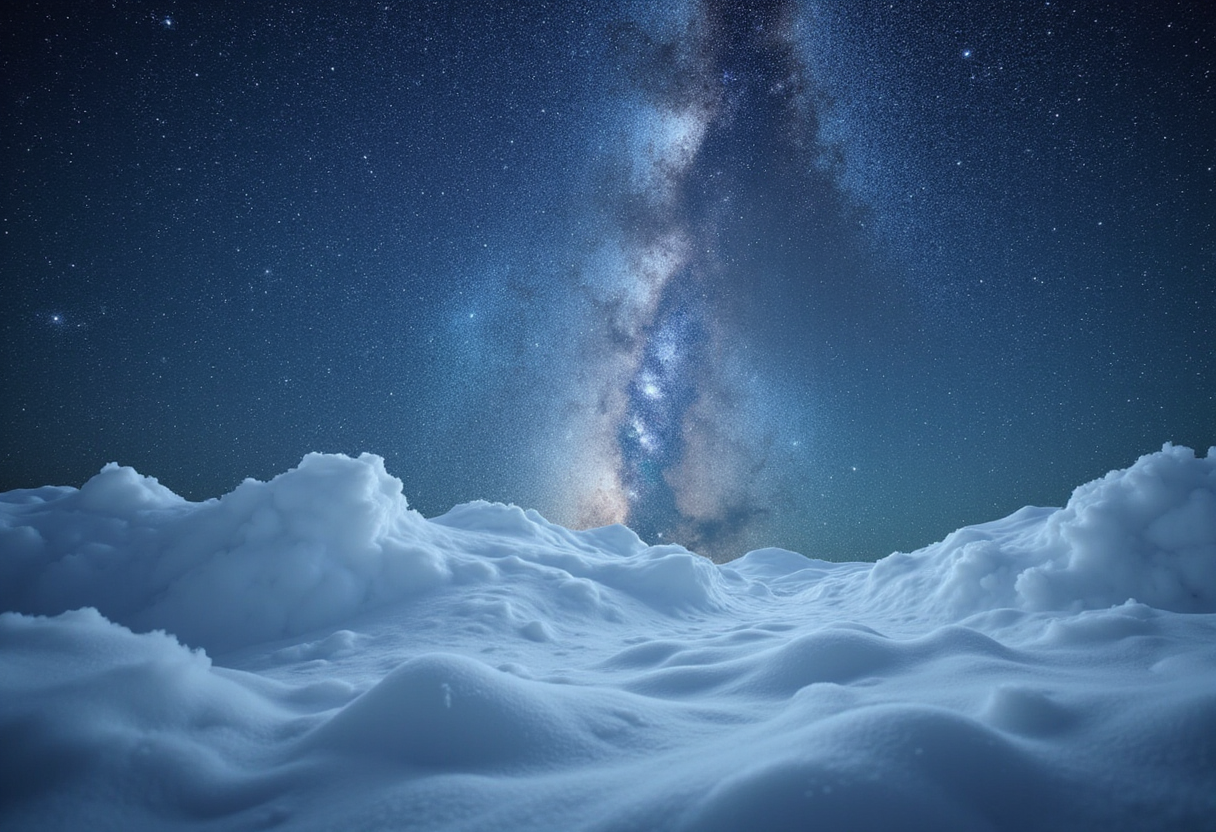
Astronomers have detected a globular cluster stellar stream outside the Milky Way for the first time — a faint ribbon of stars wrapped around a dim, distant galaxy. The discovery, published in Nature on September 23, 2026, opens a new window on dark matter, the invisible stuff that makes up most of the mass in the universe.
The team, led by PhD student Julie Kiel Holm of the Niels Bohr Institute and Associate Professor Sarah Pearson of DTU Space, spotted the stream in an ultra-diffuse galaxy called UGC9050-Dw1. Ultra-diffuse galaxies are extremely faint — they spread their stars thinly over a wide area, producing very little light.
"We have discovered a globular cluster stellar stream in another galaxy. This is the first time such a stream has been observed outside our own galaxy, the Milky Way, which makes the discovery particularly exciting," says Julie Kiel Holm.
What is a stellar stream?
A globular cluster is a dense, gravitationally bound ball of stars. When such a cluster orbits a larger galaxy, the galaxy's gravity slowly tears stars away from it through a process called tidal stripping. The stripped stars stretch into a long, narrow trail behind the cluster — a stellar stream.
Because gravity dictates the shape and motion of these streams, they act as tracers of a galaxy's gravitational structure. Where the light bends and thins, invisible mass must be pulling. That makes streams a promising probe of dark matter, which is thought to account for roughly 80–85 percent of all matter in the universe despite remaining fundamentally unexplained.
Until recently, the extreme faintness of these structures made them nearly impossible to detect anywhere, let alone in another galaxy. A stream orbiting inside an ultra-diffuse galaxy — itself one of the dimmest galaxy types known — compounds the challenge. Improvements in large astronomical datasets and analysis methods made the new detection possible.
More than a first sighting
The finding matters beyond the novelty of spotting a stream beyond our cosmic doorstep. The researchers also demonstrate, for the first time, that globular cluster stellar streams can be used to measure dark matter in galaxies outside the Milky Way.
"This opens entirely new possibilities. Not only can we now search for globular cluster stellar streams in other galaxies, but in the long term, we may also be able to measure the dark matter content of more ultra-diffuse galaxies," says Sarah Pearson, who contributed to the discovery during her employment at the Niels Bohr Institute.
Applied to UGC9050-Dw1, the method yielded new estimates of the galaxy's total mass and of how that mass is distributed. The analysis suggests the galaxy holds a large amount of dark matter — consistent with expectations for ultra-diffuse galaxies and with earlier studies of this particular one.
"We show that a well-established tool from studies of the Milky Way can be used to understand other galaxies, where measuring the distribution of dark matter has traditionally been very challenging," says Julie Kiel Holm.
Caveats and what comes next
The study covers a single galaxy, so the broader power of the method remains to be demonstrated across many systems. Still, the proof of principle is significant: until now, everything astronomers have learned about dark matter from stellar streams has come from one galaxy — our own.
"Being able to observe these streams in entirely different kinds of galaxies opens the door to using them to build a much broader understanding of how dark matter behaves," says Julie Kiel Holm.
The researchers expect the number of detectable streams to climb sharply in the coming years. Observatories such as the Euclid Space Telescope and the Nancy Grace Roman Space Telescope are beginning to deliver deep views of faint galaxies and stellar structures that ground-based surveys could not reach.
The study's additional authors are Jacob Nibauer, David J. Sand, Adrian M. Price-Whelan, Tjitske Starkenburg, David Hendel and Catherine Fielder. The Villum Foundation and the European Research Council funded the work.
via dx.doi.org (Original)
More from Nathan Brooks
Nearby plates
- Faint Young Stars Suggest Messier 74 Is Nearly Twice as Large as Thought
- Simulations Reconstruct How the First Stars Forged the Universe
- Webb Telescope Witnesses Planet-Smashing Collisions Around Young Stars
- Simulations Trace First Stars to Chemical Clues in Today's Universe
- A Mysterious Radio Signal Pointed at a Super-Earth. Was It Aliens?