Plate Nº 72 · recorded November 17, 2026
Space & AstronomyReported finding
Five-Star Brawl 52,000 Years Ago Sent Giant Stars Fleeing
Gaia data let astronomers reconstruct a 52,000-year-old five-star gravitational brawl that ejected the most massive runaway binary known — and the solution defies existing theory.
By James Calloway5 min read935 words
In brief
- 52,000 years ago an encounter ejected two binaries and one star from the Tarantula Nebula cluster R136.
- Melnick 34, a binary of 140 and 130 solar masses, was flung out at 46 km/s — the most massive runaway known.
- The scenario was reconstructed using Gaia satellite data and N-body simulations of five interacting stars.
- All four binary stars should collapse into black holes within 4 million years; any merger would take ~14 billion years.
- The cluster is only 2 million years old, yet shows a dense phase expected only in ancient globular clusters.
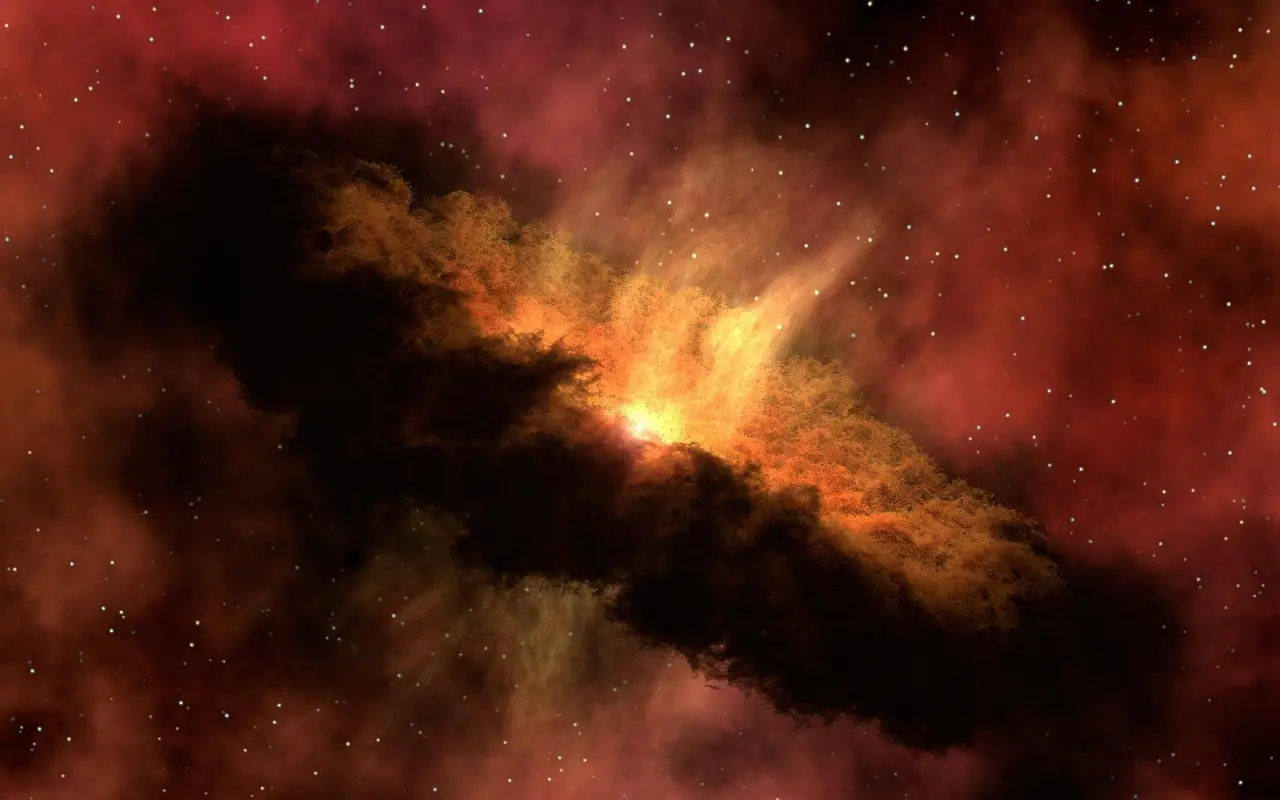
Roughly 52,000 years ago — around the time the first humans reached Australia — a gravitational brawl inside a star cluster in the Large Magellanic Cloud flung out two binary stars and a lone star at extraordinary speeds. A team of astronomers now says it has reconstructed that encounter, and their solution required a five-star pile-up that theory said shouldn't happen.
The findings, built on precision measurements from the European Space Agency-style mapping satellite Gaia (launched in 2013 by the European Southern Observatory, operating until January 2025), resolve a long-standing puzzle about so-called runaway stars. They also raise awkward questions about how dense young star clusters really work.
What are runaway stars?
Most stars, including our sun, cruise along sedately. The sun moves at about 64,800 kilometers per hour relative to its local surroundings. A rare few race. Astronomers have chased them since the 1950s, when Adriaan Blaauw, then at Yerkes Observatory in Illinois, found that AE Aurigae — roughly 20 times the sun's mass — was barreling along at nearly 460,000 kilometers per hour.
The problem is provenance. Fast stars leave home quickly. Tracing their orbits backward is like watching a car zip past and guessing its garage. And massive stars, the ones that usually run, are scarce: the entire galaxy holds only about 100 stars above 100 solar masses.
Where did this fight happen?
About a dozen of those monsters live in one cluster, R136, at the heart of the Tarantula Nebula in the Large Magellanic Cloud, a dwarf galaxy orbiting the Milky Way more than 160,000 light-years away. The cluster packs some 100,000 stars; its brightest members shine over a million times brighter than the sun.
In the late 2000s, Hugues Sana of KU Leuven began measuring the nebula's stars with the Very Large Telescope in Chile. The breakthrough came two years ago, when Mitchel Stoop of the University of Amsterdam's Anton Pannekoek Institute precisely measured velocities, masses and ages of 55 runaways within 1,500 light-years of the nebula, using Gaia data.
Those measurements showed that the object Melnick 34 was ejected 52,000 years ago at 46 kilometers per second — fast enough to fly from Amsterdam to Istanbul in under a minute and a half. Mel 34 is not one star but two: a pair weighing 140 and 130 solar masses, orbiting each other every 155 days. Not the fastest runaway known. Easily the most massive.
Who was the culprit?
The prime suspect was VFTS 590, a star of 47 solar masses ejected around the same time, whose orbit traces back to Mel 34's launch site. But the physics wouldn't cooperate. The team checked energy and momentum — the conserved quantities that, unlike footprints, never lie — and VFTS 590 came up short. Too light, too slow, and moving at a 70-degree angle to Mel 34's path.
So a third party had to be involved. When the researchers searched along the calculated trajectory, they found nothing — until a fuzzy smudge on the screen turned out to match, provided it was another binary. That object, Mel 39, had been flagged as a probable binary in a 2020 paper by Paul Crowther of the University of Sheffield: an observed star of 140 solar masses plus a hinted companion. The numbers balance if that unseen companion carries about 80 solar masses and orbits every 92 days.
Computer simulations — "N-body" calculations that solve Newton's equations of motion for multiple stars — pointed to the likeliest scenario: a binary (Mel 34) met a triple system (Mel 39 plus VFTS 590, in a 40-year orbit), and the collision of those systems ejected both binaries and the single star.
That answer startled the researchers. Earlier work with Michiko Fujii, now at the University of Tokyo, suggested such encounters involve at most three or four stars. Meanwhile Ataru Tanikawa, then at the University of Tsukuba, had shown six or seven stars could interact in dense young clusters. The observation fit neither theory cleanly.
What happens next to the fugitives?
VFTS 590 will cruise about 650 light-years, reaching the edge of the James Webb Space Telescope's view of the nebula, before exploding as a supernova in roughly 2.3 million years and leaving a black hole. The four stars in the two binaries will swap mass as they swell, then each collapse into a black hole within four million years, having traveled 650 to 1,000 light-years from home.
Those future black holes will stay paired but on wide orbits. A collision would likely take another 14 billion years — double the universe's current age.
What does this change for astronomy?
Possibly plenty, with caveats attached. If such ejections are common, clusters like R136 may be kicking out a sizable share of the black holes that gravitational-wave detectors hope to see merge. Bad news for that field; a gift for runaway-star hunters.
And the loose ends are real. Current observations can't yet confirm the simulated orbital configurations — the team hopes future Gaia data releases and the Extremely Large Telescope, under construction in Chile, will do better. The cluster is only two million years old, yet the encounter implies a dense phase theorists expected only in ancient globular clusters. And the nebula's most massive stars — R136a1, a2, a3, b and c — stood by as bystanders when, by all expectations, they should have bullied the others around.
A solved case, then. But as the researchers themselves note, science rarely ends with a conviction. It ends with better questions.
via scientificamerican.com (Source)
More from James Calloway
Show full bio
Staff writer covering regulation, policy and their impact on general science news at SciBeat.
474 articles
Nearby plates
- Chandra Catches Hidden Black Hole Fueling 'Supernova Impostor'
- Early-Universe Star Collisions Can Build 100,000-Sun Stars
- Dead Star Pulses Every Eight Minutes, and Astronomers Are Puzzled
- Astronomers Find First Stellar Stream Beyond the Milky Way
- White dwarf pair sends radio pulses to Earth every eight minutes