Plate Nº 43 · recorded November 12, 2026
Space & AstronomyReported finding
Astronomers Watch a Hot Jupiter Vanish From View Mid-Observation
TOI-2535 b, a hot Jupiter 1,000 light-years away, vanished from TESS observations in March, tilted out of alignment by a closely orbiting companion giant planet.
By Marcus Bennett3 min read599 words
In brief
- TESS first observed TOI-2535 b in April 2019, about 1,000 light-years from Earth.
- The planet orbits its star every 8.25 days, far faster than Mercury's 88-day solar orbit.
- Transits arrived up to six hours early or late before vanishing entirely in March.
- The study appears in Astrophysicalysical Journal Letters; next transit expected in 30–50 years.
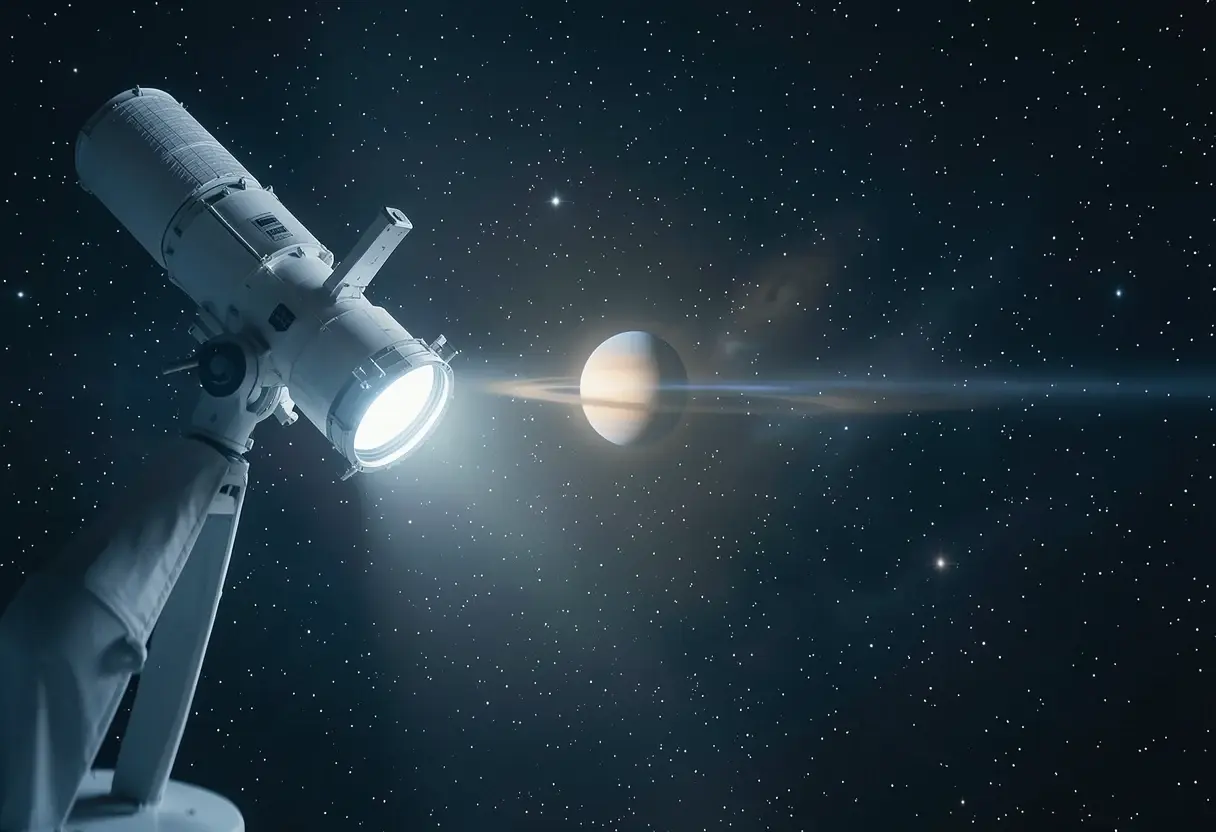
For the first time on record, astronomers have watched an exoplanet disappear from view while they were observing it. The gas giant TOI-2535 b, located roughly 1,000 light-years from Earth, missed its scheduled transit in front of its star in March — and researchers say a second, unseen giant planet is responsible.
The finding, published in Astrophysical Journal Letters, draws on seven years of observations from NASA's Transiting Exoplanet Survey Satellite (TESS), an orbital telescope that finds planets by detecting subtle dips in stellar brightness as they pass in front of their stars.
What exactly happened to TOI-2535 b?
The planet did not evaporate or break apart. According to the study team, an unusually close companion gas giant on a tilted orbit is gravitationally tugging on TOI-2535 b, making both planets wobble like a pair of spinning tops. Over time, that wobble has knocked the hot Jupiter out of alignment with our line of sight, so it no longer crosses the face of its star as seen from Earth.
"We think of the universe as resembling clockwork, where everything is regular, but that's not true," Samuel Yee, a University of California, Los Angeles astronomer and study co-author, said in a recent profile. "If there are multiple planets in a system, they can affect each other's orbits."
Why did it take seven years to notice?
Astronomers first examined TOI-2535 b in April 2019 using TESS transit data. The planet is a "hot Jupiter" — a gas giant similar in character to Jupiter but orbiting far closer to its star than Mercury does to our sun. Mercury completes one lap around the sun in 88 days; TOI-2535 b circles its star once every 8.25 days.
The first signs of trouble were timing errors. Unlike most planets, whose transits arrive like clockwork, TOI-2535 b's dips in starlight showed up as much as six hours earlier or later than predicted. As the years passed, the transits also grew shallower and shorter. Then, in March, the planet failed to appear during TESS's scan of the system entirely.
"This is the most extreme example we've seen because the two planets are interacting so strongly," Yee said. "The planet's orbit is tilting so quickly that its transit disappeared while we were watching."
How is this connected to eclipses?
The mechanism, the researchers explain, is the same one that governs solar and lunar eclipses. Earth's moon orbits on a tilted plane — a legacy of its violent formation in a collision with the young Earth — so it rarely lines up exactly with the sun.
"If the moon's orbit around the Earth was perfectly aligned with the Earth's orbit around the sun, we would see an eclipse every month," UCLA astrophysicist and study co-author Erik Petigura explained. Tilt breaks the cycle; TOI-2535 b's rapidly shifting tilt broke its transits.
When will astronomers see it again?
Not soon. Based on the team's calculations, TOI-2535 b will not transit its star again for another 30 to 50 years. The companion planet, however, may reappear sooner, once it emerges from behind its stellar anchor.
The team acknowledges the observation carried an element of luck: catching a planet mid-disappearance required the telescope to be watching during a narrow window. For practitioners hunting exoplanets in long-baseline surveys, the case is a caution that irregular transit timing can signal strong planet-planet interactions rather than bad data.
A wobbling giant slipped out of view, and it left a schedule behind.
via popsci.com (Source)
More from Marcus Bennett
Show full bio
News editor covering regulation, policy and their impact on general science news at SciBeat.
370 articles
Nearby plates
- First known “disappearing planet” traced to an orbit-tilting neighbor
- A Giant Planet Vanished From View — And a Hidden Neighbor May Be Why
- Astronomers Watch an Exoplanet's Transits Vanish for the First Time
- Webb Telescope Finds Lava Planet TOI-561 b Has a Reflective, Cloudy Atmosphere
- Webb Data Reveals Hidden Giant Planet After Software Clears Starlight