Plate Nº 89 · recorded November 10, 2026
Space & AstronomyReported finding
Webb Telescope Finds Lava Planet TOI-561 b Has a Reflective, Cloudy Atmosphere
New Webb telescope observations show lava planet TOI-561 b reflects about three-quarters of its star's heat, with mineral clouds confirming a thick atmosphere that theory says should not exist.
By Priya Raman4 min read825 words
In brief
- TOI-561 b orbits its star in under 10.5 hours, at temperatures over 2,000 K, 280.5 light-years from Earth.
- Webb observed the planet for 37 hours across three orbits; findings published in The Astronomical Journal on September 29, 2026.
- The planet reflects about three-quarters of stellar heat, with a high albedo of 0.6 indicating clouds or haze.
- Likely cloud compositions include silicon dioxide and magnesium metasilicate.
- The atmosphere challenges theory, which predicts strongly irradiated super-Earths should have lost all gases.
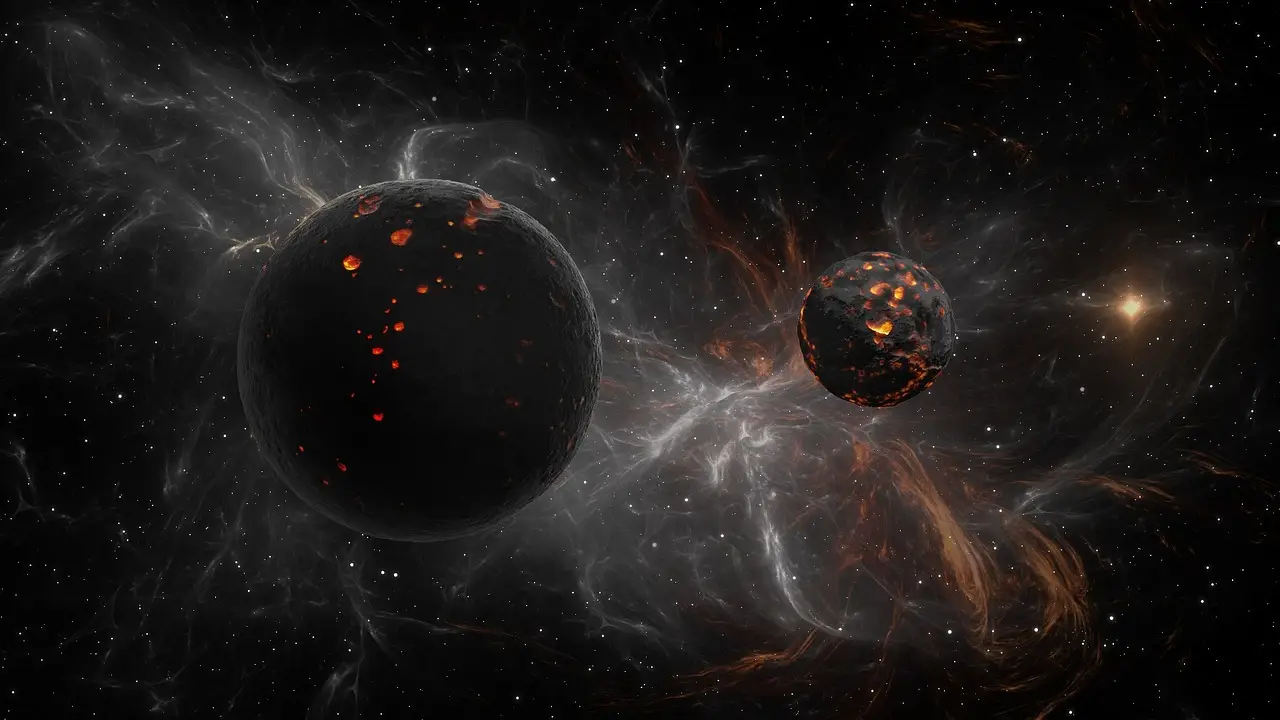
A planet with a surface of molten lava, orbiting its star in under 10.5 hours, has an atmosphere that reflects roughly three-quarters of the star's heat back into space. That is the conclusion of new James Webb Space Telescope observations of the super-Earth exoplanet TOI-561 b, announced on October 27, 2026, by a team led this time by the University of Montreal in Canada. The findings, published in the peer-reviewed journal The Astronomical Journal on September 29, 2026, both re-confirm the planet's atmosphere and deepen the puzzle of how it survives at all.
TOI-561 b lies about 280.5 light-years from Earth, in the direction of the constellation Sextans. It is what astronomers call an ultra-short period (USP) planet — a world circling its star in less than one Earth day. Its surface temperature exceeds 2,000 K, around 3,100 degrees Fahrenheit (1,700 Celsius). At such heat, rock melts. The planet's dayside is likely a global ocean of lava.
Why was an atmosphere a surprise?
TOI-561 b is a super-Earth — a rocky planet more massive than our own — yet scientists judged it too small and too close to its star to hold on to any air. Intense stellar radiation should have stripped any gaseous envelope away long ago. Last December, researchers at the Carnegie Institution for Science in Washington, D.C. announced the first evidence of a thick atmosphere, based on the planet's bulk density and dayside emission spectrum (the pattern of light a planet emits at different wavelengths). It was, in the field's own understatement, unexpected. The new study used a more comprehensive method: full-orbit phase-curve observations, which track how a planet's brightness and heat change across its entire orbit.
The team watched TOI-561 b with Webb for 37 hours — three complete orbits. The planet's dayside proved far cooler than a bare rock should be. Two explanations were possible: the atmosphere reflects heat into space, or it transports heat to the nightside. The nightside, however, was not warm enough. Computer simulations of atmospheric circulation showed that heat redistribution alone cannot match the data. The researchers concluded that about three-quarters of the incoming heat must be reflected away, indicating a high albedo (reflectivity) of 0.6, attributable to clouds or haze.
Lisa Dang, project lead at the University of Waterloo, Ontario, explained: "We measured how the planet's brightness and heat changed throughout its orbit. This technique, known as a phase curve, revealed that the planet reflects a significant amount of light from its star, and that heat is being redistributed around the planet instead of only on the sunlit side. Together, these point to the presence of an atmosphere."
What are the clouds made of?
The reflective layer likely consists of mineral clouds. The paper identifies multiple possible cloud species forming on the dayside, including silicon dioxide (SiO2) and magnesium metasilicate (MgSiO3) — rock-forming compounds condensed high in the atmosphere. Think of the planet as wearing a cloudy, reflective sunscreen over an ocean of fire.
How does the atmosphere survive?
The results challenge atmospheric-escape theory, which holds that strongly irradiated super-Earths should have lost all volatile gases (light compounds such as water and carbon dioxide). The puzzle sharpens because TOI-561 b orbits a sun-like star, whereas most USP planets orbit red dwarfs — small stars notorious for radiation bursts that strip planetary atmospheres. TOI-561 b receives even more radiation than planets around typical red dwarfs, and it retains its air.
Dang said: "Our discovery challenges current theories. We would expect a heavily irradiated rocky planet like TOI-561 b to have lost its atmosphere billions of years ago. Instead, the evidence suggests it still has a significant atmosphere today."
The team offers several hypotheses, none yet confirmed:
- The planet may have begun with a much thicker primordial atmosphere, perhaps as a sub-Neptune, and the present air is a secondary atmosphere left after stellar radiation removed the original.
- The planet may have formed farther out and migrated inward while its young star was "calming down" and emitting less radiation, sparing the remaining atmosphere.
- Both scenarios together may apply.
- The planet may have "consumed" its original atmosphere by trapping the gases in its interior.
Co-author Anjali Piette, Assistant Professor in Astronomy at the University of Birmingham, raised another possibility: whether the molten-rock ocean "acts as a planet-wide volcano that is constantly feeding its atmosphere."
What comes next?
The next question, according to Dang, is whether TOI-561 b's atmosphere resembles Venus or an extreme version of Io, Jupiter's volcanic moon. Observing at longer wavelengths with Webb could help explain how a planet this hot has kept its atmosphere for billions of years. The answer will also guide astronomers studying other rocky super-Earths: how many of them hold atmospheres, and of what kind.
via birmingham.ac.uk (Original)
More from Priya Raman
Show full bio
Senior reporter covering people, launches and day-to-day practice in general science news at SciBeat.
342 articles
Nearby plates
- Webb Telescope Detects Atmosphere on Scorching Lava World HD 3167 b
- Lava World 280 Light-Years Away Reflects 75% of Its Star's Light
- Astronomers Watch a Hot Jupiter Vanish From View Mid-Observation
- First known “disappearing planet” traced to an orbit-tilting neighbor
- Webb Telescope Finds Orderly Weather on a World 20 Light-Years Away