Plate Nº 38 · recorded November 11, 2026
Space & AstronomyReported finding
Unexpected Iron Phase Survives in Chang’e-6 Lunar Impact Glass
Chang’e-6 impact glass contains γ-iron, a phase never before confirmed in lunar samples. Its magnetic nanoparticles may preserve clues about the Moon’s ancient field.
By Priya Raman3 min read635 words
In brief
- Researchers found γ-Fe as the dominant iron phase in two Chang’e-6 impact-glass samples.
- The iron phase had never before been confirmed in natural lunar samples.
- The PNAS paper was published on September 16, 2026.
- Relatively large γ-Fe nanoparticles displayed stable single-vortex magnetic states and stable responses to external magnetic fields.
- The study DOI is 10.1073/pnas.2608395123.
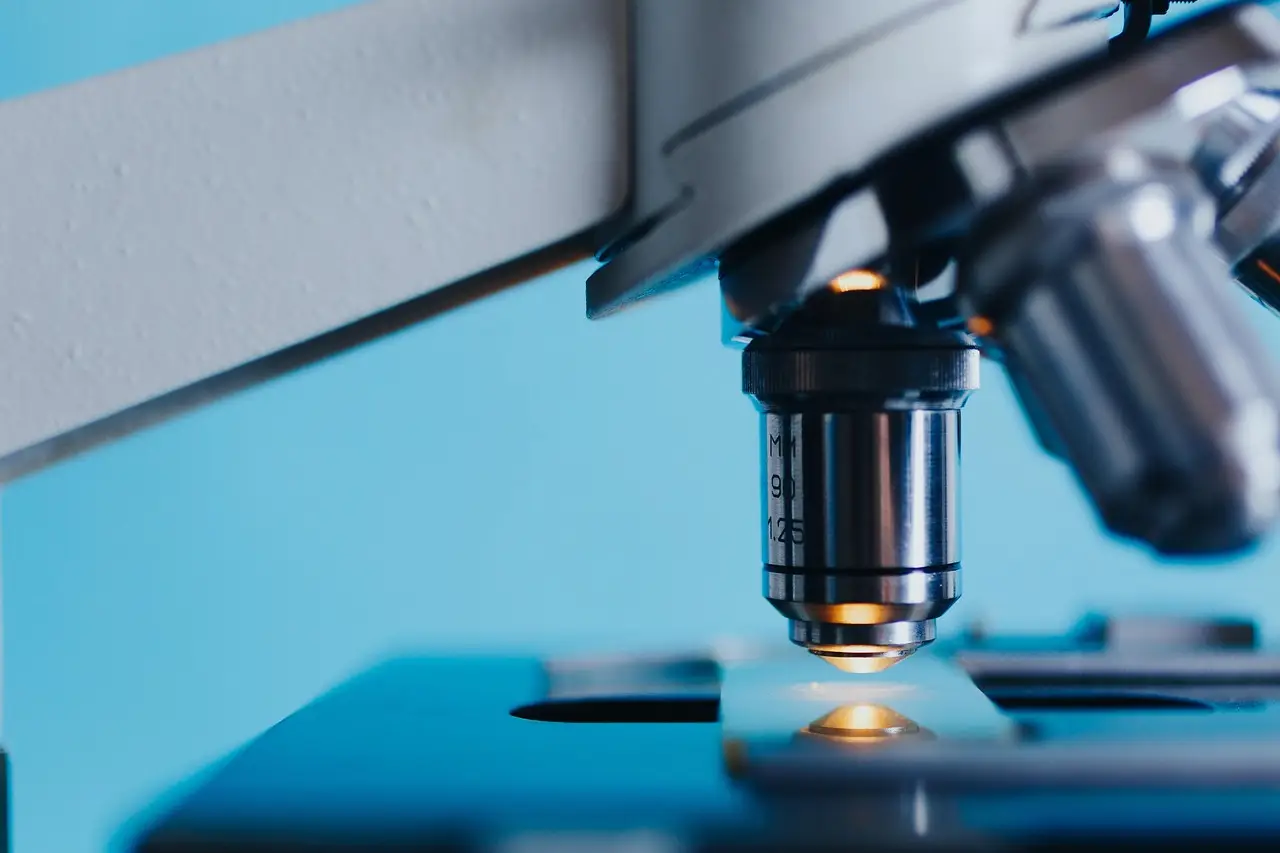
Two microscopic glass samples from China’s Chang’e-6 lunar soil contain γ-Fe, a form of metallic iron never before confirmed in natural lunar samples, according to a study published September 16, 2026.
The phase, pronounced “gamma-iron,” was the dominant iron phase in both samples. Its face-centered cubic structure places atoms at the corners and centers of a cube. This arrangement normally exists only at high temperatures; as γ-Fe cools under ordinary conditions, it changes into α-Fe, the more familiar low-temperature form of iron.
Both phases contain the same element; their distinction lies in the arrangement of atoms rather than a different chemical identity. That structural difference is what the analytical methods had to resolve.
Yet the researchers found this high-temperature phase preserved inside microscopic impact glass, the melted and rapidly cooled material created by strikes on the lunar surface.
How did the unusual iron survive?
Researchers led by Prof. Haifeng Du of the High Magnetic Field Laboratory at the Hefei Institutes of Physical Science, part of the Chinese Academy of Sciences, examined impact glass containing numerous iron nanoparticles. A nanometer is one billionth of a meter.
They used focused ion beam preparation, which slices minute specimens for analysis; transmission electron microscopy, which directs electrons through a thin sample to reveal its structure; and chemical analysis. These methods confirmed γ-Fe as the dominant iron phase in the two glass samples.
The ion beam preparation allowed the researchers to target glass regions containing embedded particles, while microscopy resolved the crystal structure needed to distinguish γ-Fe from α-Fe. Chemistry provided a further check on the material being examined.
The team proposed that the extreme conditions of lunar impacts could prevent γ-Fe from changing into α-Fe. Rapid cooling of molten material, small amounts of carbon and other elements, and the surrounding glassy matrix, the solid material enclosing each particle, may all have helped preserve the unusual crystal structure at the lunar surface.
The paper, “Magnetic vortex state of natural lunar γ-Fe,” appeared in the Proceedings of the National Academy of Sciences (PNAS) on September 16, 2026. Its DOI is 10.1073/pnas.2608395123.
The listed authors are Pengfei Liu, Ziliang Jin, Zheng Gong, Long Li, Kang Wang, Xiandi Zeng, Jing Liu, Dongsheng Song, Haifeng Du, Kelei Zhu, Chuanxin Yan, Jinhua Li, Keke Zhang, Wyn Williams and Ann M. Hirt.
Can the particles preserve ancient magnetism?
Researchers tested whether the particles could retain magnetic information by using off-axis electron holography, a technique for mapping magnetic fields at extremely small scales. Relatively large γ-Fe particles displayed a stable single-vortex state, meaning their magnetization followed a circulating path rather than aligning uniformly in one direction. The pattern resembles water circling a drain.
The particles also maintained a stable magnetic response when exposed to an external magnetic field. That persistence matters because a magnetic archive must retain its internal configuration after formation.
“This tiny magnetic fossil may help us better understand the Moon’s ancient magnetic history,” said Dr. Long Li of the High Magnetic Field Laboratory, a member of the research team.
What can lunar impact glass reveal?
The Moon no longer possesses a global magnetic field, but magnetic minerals in its rocks and soils can preserve information about past conditions. The confirmed γ-Fe adds another material for researchers studying that history.
Because γ-Fe and α-Fe develop under different physical conditions and exhibit distinct magnetic properties, they may retain records from different stages of lunar impact events.
Further research must determine how reliably these particles preserve ancient magnetic signals and what those signals reveal about the evolution of magnetism on the Moon.
The discovery identifies a promising material for lunar magnetic research, but its full interpretive value remains to be tested.
via google.com (Original)
More from Priya Raman
Show full bio
Senior reporter covering people, launches and day-to-day practice in general science news at SciBeat.
343 articles
Nearby plates
- Gamma-Iron Phase Identified in Chang'e-6 Lunar Soil for First Time
- Chang'e-6 Lunar Soil Hides a Microscopic Magnetic Time Capsule
- Bennu Samples Rewrite the Asteroid's Birthplace — and Jupiter's Role
- New Simulations: The Moon May Have Formed Intact in Five Hours
- Chang'e-6 Rocks Point to Earth's Gravity as the Cause of the Moon's Two Faces