Plate Nº 67 · recorded October 10, 2026
Earth & ClimateReported finding
Back-to-Back Arctic Storms Can Double Sea Ice Loss, Study Finds
Arctic cyclone clusters cause about twice the sea ice loss of single storms, with effects lasting 2.5 times longer, a 45-year AWI analysis published in Nature Communications shows.
By Nathan Brooks4 min read733 words
In brief
- Back-to-back Arctic cyclones cause about twice as much sea ice loss as isolated storms, with impacts lasting ~2.5 times longer.
- The study, led by the Alfred Wegener Institute and published in Nature Communications on September 13, 2026, analyzed satellite and weather data from 1979 to 2024.
- A typical storm cluster contains an average of 2.5 cyclones; regional impacts range from 1.5 to 7 times stronger than isolated storms.
- Sea ice loss from cyclone clusters has risen substantially in recent decades as the ice thins and weakens.
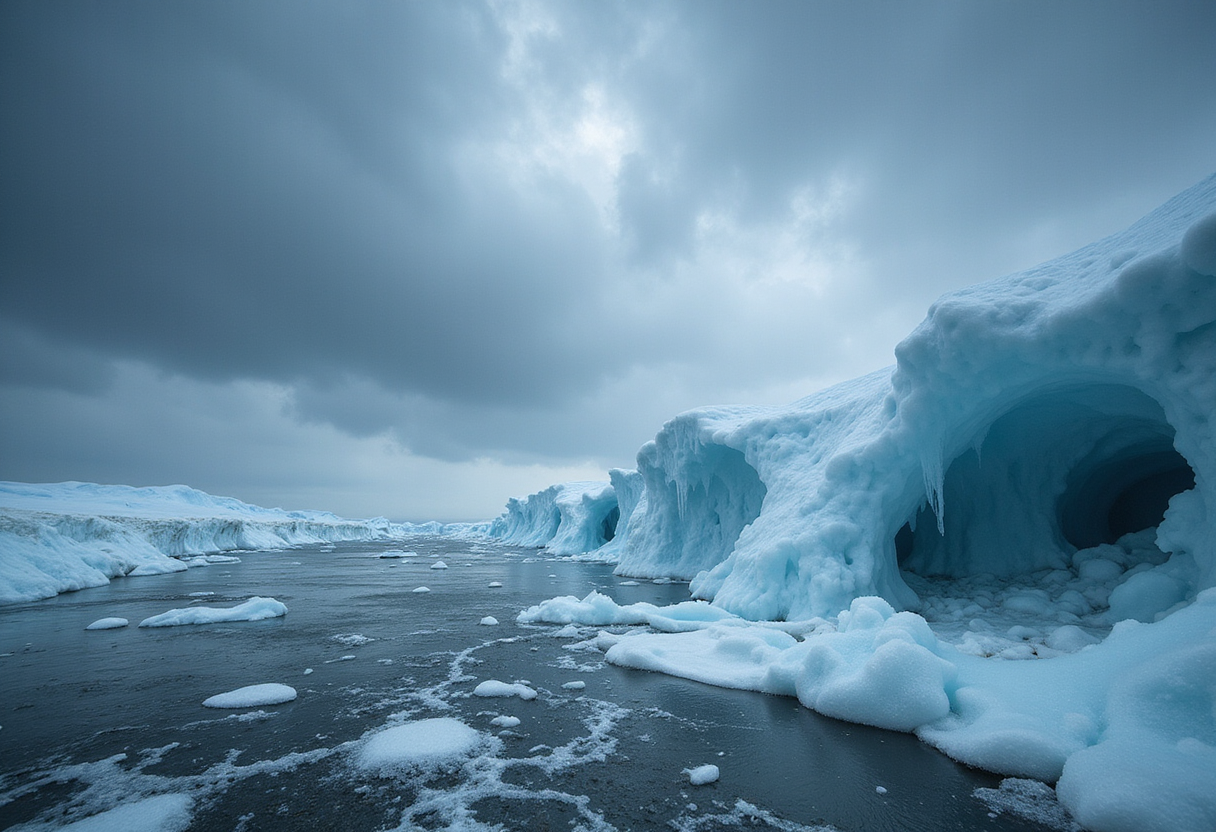
Arctic cyclones that arrive in rapid succession cause about twice as much sea ice loss as isolated storms, and their effects last roughly two and a half times longer. That is the central finding of the first systematic study of storm sequences in the Arctic, published in Nature Communications on September 13, 2026, by an international team led by the Alfred Wegener Institute (AWI).
The phenomenon, known as 'cyclone clustering', occurs when multiple low-pressure systems pass through the same region one after another. Instead of calming down between storms, the area stays stormy for extended periods — and the sea ice pays the price.
"In Europe, such events have frequently led to significant damage in the past due to high winds, heavy rainfall or high tide levels along the coast," says Dr. Lars Aue, the study's lead author from AWI, the Helmholtz Centre for Polar and Marine Research.
How did the researchers track storm clusters?
The team analyzed satellite observations and weather records spanning 1979 to 2024 — 45 years of data. They adapted an algorithm designed for tracking weather systems so it could detect rapidly consecutive cyclones in the Arctic.
"We were then able to compare the state of the sea ice on satellite images before and after a cluster had passed through," Aue explains.
On average, a cluster consists of 2.5 cyclones, though the number varies by location and season. This is the first systematic analysis of how such clusters affect Arctic sea ice.
What do storm clusters do to the ice?
The damage happens in several ways:
- Mechanical break-up. Powerful winds shatter the ice cover, setting floes in motion so they drift and collide.
- Delayed refreezing. In deep winter, newly opened gaps in the ice would normally freeze over within days. A following storm keeps conditions turbulent and slows that recovery.
- Compaction in summer. Storms are weaker in the warm season, but winds can still push floes northward into other ice, reducing the total area covered.
- Attack by heat. Cyclones carry warm air that melts ice from above, and they stir up relatively warm seawater from deeper layers toward the surface.
The regional impact varies enormously. In some areas, clustering increases the effect on sea ice by 1.5 times; in others, the effect becomes as much as seven times stronger.
"On average across the entire Arctic, cyclone clusters reduce Arctic sea ice cover by about twice as much as conventional, isolated low-pressure systems. This condition also lasts about two and a half times longer," says Aue.
The key, the researchers found, is that repeated storms prevent the ice from recovering between disturbances, so the damage accumulates. The overall effect matters more than the strength of any single storm.
Could warming make it worse?
The long-term trend is troubling. Sea ice loss linked to cyclone clusters has risen substantially over recent decades, according to the analysis.
One likely reason: the ice itself is changing. As global temperatures rise, Arctic sea ice becomes thinner and more mobile, and less able to withstand the forces cyclones generate. During summer, an increasingly warm Arctic Ocean could amplify the effect.
Aue warns of a possible downward spiral: "We could be entering a self-enforcing feedback loop: the weaker the sea ice becomes, the more cyclone clusters can reduce its extent, which in turn weakens the sea ice."
That conclusion remains preliminary in one respect. The team is now using climate projections to test whether the intensification seen in recent decades will continue in the future.
Why does this matter beyond the ice?
Sea ice acts as a natural barrier protecting Arctic coastlines from powerful waves. As that cover retreats, coastal communities face greater exposure to severe storms. Rising permafrost thaw is weakening the same coastlines, making erosion and storm damage more likely.
Accurately representing cyclone clustering in models could therefore improve projections of both future ice conditions and coastal risks.
"Until now, there has been no systematic analysis of the impacts of cyclone clusters in the Arctic. With our work, we are filling a knowledge gap and lay an important foundation for projections that can depict the future of the Arctic sea ice — a central component of the global climate system — as accurate as possible," Aue said.
The study, authored by Lars Aue, Sofie Tiedeck, Peter Finocchio, Timo Vihma, Petteri Uotila, Gunnar Spreen and Annette Rinke, appears in Nature Communications.
via awi.de (Original)
More from Nathan Brooks
Nearby plates
- 362 Hidden Earthquakes Detected Under Antarctica's Doomsday Glacier
- Arctic Melt Season Grew 40 Days Longer Since 1979—Then Stalled in 2010
- Marine Heatwaves Hide Months of Extra Ocean Warming, Study Finds
- Four warning signs predict when a tilted hurricane will strengthen
- Collisions Among Arctic Ice Floes May Explain Drift Puzzles