Recorded November 22, 2026
Space & AstronomyReported finding
BepiColomo Brakes Into Mercury Orbit After Eight-Year Voyage
BepiColombo, a joint ESA-JAXA mission, completed a 37-minute burn to enter Mercury orbit on Nov. 21, ending an eight-year journey; science begins April 6, 2027.
By Priya Raman3 min read593 words
In brief
- BepiColombo entered Mercury orbit on Nov. 21 after an eight-year journey from Earth.
- The orbit-insertion burn began at 1:24 p.m. EST (1824 GMT) and lasted 37 minutes.
- The mission used one Earth flyby, two Venus flybys and six Mercury flybys to slow down.
- The two orbiters, MPO and Mio, separate around Dec. 9; science operations start April 6, 2027.
- A solar panel issue added a year to the original seven-year flight plan.
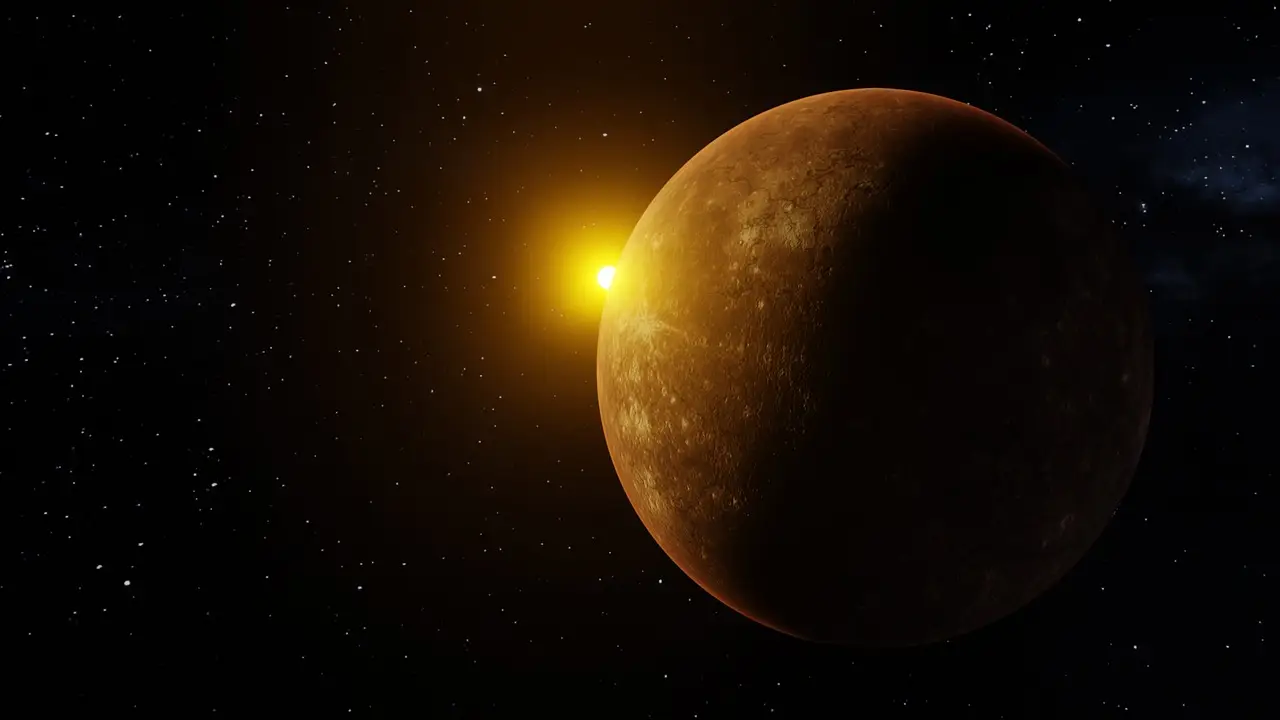
Eight years and four months after leaving Earth, the European-Japanese BepiColombo probe braked into orbit around Mercury on Nov. 21, beginning the most ambitious exploration yet of the solar system's innermost planet.
The decisive moment was an orbit-insertion burn scheduled to begin at 1:24 p.m. EST (1824 GMT) and last 37 minutes — a carefully timed firing of the spacecraft's engines that slowed it just enough for Mercury's weak gravity to capture it.
The mission is a joint effort of the European Space Agency (ESA) and the Japan Aerospace Exploration Agency (JAXA). It consists of two main spacecraft that will eventually operate independently: ESA's Mercury Planetary Orbiter (MPO), built to study the planet's surface and interior, and JAXA's Mercury Magnetospheric Orbiter (MMO), also known as Mio, designed to examine the magnetic environment around the planet.
Why is Mercury so hard to reach?
Mercury's proximity to the sun makes it a uniquely difficult target. A spacecraft falling toward the solar system's innermost planet is accelerated to enormous speeds by the sun's immense gravitational pull, and it must shed a great deal of kinetic energy — the energy of motion — before Mercury's much weaker tug can capture it.
To solve this problem, the BepiColombo team designed a trajectory featuring one flyby of Earth, two of Venus and six of Mercury over roughly seven years, using each encounter as a gravitational brake. The trio of spacecraft — the two orbiters plus a power and propulsion element called the Mercury Transfer Module (MTM) — launched aboard an Ariane 5 rocket from French Guiana in October 2018.
That flight time grew by a year after the mission suffered a problem with its solar panels, which reduced the power available to the MTM's electric thrusters (ion engines that accelerate charged particles to generate gentle, sustained push).
What happens now that it has arrived?
Today's orbital insertion marks the latest milestone in BepiColombo's arrival phase, expected to take about six months in total. The phase began on Sept. 3, when the MTM released the two orbiters. MPO and Mio remain connected for now; they will not separate until Dec. 9 or thereabouts.
Soon after separation, Mio will settle into its final orbit — a highly elliptical, elongated path carrying it over Mercury's poles. MPO is also bound for a polar orbit, though a much less elliptical one; the ESA probe will conduct a series of engine burns before reaching its final path on March 10, 2027.
Science operations begin on April 6, 2027.
What will the two probes study?
From their two different vantage points, the probes will gather complementary data on a world that remains poorly understood.
"The mission will study all aspects of Mercury, from the structure and dynamics of its magnetosphere and how it interacts with the solar wind, to its internal structure with its large iron core, and the origin of the planet's magnetic field," ESA officials wrote in a mission description.
The magnetosphere is the bubble of magnetic fields that shields a planet from the solar wind, the steady stream of charged particles flowing from the sun.
ESA officials added that the findings should reach beyond Mercury itself: "The data will enable scientists to understand more about the origin and evolution of a planet located close to its parent star, and a better understanding of the overall evolution of our solar system."
For now, the two spacecraft ride together, circling a scorched world that has waited eight years for this visit.
via space.com (Source)
More from Priya Raman
Show full bio
Senior reporter covering people, launches and day-to-day practice in general science news at SciBeat.
549 articles