Recorded November 19, 2026
Space & AstronomyReported finding
Brightest-Ever Gamma-Ray Burst May Hide a Hollow-Core Magnetic Jet
A China–Italy team recovered unsaturated spectra of GRB 221009A, the brightest gamma-ray burst ever seen, and found a 40 MeV emission line and 2 MeV bump hinting at a hollow-core magnetic jet.
By Elena Vasquez3 min read697 words
In brief
- GRB 221009A, about 2.4 billion light-years away, reached Earth on Oct. 9, 2022 as the brightest gamma-ray burst ever observed.
- CSES-01's HEPP-H detector, built for charged-particle monitoring, preserved unsaturated data through the burst's brightest phase.
- A narrow emission line fell from about 40 MeV to 12 MeV, with significance up to >4.5 sigma; a ~2 MeV bump carried about 6% of gamma-ray energy.
- The study, published Nov. 12 in The Astrophysical Journal Letters, proposes a hollow-core, magnetically dominated jet as one interpretation.
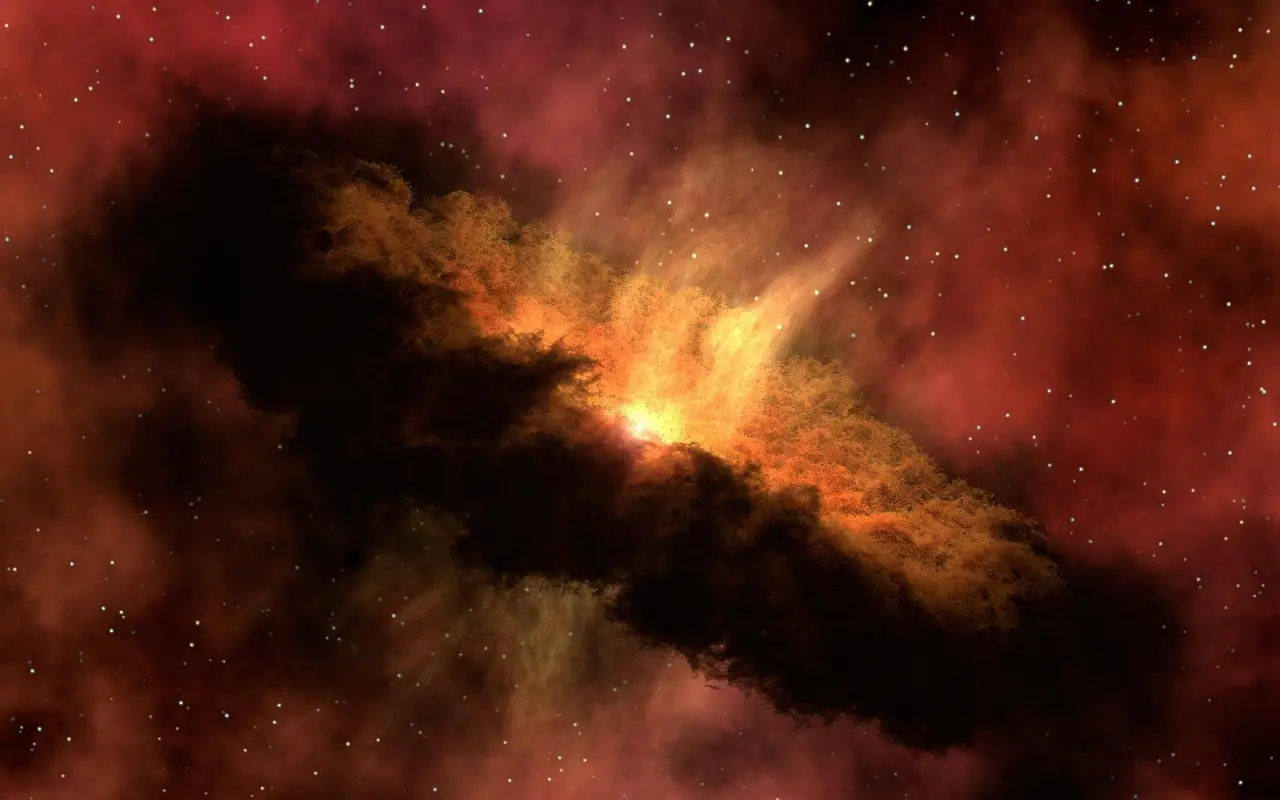
A ring-shaped magnetic jet with a hollow core may explain the brightest gamma-ray burst ever recorded, according to a China–Italy team that reconstructed the event's spectrum across its most saturated seconds. The interpretation remains a model, not a direct detection.
The burst, GRB 221009A, sits about 2.4 billion light-years from Earth. Its light arrived on Oct. 9, 2022, and its extreme brightness blinded most conventional gamma-ray detectors at the peak. The study, led by Zhi-Qiang Ding and colleagues, appeared in The Astrophysical Journal Letters on Nov. 12 (DOI: 10.3847/2041-8213/aeba80).
How did researchers see what other instruments couldn't?
The team relied on HEPP-H, the high-energy detector of the High Energy Particle Package built by the Institute of High Energy Physics (IHEP) of the Chinese Academy of Sciences and flown on the CSES-01 (Zhangheng-1) satellite. CSES-01 is a joint Chinese-Italian mission backed by the China National Space Administration and the Italian Space Agency.
HEPP-H was never meant for gamma-ray astronomy. It was designed to monitor energetic charged particles, and it detects gamma rays only indirectly, through secondary electrons. That low detection efficiency turned into an asset. Because the instrument responded weakly to the flood of photons, its data never saturated during the burst's brightest phase.
The researchers then applied a dynamic Monte Carlo correction — a statistical technique that models how the instrument responds to incoming radiation — and cross-calibrated the results against observations from GECAM-C and NASA's Fermi telescope. This combination recovered the intrinsic spectrum and filled the gap at peak brightness.
"HEPP-H let us study the burst when it was exceptionally bright and reveal an additional broad component at ~2 MeV that had not been observed in this phase," said Li Xinqiao of IHEP, the study's corresponding author.
What did the recovered spectrum show?
Two features stood out:
- A spectral bump near 2 MeV, present in all six time intervals analyzed. Standard models of gamma-ray burst spectra, built on the so-called Band function, cannot account for it, so the team added an extra component. If the bump is thermal emission — light from hot matter — it carries about 6% of the gamma-ray energy in that period, hinting at a relatively weak hot fireball coexisting with a more powerful, likely magnetized jet.
- A narrow emission line whose energy started near 40 MeV early in the burst and fell over time, roughly in inverse proportion to elapsed time. Its width stayed at about 10% of its central energy. Fermi had previously spotted this line at about 12 MeV; CSES-01 pushed the known evolution back by about five seconds. The line may come from electron–positron annihilation, the process where matter and antimatter electrons destroy each other and release photons.
In two key time intervals, the line feature reached a statistical significance of about 4.0 sigma in one and above 4.5 sigma in the other. In physics, significance above roughly 5 sigma is conventionally treated as a discovery, so these values mark strong but preliminary evidence.
Why a hollow core?
The line's brightness rose, then fell. To explain that pattern, the team proposed a structured jet wrapped in a ring-like magnetic field. In this picture, weak line emission near the jet's axis reaches Earth first, while stronger emission from off-axis regions arrives later — producing the observed rise and fall.
The relatively weak magnetic field and faint line emission near the axis correspond, in this model, to a hollow core at the jet's center. The researchers frame this as one possible reading of the data, not a settled conclusion.
Roberto Battiston of the University of Trento and the Trento Institute for Fundamental Physics and Applications said the agreement between CSES-01 and Fermi — two instruments with very different designs — strengthens the case for a genuinely evolving emission process rather than an instrumental artifact.
The bottom line: a particle-monitoring satellite accidentally became the only clear window onto the brightest flash ever seen, and its data now hint at a jet with a hole down its middle.
via phys.org/rss-feed/ (Source)
More from Elena Vasquez
Show full bio
Correspondent covering money, funding and market shifts around general science news at SciBeat.
592 articles
Nearby plates
- Brightest Ever Space Explosion May Have Fired a Hollow Magnetic Jet
- Gamma-ray burst's engine fired for 27 days, shattering the record
- Astronomers Map 450 Gamma-Ray Sources in a Neglected Energy Range
- Fermi catalog maps about 450 gamma-ray sources in 14 years
- Einstein Probe catches 10-minute X-ray tail of neutron star merger