Recorded November 23, 2026
Space & AstronomyReported finding
Cassiopeia A dust points to shell merging before the supernova
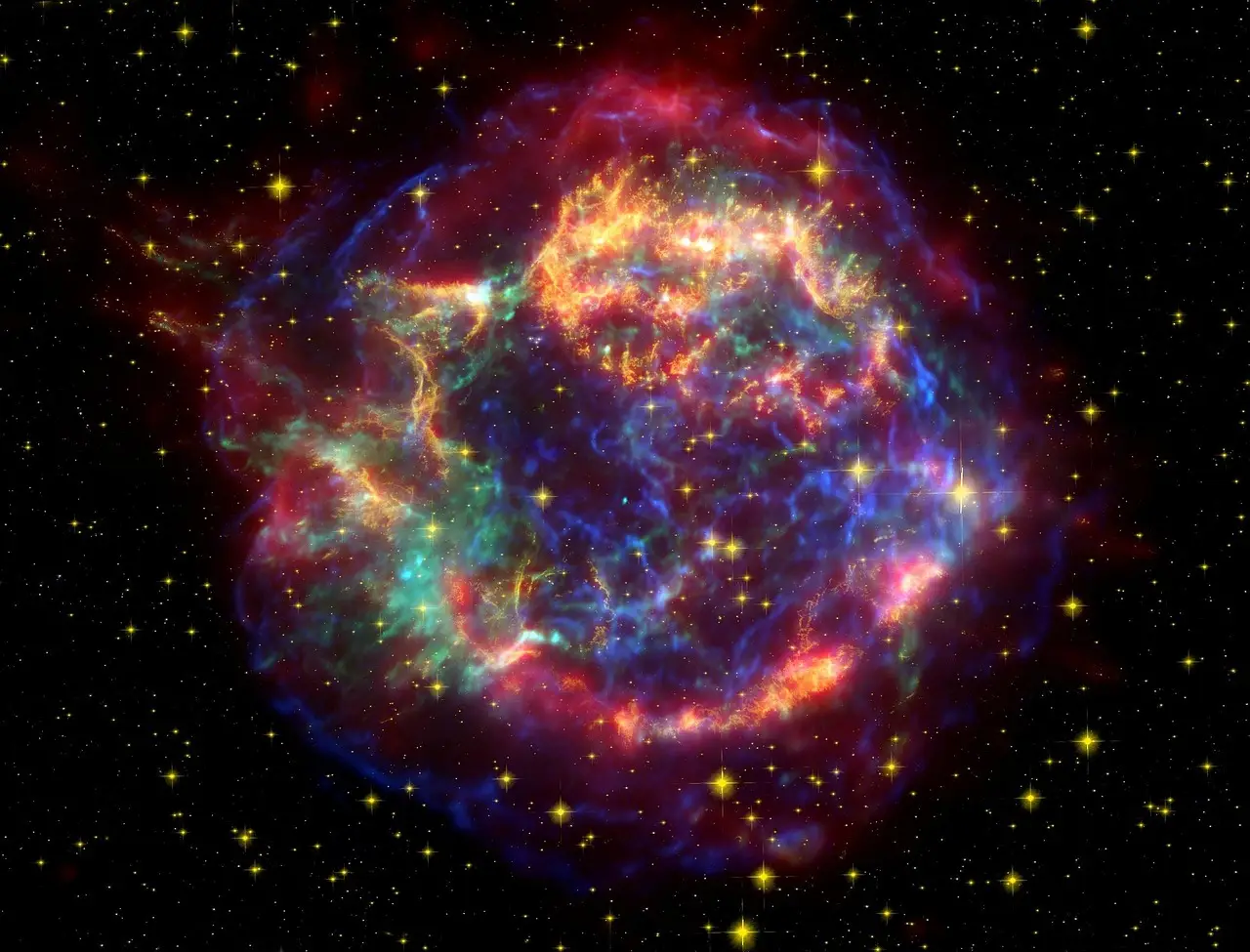
Webb’s mid-infrared map of Cassiopeia A reveals distinct dust compositions and evidence that the dead star’s inner shells may have mixed shortly before its supernova.
By Priya Raman4 min read774 words
In brief
- Webb found evidence that Cassiopeia A’s progenitor shells may have merged hours before the supernova.
- The study targeted three regions: two in the reverse-shocked area and the Green Monster.
- One reverse-shocked region was silica-rich, while the other was dominated by carbon dust.
- The Green Monster contained complex magnesium silicates and came from material shed before the explosion.
- The 2026 paper appeared in The Astrophysical Journal Letters with DOI 10.3847/2041-8213/aea901.
By Priya Raman
Webb found evidence that the inner shells of the massive star that became Cassiopeia A may have merged only hours before it exploded, altering the chemical material that the supernova scattered into space.
The findings appeared Monday in The Astrophysical Journal Letters. The paper, “JWST Resolves Dust Emission from Individual Ejecta Clumps in Cassiopeia A: Dominant Grain Compositions Point to a Shell Merger in the Progenitor,” lists 2026 as its publication year and the DOI 10.3847/2041-8213/aea901.
Cassiopeia A, or Cas A, is a supernova remnant (the clouds of gas and dust that remain after a massive star explodes). Such remnants eventually seed a new generation of stars and planets. Webb’s high-resolution, mid-infrared observation produced a vibrant view of Cas A and details that let astronomers reconstruct the structure and evolution of its original star.
What does a star’s layered interior record?
Stars begin as molecular clouds (vast clouds of mostly hydrogen gas and cosmic dust). Gravity collapses them, the material heats, and protostars (infant stars) form.
Under gravity’s constant pressure, hydrogen in a protostar undergoes nuclear fusion (the joining of light elements), producing helium and marking the transition to a full-fledged star.
When core hydrogen runs out, the core contracts and heats until helium fuses into heavier elements. The process repeats: increasingly heavy elements fuse in the core until iron, while lighter elements fuse in surrounding layers.
The sequence produces multiple shells of elements, a chemical record of stellar evolution. A supernova scatters those elements into space, where some condense into dust grains and clump together.
Webb mapped the composition of individual, solar-system-sized dust clumps in Cas A. Their chemical pattern supplied evidence for a shell merger (the mixing of inner stellar layers before an explosion).
What do the three regions reveal?
To select targets, the team used data from NASA’s retired Spitzer Space Telescope. Spitzer could not resolve Cas A’s minute details, but it identified three specific regions for Webb to examine.
Two targets lay inside the reverse-shocked region (where an inward-moving shock wave collides with debris thrown outward by the supernova). Webb found mostly silica dust, a silicon-and-oxygen mineral, in one and carbon-dominated dust in the other.
The third target was the “Green Monster,” a structure Webb first discovered. It contained complex magnesium silicates (minerals containing magnesium, silicon and oxygen). Unlike the other two regions, it formed from material the star shed before it exploded, not from the supernova’s ejecta.
Combining X-ray observations from NASA’s Chandra X-ray Observatory and the JAXA-led XRISM observatory with Webb data, the team mapped dust composition across the entire remnant. Together, the observations indicated that the merger was underway very shortly before the explosion.
How could the stellar shells merge?
Tea Temim, the study’s lead author and a research scientist at Columbia University in New York, said:
“Material within these shells churns and circulates, which can cause the shells to merge shortly before the supernova explosion.”
He offered the merger of oxygen- and carbon-burning shells as an example. Such a merger significantly changes the star’s structure and then the chemical abundances (relative amounts of elements) in the remnant’s ejecta (scattered debris).
Webb’s full map also revealed merger signatures across much of Cas A, extending the evidence beyond the three selected regions.
Can dust preserve a star’s final hours?
Dan Milisavljevic, an associate professor and study co-author at Purdue University in West Lafayette, Indiana, said:
“With Webb, the vast improvement in being able to resolve at the individual clump level helps us do more sophisticated dust chemistry. As a result, we can tie the explosion back to the makeup of the progenitor star hundreds of years afterward.”
He said the progenitor, meaning the original massive star, was changing during the hours before core collapse (the collapse of its central core). The dust record indicates what researchers think was happening in that final interval.
Milisavljevic said this understanding is essential for explaining which elements the supernova releases into the galaxy and how they enrich future generations of stars and planets.
Because the evidence comes from dust and debris after the explosion, the conclusion is indirect. The study supports a shell-merger scenario in the final hours rather than claiming a precisely witnessed sequence of events.
The broader map nevertheless gives astronomers a new method: infer an originating star’s internal structure by measuring the composition of dust in a supernova remnant.
Cassiopeia A thus preserves a chemical archive of its progenitor’s last possible restructuring.
via phys.org/rss-feed/ (Source)
More from Priya Raman
Show full bio
Senior reporter covering people, launches and day-to-day practice in general science news at SciBeat.
567 articles
Nearby plates
- Webb Telescope Witnesses Planet-Smashing Collisions Around Young Stars
- Webb Captures a Turbulent Star Nursery 161,000 Light-Years Away
- Webb Telescope Reveals Hidden Stars in NGC 7129, 3,300 Light-Years Away
- ALMA Catches a Dying Star's Final Nuclear Heartbeat, Frozen in Gas
- Webb Telescope Spots Mars-Sized Worlds Smashing Together