Recorded November 19, 2026
Chemistry & MaterialsReported finding
Catalyst Surface Alone Can Explain Entropy Puzzle in Electrocatalysis
A minimal kinetic model in ACS Catalysis (2026) reproduces entropy–enthalpy compensation in electrocatalysis without water effects, resetting how researchers read temperature-dependent rates.
By Nathan Brooks3 min read683 words
In brief
- The study by Andrew Jark-Wah Wong et al. was published in ACS Catalysis in 2026 (DOI: 10.1021/acscatal.6c05402).
- A minimal kinetic model reproduced entropy–enthalpy compensation without any potential-dependent entropy in individual reaction steps.
- The mechanism involves the surface filling with hydrogen and the rate-limiting step switching between kinetic regimes.
- Similar compensation patterns appear in many reactions, from oxygen evolution to CO reduction.
- The textbook Butler–Volmer picture assumes the prefactor stays constant as potential changes — experimental data often contradict this.
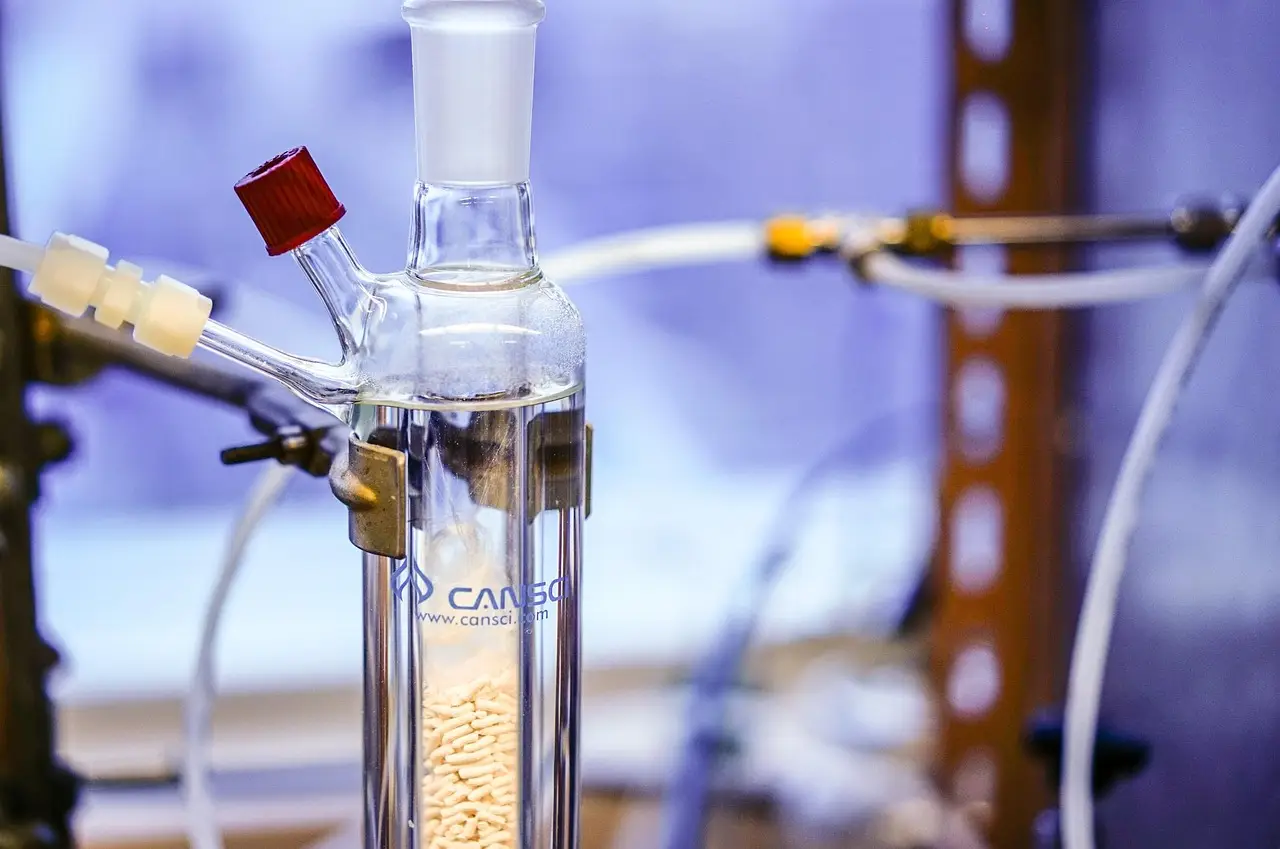
A deliberately simple kinetic model of the hydrogen evolution reaction reproduces a decades-old puzzle in electrocatalysis — the paired shifting of activation energy and a second quantity called the prefactor — without invoking any exotic solvent behavior at the electrode. The findings appear in ACS Catalysis in 2026, in a study by Andrew Jark-Wah Wong and colleagues, and they could change how scientists interpret temperature-dependent measurements across the field.
Why does this matter for renewable fuels?
Electrocatalysis is the technology that turns renewable electricity into fuels and chemicals — think of an electrolyzer as a factory that uses wind or solar power to make hydrogen instead of burning fossil fuels. Industrial electrolyzers typically run at moderately elevated temperatures, so understanding how reaction rates change with temperature isn't an academic side note. It's directly relevant to making these devices efficient and cheap.
Measuring rates versus temperature yields two numbers. The first is the apparent activation enthalpy, which reflects the energetic cost of the reaction. The second is the prefactor, which links to the activation entropy — a measure of how the system's order and disorder change during the reaction.
What did the textbook get wrong?
The standard Butler–Volmer picture, a foundational textbook description of electrode reactions, assumes that a higher electrode potential lowers the activation energy while leaving the prefactor unchanged. That's not what experiments show. Data in the literature often reveal both quantities shifting together, so that a change in one is partly offset by the other.
Scientists call this entropy–enthalpy compensation, and they've mostly blamed it on potential-dependent reorganization of water molecules at the electrode surface — a complex solvent effect that's difficult to measure or model directly.
The research team asked a blunt question: are such complex solvent effects really needed to explain these observations, or can the reaction chemistry at the catalyst surface alone produce the same fingerprints?
How the model works
To find out, the researchers built a kinetic model of the hydrogen evolution reaction (HER) — the reaction that produces hydrogen gas at an electrode. They deliberately excluded any potential-dependent entropy from the individual reaction steps.
Then they did something clever: they analyzed their own model's output exactly as an experimentalist would, extracting apparent activation energies and prefactors at each potential.
Even this minimal model showed the prefactor changing alongside the activation energy. The mechanism turned out to be kinetic, not solvent-driven:
- The catalyst surface gradually fills up with hydrogen as conditions change
- The elementary step that limits the overall rate can switch from one chemical step to another
- Each such transition between kinetic regimes leaves a characteristic signature in the temperature dependence
What does this change for experiments?
The model's trends rationalize a series of entropy–enthalpy correlations seen in experimental HER rates, including the distinct behavior of different groups of metal catalysts. And the pattern isn't limited to hydrogen. Similar compensation effects show up in measurements on many other reactions, from oxygen evolution to CO reduction.
The practical takeaway for researchers: a changing prefactor is not, by itself, evidence of solvent effects at the electrode. Shifting kinetic regimes need to be ruled out first.
That's a meaningful correction for a field where temperature-dependent measurements serve as a window into electrocatalytic kinetics. Without accounting for regime shifts, scientists could attribute a surface-chemistry effect to water reorganization and draw the wrong conclusion about how a catalyst actually works.
The study provides a baseline for interpreting experimental data — a reference point against which real measurements can be compared before invoking more complicated explanations.
The bottom line
Temperature-dependent measurements remain a valuable diagnostic tool for electrocatalysis, the authors conclude. But reading them correctly requires checking whether the reaction has simply moved from one kinetic regime to another. For a field racing to improve catalysts for renewable fuel production, that's a caution worth heeding before crediting — or blaming — the water.
The paper is published as Andrew Jark-Wah Wong et al., "Entropy–Enthalpy Compensation in Electrocatalytic Rates," ACS Catalysis (2026), DOI: 10.1021/acscatal.6c05402.
via phys.org/rss-feed/ (Source)
More from Nathan Brooks
Show full bio
Market editor covering companies, deals and strategy in general science news at SciBeat.
563 articles
Nearby plates
- Electric Fields, Not Just Voltage, Steer Catalytic Reactions
- Trace iron helps alkaline electrolyzers until dendrites form
- Chemists identify true active surface of nickel hydrogen catalysts
- Real-Time Oxygen Sensing Exposes Hidden Losses in Solar Water Splitting
- Chromium Helps Keep Ruthenium Stable in Water Electrolysis