Plate Nº 63 · recorded October 10, 2026
Earth & ClimateReported finding
Collisions Among Arctic Ice Floes May Explain Drift Puzzles
UC Riverside researchers show that floe-on-floe collisions, not just wind, explain why Arctic sea ice drifts faster and spreads slower than models predict.
By James Calloway3 min read621 words
In brief
- Study published September 17, 2026 in Physical Review Letters, DOI 10.1103/g8y2-8ytt
- Lead authors: Bryan Shaddy (now USC), P. Alex Greaney and Bhargav Rallabandi (both UC Riverside)
- The model reproduced three previously puzzling observations: ice spread rate, floe speed range, and motion shifts over hours to days
- Comparisons used measurements from the Fram Strait between Greenland and the Norwegian archipelago of Svalbard
- Only wind, ocean drag, and floe collisions were needed to reproduce the observations; just one extra parameter was used
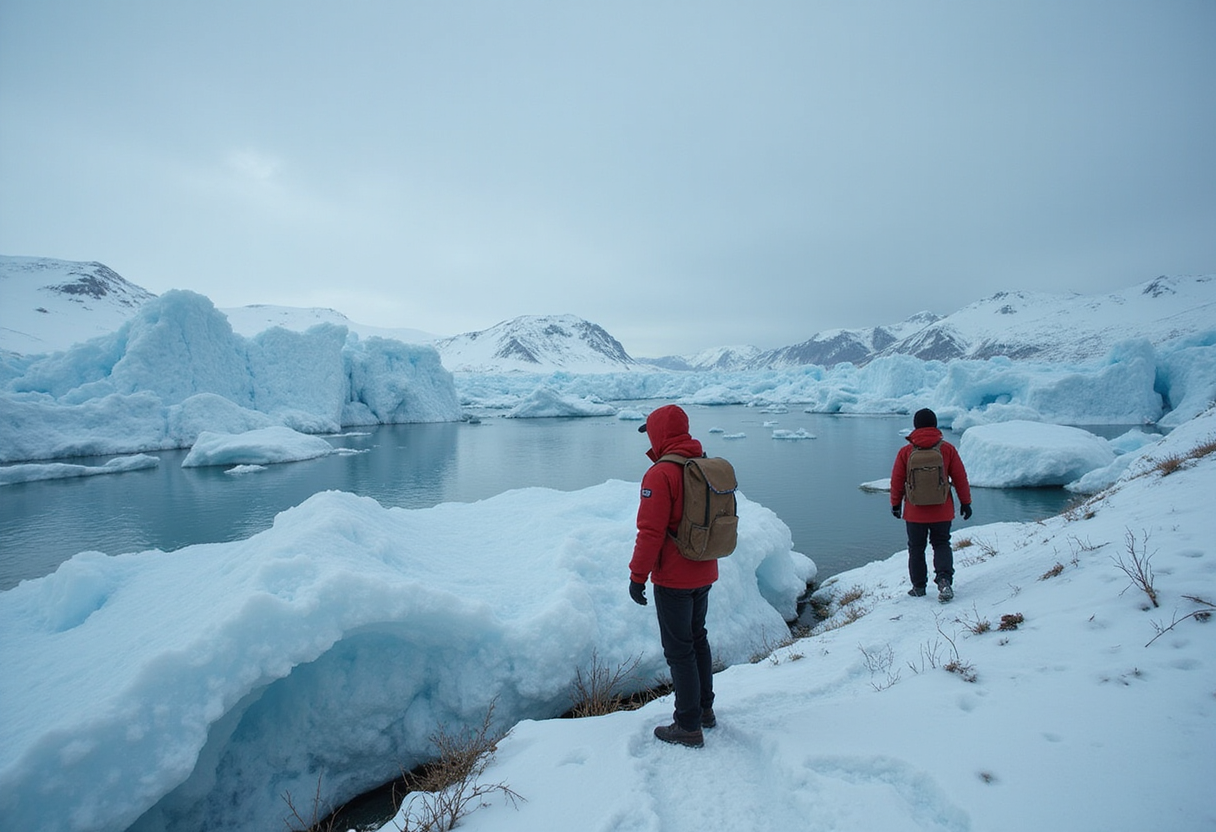
A computer model published September 17, 2026 in Physical Review Letters suggests that collisions between drifting ice floes explain why Arctic sea ice moves in ways wind alone cannot predict. The study, led by researchers at the University of California, Riverside, reproduced three long-puzzling features of sea ice motion using only wind, ocean drag, and floe-on-floe bumping.
Why does Arctic sea ice not move the way wind predicts?
Arctic sea ice consists of separate floating slabs called floes, ranging from several meters to several kilometers across. Wind pushes these floes across the ocean surface.
Yet observations have long shown that ice often travels faster than wind-based models predict. It also spreads outward more slowly than those same models suggest. Scientists have proposed unusual wind patterns, ocean eddies, and cracks in the ice as explanations. None fully accounted for the data.
What did the new computer model show?
The team, led by Bryan Shaddy (formerly a UCR undergraduate and now at the University of Southern California), built a simulation that treats floating ice much like grains tumbling through a silo. UCR materials scientist P. Alex Greaney and mechanical engineering associate professor Bhargav Rallabandi co-authored the work.
The model includes two ingredients: drag from the ocean and repeated collisions among floes. Researchers then compared the simulation against real measurements from the Fram Strait, the passage between Greenland and the Norwegian archipelago of Svalbard, where large amounts of Arctic sea ice exit toward the Atlantic.
The model reproduced three observations that had previously puzzled researchers:
- How quickly the ice spreads
- The range of speeds at which individual floes travel
- How ice motion shifts over timescales from hours to days
It did so using measured local wind and ice conditions, plus a single additional parameter that had little effect on the outcome.
Why do collisions matter so much?
In tightly packed ice fields, floes hit neighbors far more often than the wind direction itself changes. Each collision drains energy from the wind and shortens the distance a floe can travel before the next impact. This repeated jostling explains why the ice does not simply keep accelerating and spreading as the wind blows.
"If you get a lot of ice floes together in the same place with some wind, they bump into each other and transfer energy to neighbors," Rallabandi said. "We showed that that's the only ingredient you need to explain these observations."
Could this improve future sea ice forecasts?
The study does not predict where Arctic sea ice will end up under future warming. It does, however, give researchers a framework to explore such questions.
Rallabandi noted that the model could help test whether shrinking ice cover or changing floe size might allow floes to drift apart more easily, enter warmer waters, and melt faster.
Global climate models cannot track every individual floe across the Arctic. A physics-based model that captures how floes interact as a group could fill that gap, representing small-scale processes that climate simulations currently miss.
What other systems might behave this way?
The same rules could apply anywhere many objects collide while being shoved by an unpredictable force. The researchers point to possible uses in modeling avalanches, landslides, granular materials, and particle-filled inks used in 3D printing.
"The model is not restricted to ice," Rallabandi said. "It just needs a noisy source of force and the things that are moving to experience collisions."
What are the limits of this study?
The work is preliminary in scope. It tested one location, the Fram Strait, with one main set of conditions. Broader Arctic testing, and incorporation into operational climate models, would help determine how much the collision-based framework improves real-world forecasts.
via news.ucr.edu (Original)
More from James Calloway
Show full bio
Staff writer covering marketplaces and e-commerce at SciBeat.
205 articles
Nearby plates
- Arctic Ice Trapping a NOAA Ship Was Forecastable, Scientists Say
- Arctic Melt Season Grew 40 Days Longer Since 1979—Then Stalled in 2010
- 362 Hidden Earthquakes Detected Under Antarctica's Doomsday Glacier
- Back-to-Back Arctic Storms Can Double Sea Ice Loss, Study Finds
- 76 km² Ice Island Breaks Off Greenland's Petermann Glacier