Plate Nº 49 · recorded November 17, 2026
Neuroscience & MindReported finding
Consciousness Lives in the Brainstem, Not the Cortex, Scientists Argue
Neuroscientists argue raw sentience arises in the brainstem, not the cortex: tiny brainstem lesions cause coma while massive cortical damage does not erase the self.
By Elena Vasquez4 min read846 words
In brief
- The hypothesis paper was published online in The Neuroscientist on August 25, 2026, by Dr. Marshall Devor of the Hebrew University of Jerusalem and colleagues.
- One study evoked pain at only 8 of 313 cortical stimulation sites in the insula, while brainstem stimulation reliably produces felt pain.
- In rats, microinjecting tiny anesthetic doses into the mesopontine tegmental anesthesia area, a region in a zone about 3 by 4 mm, rapidly and reversibly induced anesthesia.
- The identified brainstem region matches the consensus location where strokes cause coma in human patients.
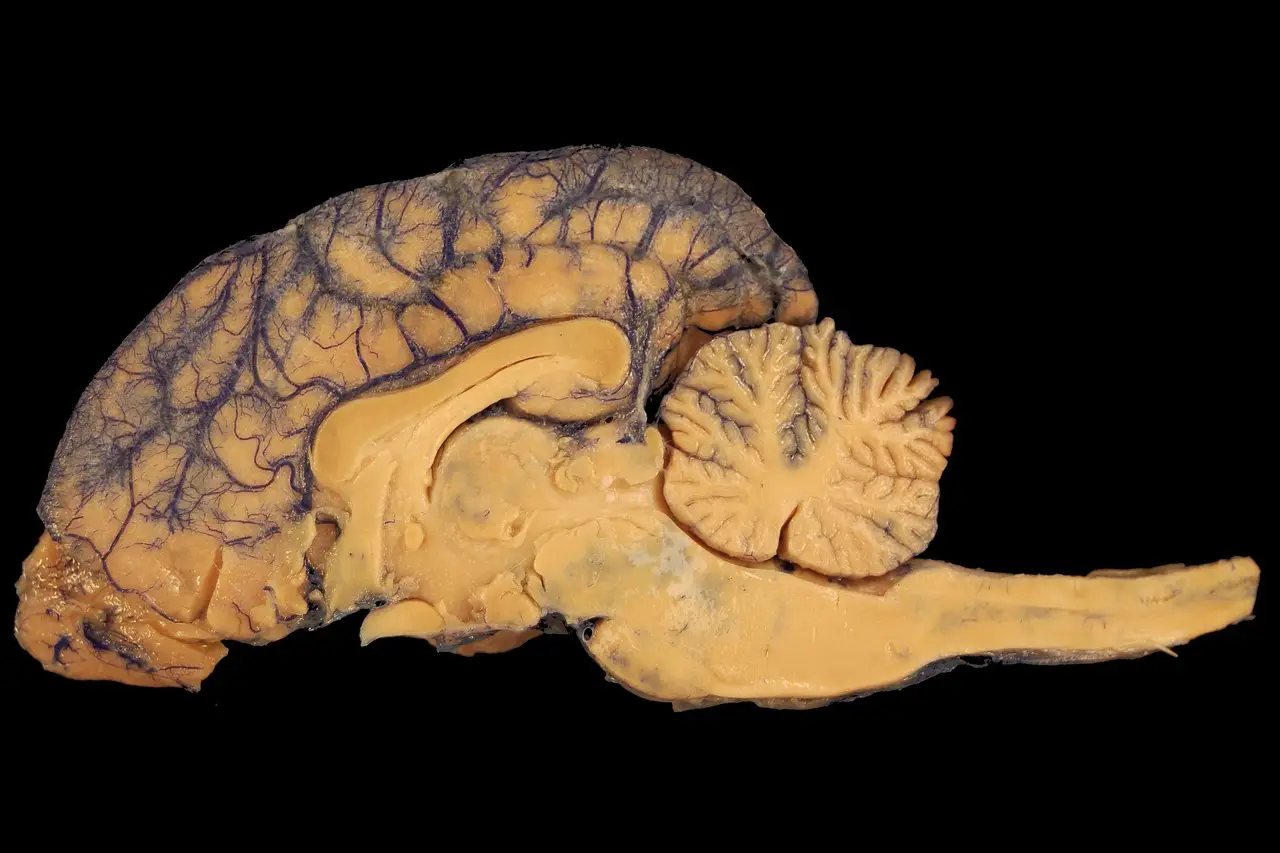
A hypothesis paper published August 25, 2026, in The Neuroscientist argues that consciousness arises in the brainstem, not the cerebral cortex — the folded outer layer long treated as the seat of the self.
Lead author Dr. Marshall Devor of the Hebrew University of Jerusalem and his colleagues contend that raw sentience — the feeling of being a "me inside" — comes from computations in brainstem circuitry. The cortex, in their view, supplies the content of experience but not the experiencer.
It's a direct challenge to the dominant neuroscience view that the cortex is where the self lives.
What's the core claim?
The paper proposes that what it calls raw consciousness — also termed phenomenal consciousness, first-person or core consciousness, "something it's like to be," or simply sentience — results from neural computation in the brainstem.
"Raw sentience, the 'me inside,' remains 100% present even when the bulk of, or perhaps all, sensory input is blocked along with input from stored memory," the researchers said.
They invite readers to test it themselves. Close your eyes and cover your ears, and "you" are still fully there, despite losing perhaps 70% of what you were conscious of a moment before.
"'You' are not fractional despite the fact that perhaps 70% of what you were 'conscious of' just a moment ago is now gone," they write.
The takeaway: losing the cortex's inputs doesn't seem to shrink the self.
Where's the evidence from pain?
The authors build their argument partly on pain, a familiar experience with an odd neuroanatomy.
Electrical stimulation of the cortex reliably produces flashes of light in the visual cortex, sounds in the auditory cortex, and tingling in the sensory cortex. But there is no recognized "primary pain cortex." Painful epileptic seizures are rare: one study evoked pain at just 8 of 313 stimulation sites tested in the insula, a region often proposed as a pain center.
Stimulation along the brainstem's ascending pain pathways, by contrast, evokes genuine felt pain.
Cortical damage doesn't erase it either. Large cortical lesions, including those from prefrontal lobotomies, did not eliminate pain or cause unconsciousness. People who are cortically blind are no less sentient than sighted people.
Small brainstem lesions, however, often cause coma. General anesthetics injected into that same area can switch consciousness off entirely.
In short: destroy big chunks of cortex and pain persists; pinch the brainstem and everything goes dark.
What about children born without a cortex?
The researchers also point to children born without a cerebral cortex who appear to show signs of joy and pain.
They acknowledge a real limitation: these children cannot describe their internal states in language, so the observations of their apparent emotions remain indirect and hard to confirm.
Still, the cases fit the pattern the theory predicts.
Which brainstem region matters?
The paper names the mesopontine tegmentum, a region roughly 3 by 4 mm across in rats. Within it, the team identified a spot they call the mesopontine tegmental anesthesia area.
In rats, microinjections of tiny amounts of anesthetic into that spot rapidly and reversibly induced anesthesia. Slightly off-target injections did nothing.
The team says this region matches the consensus location where strokes cause coma in human patients.
How would the brainstem produce a self?
The authors describe the brainstem as an "adjudicator." The cortex does the heavy computing — say, telling a distant cloud from a charging rhinoceros — and passes along an assessment of its importance for survival.
The brainstem then decides whether that stream merits conscious attention. If it does, the brainstem "marks" it, while other processing continues "robotically," like a self-driving car.
Pain is the exception. Its evolutionary-fitness signal arrives directly from nerve fibers, with no cortical processing needed at all.
Why evolution points the same way
Evolution didn't reinvent consciousness when the mammalian cortex emerged, the authors argue. It connected the new cortex to a brainstem system already working for hundreds of millions of years.
"Except for pain, advanced sensory feature extraction requires the supercomputer-like capacity of the mammalian cerebral cortex, available evolutionarily only eons after reptiles," they said.
"Rather than reinventing sentience circuitry with cortical architecture, evolution exploited the sentience-of-pain capability long functioning in the brainstem with the aid of dedicated axonal pathways."
In their account, that arrangement explains why large cortical lesions disrupt consciousness of specific things without causing unconsciousness, while focal brainstem lesions erase all sentience, including pain.
How solid is this?
Readers should hold this loosely. It's a hypothesis paper, not a definitive experimental demonstration in humans. The rat anesthesia data covers one small region, and the evidence from cortex-free children rests on observations the authors themselves flag as limited.
Still, the argument assembles an unusually broad sweep of clinical and laboratory findings into one claim. The bottom line: if Devor and colleagues are right, the "me inside" is far older and sits far lower in the brain than most textbooks place it.
Marshall Devor et al. Brainstem Theory of Consciousness. The Neuroscientist, published online August 25, 2026; doi: 10.1177/1073858426147036
via sci.news (Source)
More from Elena Vasquez
Show full bio
Correspondent covering money, funding and market shifts around general science news at SciBeat.
503 articles
Nearby plates
- The Brain Might Not Create Consciousness After All, Scientists Suggest
- Distant Brain Synapses Build Their Own Proteins, Study Finds
- The Brain's Fear Center Doubles as a Save Button for Memory
- The Unconscious Brain Predicts Words, Baylor Study Finds
- Brain Cells Vote: How Conflicting Visual Signals Fade in a Fraction of a Second