Plate Nº 36 · recorded November 13, 2026
Space & AstronomyReported finding
Dead Star Fires Radio Pulse Every Eight Minutes, and a Sun-Like Star Answers
Astronomers have traced repeating eight-minute radio pulses to a white dwarf orbiting a sun-like star 5,000 light-years away — a first for this kind of stellar pairing.
By Elena Vasquez4 min read780 words
In brief
- Radio pulses repeat on an eight-minute cycle tied to a white dwarf's spin in system GPM J071507−114153, some 5,000 light-years away.
- It is the first detection of radio pulses from a white dwarf orbiting a sun-like G-type star; study published in Nature Astronomy (2026).
- The team processed over 100 hours of radio data at the Pawsey Supercomputing Research Centre.
- Only about a dozen long-period transients are known; the same ICRAR team found the first in 2021.
- The MWA in Australia and MeerKAT in South Africa are precursor telescopes for the SKA-Low and SKA-Mid arrays.
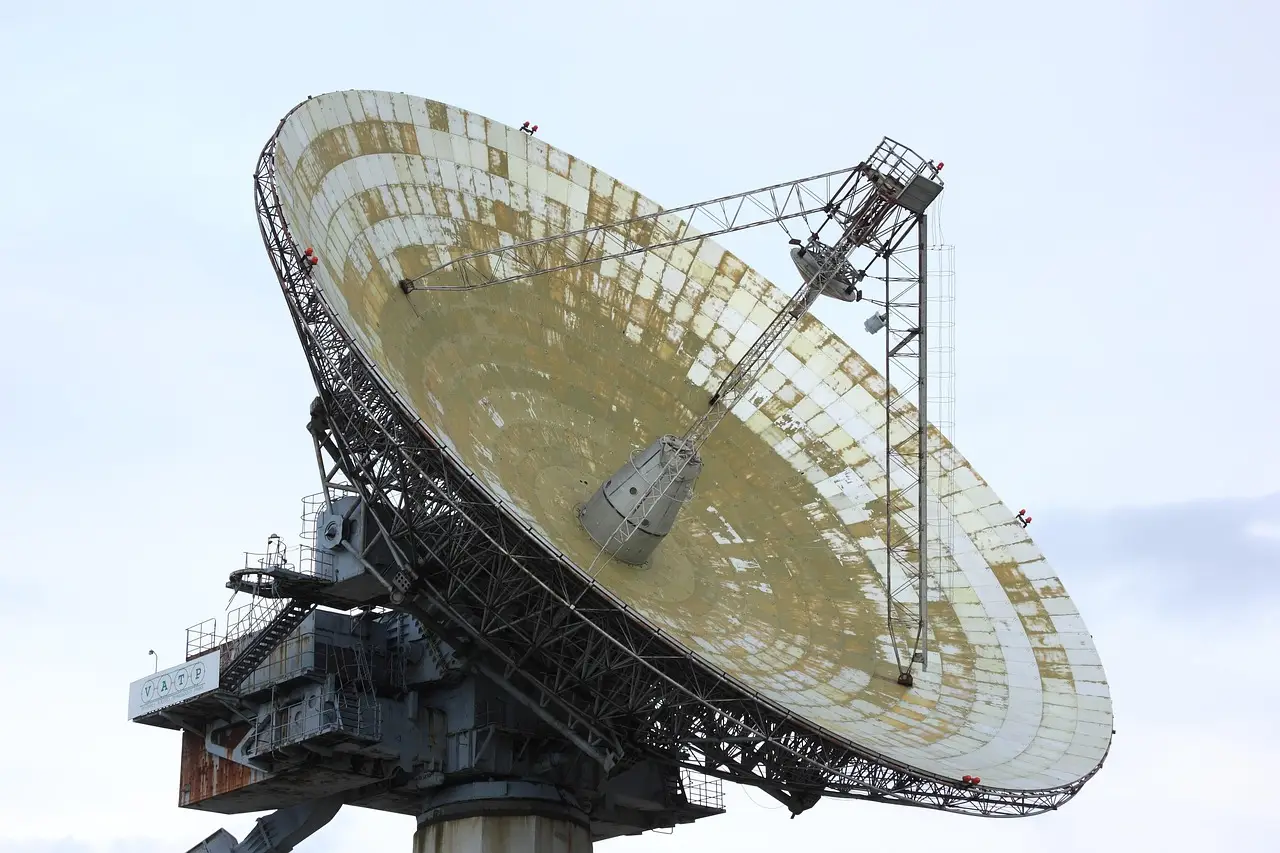
A dead star spinning once every eight minutes is firing radio pulses at Earth from a system 5,000 light-years away — and for the first time, astronomers can prove the dead star itself is the one doing the pulsing.
The system, catalogued as GPM J071507−114153, contains a white dwarf — the dense core left behind when a star dies — locked in orbit with a G-type star similar to our own sun. Researchers at the Curtin University node of the International Centre for Radio Astronomy Research (ICRAR) reported the find in the journal Nature Astronomy.
It's a first. Nobody has ever detected radio pulses from a white dwarf paired with a sun-like star. Until now, such pulses showed up almost exclusively in systems with red dwarfs — smaller, cooler stars.
What is this object?
The pair belongs to a class astronomers call long-period transients, or LPTs. These are stellar systems that emit radio signals switching on and off over intervals from minutes to hours.
Only about a dozen exist in the known catalog. The same ICRAR team found the very first one in 2021, and researchers are still piecing together how they work.
Several previously known LPTs contain a white dwarf plus a companion star. The nagging problem: nobody could tell which star was actually producing the radio flashes.
This discovery settles it, at least here.
"This is the first time the pulses are clear enough to see the white dwarf moving in its orbit around its companion, so we know that the pulsations are coming from a region close to the white dwarf, or possibly even from the white dwarf itself," said Dr. Sam McSweeney, lead author of the study.
McSweeney, now a commissioning scientist with the Square Kilometre Array Observatory, made the discovery while working at ICRAR's Curtin node.
The pulses track the white dwarf's orbit with enough clarity to finger the culprit. That's the breakthrough.
How the team cracked it
The numbers behind the work are substantial. The team processed more than 100 hours of radio data at the Pawsey Supercomputing Research Centre to confirm and map the white dwarf's motion.
The hunt ran across three instruments on two continents:
- The Murchison Widefield Array (MWA) in Western Australia, led by Curtin University, scanned the entire Milky Way visible from Australia and first flagged the system.
- The MeerKAT radio telescope in South Africa's North Cape province pinned down its precise position.
- The W.M. Keck Observatory on Maunakea, Hawaiʻi Island, confirmed through optical observations that the system hosts a G-type, sun-like star.
"We detected this system in a large survey using the MWA to scan the entire Milky Way visible from Australia. We then used the MeerKAT radio telescope in South Africa to determine its precise position," said co-author Associate Professor Natasha Hurley-Walker of ICRAR.
A storm on a distant sun
The radio pulses carried a bonus. They let the team detect stellar flares on the sun-like companion — eruptions similar to those that create aurorae here on Earth.
"As a bonus, we also saw the white dwarf moving behind a region with a strong magnetic field, most likely a 'stellar prominence,' which is a large loop of plasma erupting from a star's surface," Hurley-Walker said.
"It's amazing that by using radio wavelengths we can detect the storms on a star over 5,000 light-years away."
In plain terms: a dead star's beacon doubles as a probe of weather on its living partner.
Why it matters for the SKA
Both workhorse telescopes in this find are precursors to the Square Kilometre Array. The MWA foreshadows SKA-Low in Australia; MeerKAT foreshadows SKA-Mid in South Africa.
McSweeney sees this discovery as a down payment on what's coming. "If we are already making such discoveries with precursor telescopes, just imagine how many more star systems we will be able to find, and what a beautifully detailed view of their signals we will have, once the SKAO telescopes are completely built."
The caveats are real. Roughly a dozen LPTs are known, and the mechanism driving their on-off radio behavior remains an open question. Whether most white dwarfs in such pairs pulse, or this one is a rarity, nobody yet knows.
Still, the result hands astronomers their cleanest look yet at which star in an LPT does the talking. One dead star, one sun-like companion, one eight-minute heartbeat — and a map for finding more.
The study: Samuel J. McSweeney et al., "A long-period transient with a Sun-like companion," Nature Astronomy (2026). DOI: 10.1038/s41550-026-03016-z.
via phys.org/rss-feed/ (Source)
More from Elena Vasquez
Show full bio
Correspondent covering money, funding and market shifts around general science news at SciBeat.
388 articles
Nearby plates
- Dead Star With Two Debris Rings May Preview Our Solar System's End
- Astronomers Find Youngest White Dwarf Paired With a Millisecond Pulsar
- LISA's Gravity Ripples Could Spot Planets Around Dead Stars
- Hubble Data Reveals Possible Planet Born Around a Dead Star
- Dead Star Powers a 1,000-Year Shock Wave It Shouldn't Be Able to Make