Plate Nº 60 · recorded November 17, 2026
Biology & EvolutionReported finding
E. coli's Gene-Copying Machine Can Read an Eight-Letter DNA Alphabet
UC San Diego scientists showed E. coli RNA polymerase can transcribe DNA with eight letters — four natural, four synthetic — bringing expanded genetic alphabets closer to working biology.
By Nathan Brooks3 min read695 words
In brief
- UC San Diego researchers showed E. coli RNA polymerase can transcribe an eight-letter DNA alphabet, four letters beyond nature's A-T-G-C.
- P–Z incorporation ran only about twofold slower than a natural G–C pair under the same conditions.
- The redesigned letter Z* sharply cut erroneous pairing with natural guanine while preserving pairing with P.
- Steven Benner's team first reported an eight-letter DNA/RNA system in 2019.
- The study was done with purified enzyme in the lab — no living organism with an eight-letter genome was created.
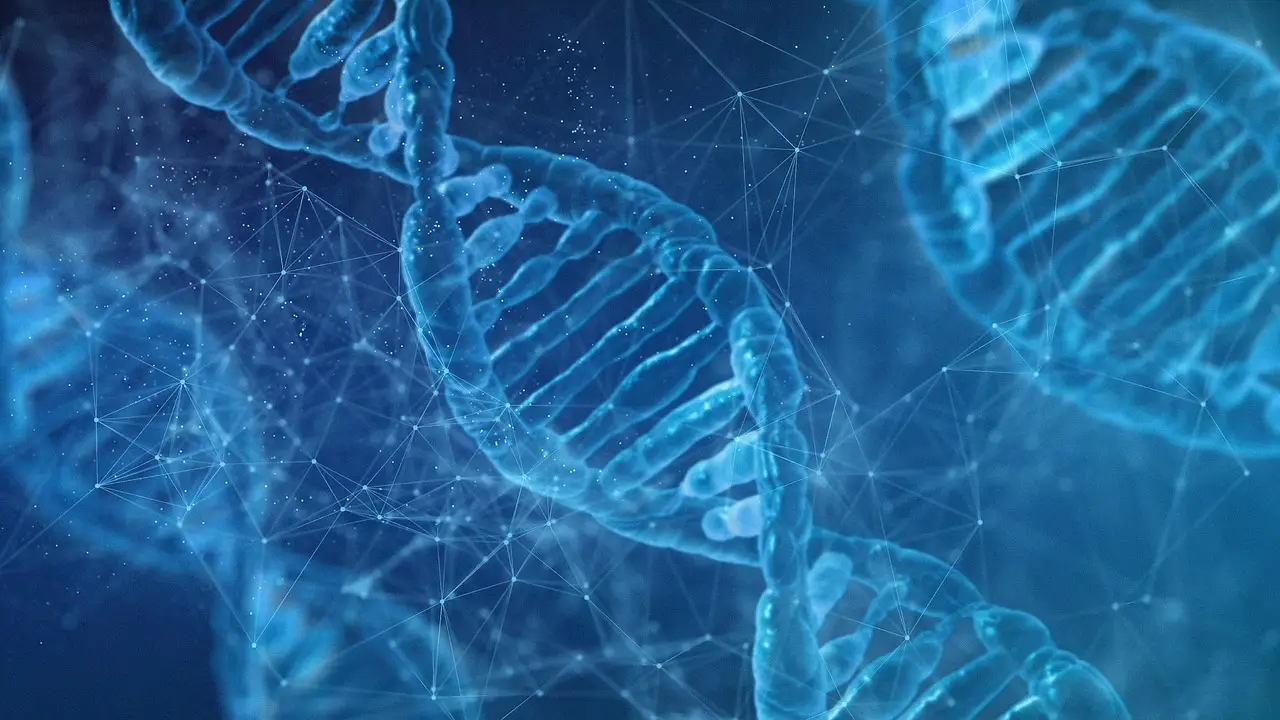
A bacterial enzyme that every living cell relies on can read DNA built from eight chemical letters instead of the natural four, researchers at the University of California San Diego have shown. The study, published in Nature Communications under the title Structural Basis of Transcription of the Hachimoji Eight-Letter Alphabet by E. coli RNA Polymerase, demonstrates that one of life's core molecular machines doesn't strictly insist on the alphabet evolution settled on.
What did the researchers actually test?
Every known organism stores genetic instructions using four letters: A, T, G and C. In natural DNA, A pairs with T and G pairs with C. The synthetic system adds two new pairs — P–Z and B–S — for a total of eight letters. Researchers call it Hachimoji DNA, from the Japanese hachimoji, meaning "eight letters."
The UC San Diego team took RNA polymerase, the cellular machine that copies DNA instructions into RNA, purified it out of Escherichia coli cells, and gave it engineered DNA strands containing the four synthetic letters. They supplied all eight RNA building blocks and tracked which ones the enzyme picked as it copied the template.
The result: it could read them. The enzyme transcribed an eight-letter DNA template and produced RNA carrying the corresponding expanded alphabet.
How well did the synthetic letters behave?
Largely as designed, according to the experiments. P paired with Z, B paired with S, and the enzyme rejected most incorrect combinations. The P–Z incorporation reactions ran only about twofold slower than a natural G–C comparison under the same lab conditions — a modest penalty for letters that don't exist in nature.
The polymerase also kept moving when it hit the artificial letters rather than stalling, which matters if expanded alphabets are ever to work inside real gene-expression machinery.
There were typos, though. The synthetic letter Z occasionally paired with natural guanine, or G. The researchers traced much of that error to Z's specific chemistry, so they redesigned it. Their modified version, called Z*, swaps out one chemical group for another and sharply reduced the erroneous pairing with G while keeping Z's intended ability to pair with P.
Is this an eight-letter organism?
No — and that distinction matters. The team didn't rewrite a living cell's genome, and no organism can reproduce using this expanded alphabet. The work was done in a test tube with purified polymerase and short, engineered strands of DNA and RNA.
In essence, the researchers removed one piece of cellular machinery and asked whether it could read artificial letters. It could. Previous experiments had already shown that E. coli RNA polymerase could handle a six-letter alphabet containing the B–S pair; this study completes the harder test by adding P and Z.
The idea itself dates back to 2019, when a team led by synthetic biologist Steven Benner reported an eight-letter DNA and RNA system that formed stable double helices and could produce a functional fluorescent RNA molecule.
Why expand the alphabet at all?
Four letters built every organism on Earth, so they're clearly sufficient. But from a chemist's perspective, they're also a constraint. Extra base pairs give researchers more possible combinations plus new chemical properties that ordinary DNA and RNA lack.
That could enable RNA molecules that bind targets more tightly, carry out new chemical reactions, or do jobs natural nucleic acids struggle with. The longer-term aim includes molecules that bind cancer markers, drugs or other targets more selectively — potential routes to new diagnostics, targeted therapies and biosensors.
There's a bigger prize, too. If an expanded genetic code could reliably assign extra codons to non-standard amino acids, scientists might build proteins with chemical features evolution never used: new enzymes, tougher biomaterials, more precise medicines.
What comes next?
The study's next milestones are steep: showing that a living cell can maintain an entire eight-letter genome, or translating the complete eight-letter system into proteins. For now, the finding answers a simpler but fundamental question — does one of life's core machines demand the same four letters as everything else on Earth? Apparently, not entirely.
via zmescience.com (Source)
More from Nathan Brooks
Show full bio
Market editor covering companies, deals and strategy in general science news at SciBeat.
410 articles
Nearby plates
- Eight-Letter DNA Works: Scientists Show Cells Can Read a Doubled Genetic Alphabet
- All Five Genetic Letters of Life Found in 4.5-Billion-Year-Old Asteroid
- Pond Protist Rewrites a Rule of the Genetic Code
- DNA 'Typewriter' Traces Mouse Embryo's First 13.5 Days
- Large-scale transfer RNA analysis suggests an ancestral code