Plate Nº 12 · recorded November 17, 2026
Biology & EvolutionReported finding
First 'Dark Magic Mushroom' Found in Florida Packs Both Trip and Toxin
Florida survey yields Galerina indica, the first fungus documented to contain both psilocybin and amatoxins — a psychedelic trip and a poison in one cap.
By Marcus Bennett3 min read571 words
In brief
- Galerina indica is the first documented mushroom containing both psilocybin and amatoxins
- Findings published in the journal Current Biology
- Researchers attribute the dual chemistry to two independent horizontal gene transfer events
- The mushroom is thumbnail-sized and hard to distinguish even for trained experts
- Florida state mycologist says the record aids identification of species harmful to people and pets
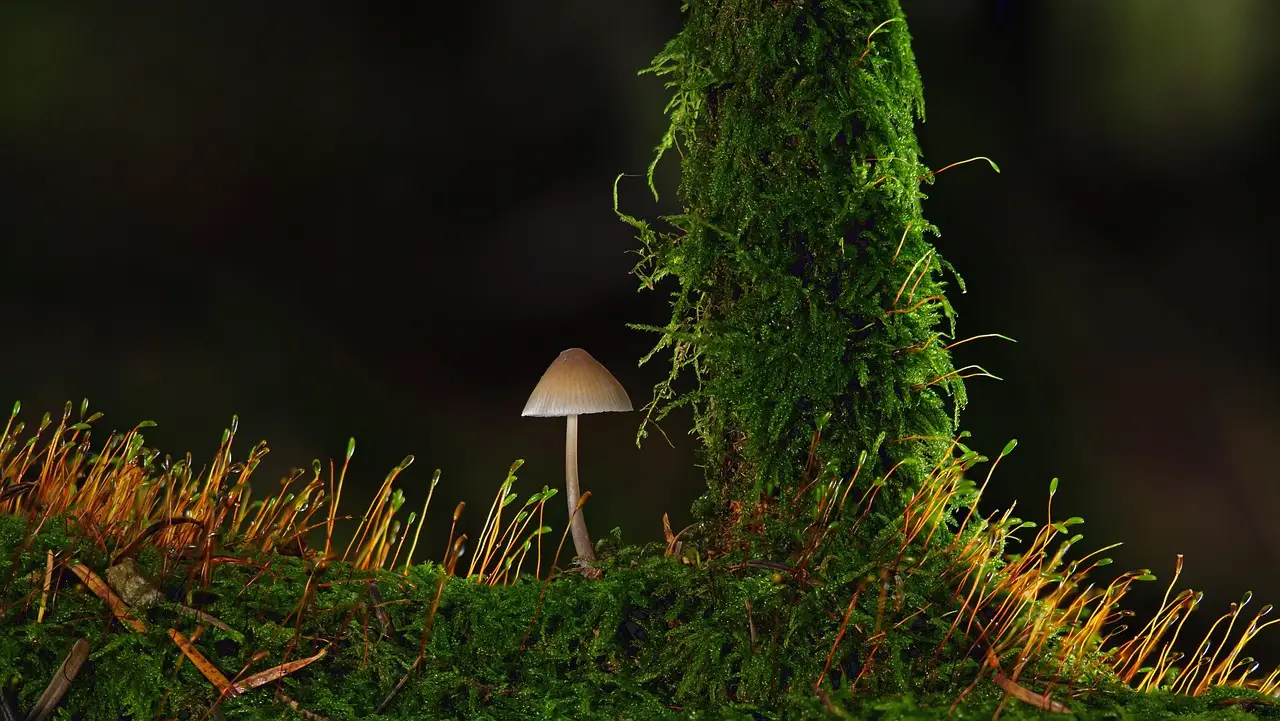
A thumbnail-sized brown mushroom from Florida has become the first documented species to carry both psychedelic and poisonous compounds. Mycologists report in the journal Current Biology that Galerina indica contains hefty doses of psilocybin — the hallucinogen behind "magic mushroom" trips — alongside amatoxins, the poisons that make some fungi lethal. They call it the first-known "dark magic mushroom."
The finding settles a long-standing open question. Most chemically notable mushrooms do one of two things. Psilocybin-rich species send users on extensive psychedelic trips; amatoxin-laden varieties poison whoever eats them. Mycologists had long assumed a single species could hypothetically carry both traits, but no one had documented an example until a recent field survey turned up G. indica.
"I could hardly believe it. We knew it was possible, but tried not to get too excited until we did a more rigorous analysis," said Andrew Kunik, a former University of Florida plant pathologist and study co-author.
How did one mushroom end up with both chemistries?
The mechanism, the researchers argue, is likely horizontal gene transfer — the movement of genes between organisms without sexual reproduction, common in microbes but striking when it involves specialized chemistry in fungi.
"Horizontal gene transfer is like if we shook hands and some of my DNA incorporated into your genome," said study co-author Bryn Dentinger, a mycologist at the University of Utah. "[But] two independent horizontal gene transfer events for these specialized metabolites in one mushroom genus are unheard of."
In plain English: the genes for making psilocybin and the genes for making amatoxins each arrived in the mushroom's lineage separately, from unrelated sources. Dentinger describes the double event as completely novel.
The evolutionary reasons remain only partly understood. Biologists suspect certain mushrooms evolved amatoxins as protection against foraging animals. Why hallucinogenic psilocybin emerged in fungi at all — and what it does for the organism — remains unclear.
One sentence: the mushroom appears to have acquired its trip-inducing and its toxic chemistry in two separate, unprecedented gene-swapping events.
Why does a tiny brown mushroom matter for public safety?
G. indica is easy to miss and hard to name. The small, innocuous brown caps barely reach thumbnail size and resemble countless other fungi.
"These mushrooms are really hard to find," said study co-author Matthew Smith, a University of Florida plant pathologist who also serves as Florida's state mycologist. "It's hard to differentiate them from others, even for a trained expert."
That difficulty is precisely why the documentation matters beyond mycology. Poison control depends on knowing which species exist where, and what they contain.
"Part of my job as Florida's state mycologist is to identify poisonous or potentially poisonous species," Smith explained. "So it is important to know what species we have and whether they might cause problems for people or pets."
In other words: a species that is simultaneously psychoactive and toxic — and nearly indistinguishable from harmless lookalikes — is exactly the kind of fungus a state mycologist needs on record.
The discovery stays preliminary in scope: one documented species, one genus, and a proposed mechanism that remains, in the authors' framing, unheard of elsewhere in the literature. But it changes the baseline. Foragers, clinicians, and toxicologists in Florida and beyond now have a confirmed example of a mushroom that breaks the old either-or rule.
A psychedelic that can also poison: that combination, once hypothetical, now has a name.
via popsci.com (Source)
More from Marcus Bennett
Show full bio
News editor covering regulation, policy and their impact on general science news at SciBeat.
493 articles
Nearby plates
- Florida mushroom contains both psilocybin and toxic amatoxins
- Florida Mushroom First Known to Pack Both Psychedelics and Deadly Toxins
- First 'Dark Magic Mushroom' Makes Psilocybin and Deadly Toisons
- Single Magic Mushroom Dose Can Anatomically Change the Brain
- Psilocybin Rewires Stressed Mouse Brains Without the Trip, Study Finds