Plate Nº 19 · recorded November 17, 2026
Earth & ClimateReported finding
Ground Under West Antarctica Rising 2 Inches a Year, Model Shows Why
Land under West Antarctica is rising up to 5 cm per year. A new CU Boulder 3D model pins the cause on rapid ice melt meeting an unusually weak upper mantle.
By Elena Vasquez3 min read662 words
In brief
- Land beneath the Amundsen Sea Embayment is rising up to 2 inches (5 cm) per year
- The study was published Nov. 12 in the journal Science
- The 3D model covers ice history and Earth movement from 1900 to 2020
- Rapid ice loss plus a weak upper mantle drives rebound in decades, not millennia
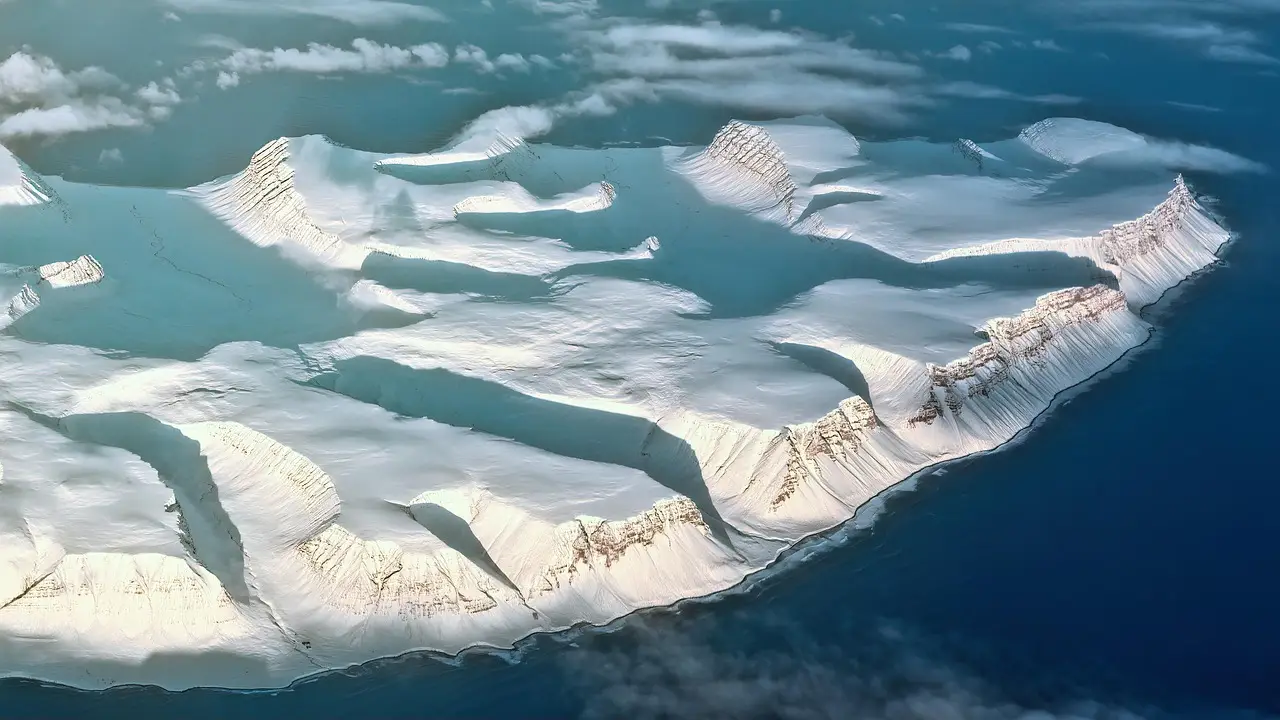
Some land beneath West Antarctica is rising up to 2 inches (5 centimeters) per year as the ice above it melts away. A new 3D model explains why that rebound is happening in decades rather than over millennia — and it points to a weak upper mantle combined with rapid ice loss.
Donna dePolo and Shijie Zhong, physicists at CU Boulder, published their findings Nov. 12 in the journal Science. Neither has ever set foot on Antarctica. They built their picture of the hidden continent from satellite measurements of ground motion and gravity, seismic data collected at remote Antarctic research stations, and runs on a supercomputer in Wyoming.
"Rapid ice loss, coupled with a weak upper mantle of the Earth, is allowing this response to happen within decades instead of thousands of years," said dePolo, a doctoral candidate in geophysics and lead author of the research.
Their model reconstructs the region's ice history and the 3D movements of the Earth's surface and interior from 1900 to 2020. It's the most detailed reconstruction to date.
What exactly is the ground doing?
Scientists have watched Antarctic ice closely for decades. What happens below it matters just as much, dePolo and Zhong argue.
As the Thwaites and Pine Island glaciers in the Amundsen Sea Embayment of West Antarctica melt, the crust underneath pops upward. Researchers call this glacial isostatic adjustment — the Earth's slow bounce-back after a heavy weight is removed.
The rebound even changes local gravity, a shift satellites have measured directly.
The analogy is a marshmallow. Press your hand down and it deforms. Lift your hand and it springs back immediately, then keeps slowly relaxing toward its original shape.
"The Earth behaves similarly," dePolo said. "So we modeled this process."
Why was the viscosity debate stuck?
The model settles a long-running argument among researchers. Scientists have debated the viscosity of the mantle beneath West Antarctica and other formerly glaciated regions, including North America and Scandinavia. Viscosity is simply how strongly a material resists flowing — think honey versus milk.
Mantle viscosity doesn't just control how fast the ground rebounds after ice melts. It also governs the motion of global tectonic plates and the long-term cooling of the planet.
Earlier studies read the satellite data with viscosity models that were coarse in space. They ignored 3D subsurface imaging showing that mantle temperature and viscosity vary across West Antarctica at different depths. Those studies concluded the entire upper mantle beneath the region is extremely weak — a finding that clashed with viscosity estimates for the rest of the Earth.
The new work resolves the tension.
"Previous studies have looked at this problem, but they ignored the 3D structure of the Earth," Zhong said. "We really resolved that puzzle by considering the Earth's 3D structure."
What does this mean for sea-level forecasts?
The study doesn't directly examine whether the ice sheet itself is stable, or predict its future. But it gives scientists a firmer foundation for doing exactly that.
"If you want to understand what's going to happen in West Antarctica and its ice sheet in the next 100, 200 and 500 years, it's very important to know how quickly the solid Earth will respond to that ice melt," said Zhong, a CU physics professor and co-author of the study.
Knowing how the Earth and the ice interact is also key to estimating how much meltwater will raise sea levels in the coming decades. An accurate 120-year record of ground movement is an important step toward those projections.
The research team also includes Matt King, a professor at the University of Tasmania in Australia, and CU Boulder graduate student Tao Yuan. The authors credit research stations in Antarctica that measure crustal movement and ice-sheet dynamics — without those field observations, they say, the work would not have been possible.
In short: the ground under West Antarctica is bouncing back fast, and scientists now know why.
via phys.org/rss-feed/ (Source)
More from Elena Vasquez
Show full bio
Correspondent covering money, funding and market shifts around general science news at SciBeat.
455 articles
Nearby plates
- Antarctica's 'Doomsday Glacier' May Double Earlier Sea Level Rise Estimates
- Slow waves deep inside Earth helped Antarctica freeze first
- Seafloor Mud Shows West Antarctic Ice Collapsed in Past Warm Spells
- Antarctica Gained 695 Billion Tons of Ice. The Trigger Was Thousands of Miles Away
- Arctic Sea Ice Ties for 10th-Lowest Minimum in 2026 Satellite Record