Plate Nº 46 · recorded November 11, 2026
Earth & ClimateReported finding
Seafloor Mud Shows West Antarctic Ice Collapsed in Past Warm Spells
Mud cores from 4,000 m deep show Thwaites and Pine Island glaciers collapsed in every warm period of the past 800,000 years—at temperatures like today's.
By James Calloway4 min read789 words
In brief
- Sediment cores show West Antarctic ice collapsed in every interglacial of the past 800,000 years.
- Past warm-period global temperatures were only 1.0–1.5°C above preindustrial levels—similar to today.
- Full Thwaites collapse would add 65 cm to sea levels; wider WAIS loss could add 3–5 meters.
- Study published in Nature Communications (2026), led by the British Antarctic Survey.
- Cores were drilled from 4,000 m below the sea surface on Antarctica's continental margin.
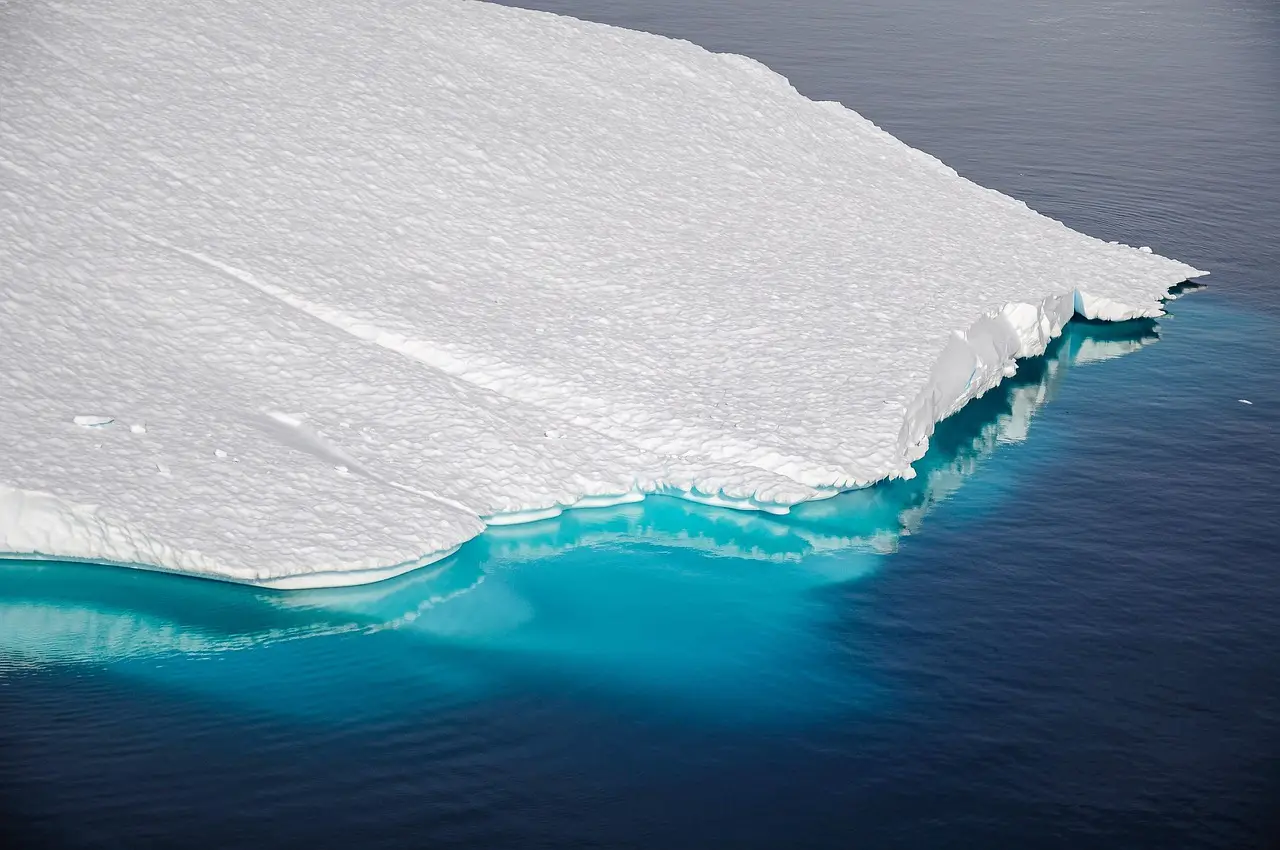
Antarctica's most dangerous glaciers, including Thwaites, collapsed repeatedly during natural warm periods over the past 800,000 years—according to mud pulled from 4,000 meters beneath the ocean surface.
That's the headline finding of a study published in Nature Communications by an international team led by the British Antarctic Survey (BAS). If the interpretation holds, much of the West Antarctic Ice Sheet (WAIS) has a natural "tipping point," and we may already be living near it.
Now for the caveats. This is one study, based on sediment cores from a handful of drill sites on Antarctica's continental margin. The authors themselves frame the result carefully. Still, the evidence chain they built is unusually tidy.
How do you read a glacier in a mud core?
The team's tool is a mineral called kaolinite—china clay to most of us. It forms in warm, wet, tropical or swampy climates, like the ones Antarctica had more than 34 million years ago. Today that ancient kaolinite sits locked in bedrock beneath the WAIS. Only the grinding weight of glaciers such as Thwaites and neighboring Pine Island can dig it out and ship it offshore, carried by icebergs and currents.
Here's the dramatic part. In sediment layers from every single interglacial—the warm periods between ice ages—over the past 800,000 years, the kaolinite signal crashed to near zero.
"When the kaolinite signal at our drill-core sites suddenly collapses, it tells us the marine-based ice in the Amundsen Sea sector of the West Antarctic—including Thwaites and Pine Island glaciers—must have melted and retreated far back into the continent's interior," said Dr. Claus-Dieter Hillenbrand, the BAS marine geologist who led the study. "It's the only way to explain why the delivery of kaolinite-rich debris to the ocean floor stops."
Only one explanation fits. That's their claim, not a proven fact. But it's a strong one.
What melted the ice?
Retreat is half the story. The team wanted a cause, and they found it in a second clay mineral: smectite. This magnesium-rich variety carries a chemical fingerprint unique to the deep Pacific Ocean floor far to the north. Something had to carry it south—and it appears in the mud exactly when the kaolinite vanishes.
The obvious suspect: warm deep-water currents pushing onto the West Antarctic continental shelf, ferrying smectite toward Antarctica while melting the grounded ice that normally produces the kaolinite signal.
A third line of evidence sealed the case for the researchers. They examined fossilized diatoms—microscopic marine algae whose shell-like structures change shape with water temperature. The results point to strong regional thermal amplification. Global average temperatures during past warm periods ran just 1.0°C to 1.5°C above preindustrial levels—similar to today, or even cooler—yet local waters in front of the WAIS reached roughly 1°C to 3°C warmer than today's near-freezing baseline.
Let that sink in. Today's global warmth was enough, in the past, to melt these glaciers back into the continent's interior.
What does this change for sea levels?
Timescale is everything. Under natural conditions, Hillenbrand says, Thwaites may have taken several thousand years to disappear. Human greenhouse gas emissions are warming oceans at an unprecedented rate, and the study warns that could compress the process into centuries. Faster, though not precisely quantified—no one can pin that number down yet.
The stakes are concrete:
- A complete collapse of Thwaites Glacier would raise global sea levels by 65 centimeters (26 inches).
- Pine Island could add another 51 centimeters (20 inches).
- Wider WAIS collapse could push the total to 3–5 meters (10–16 feet).
"What we found, to my surprise, is that even under natural conditions we had at least a partial collapse of the West Antarctic Ice Sheet. What we are doing now is making it much worse," Hillenbrand said.
Co-author Dr. Rob Larter, a BAS marine geophysicist, didn't hedge on the direction: "I'm personally convinced that future generations will see substantial sea-level rise. How fast we'll see that rise is really difficult to say. This study shows that even in past natural warm periods we had a lot of ice loss, but what we're living in now is an interglacial on steroids."
An interglacial on steroids. The phrase is memorable. The pace remains the open question—and this study, for all its clever clay detective work, cannot answer it.
The paper is Claus-Dieter Hillenbrand et al., "Repeated loss of the West Antarctic Ice Sheet's Amundsen Sea sector during late Pleistocene interglacials," Nature Communications (2026), DOI: 10.1038/s41467-026-77004-2.
via phys.org/rss-feed/ (Source)
More from James Calloway
Show full bio
Staff writer covering regulation, policy and their impact on general science news at SciBeat.
346 articles
Nearby plates
- 362 Hidden Earthquakes Detected Under Antarctica's Doomsday Glacier
- Antarctica's 'Doomsday Glacier' May Double Earlier Sea Level Rise Estimates
- 76 km² Ice Island Breaks Off Greenland's Petermann Glacier
- Utah glacier hidden under rock holds 1.5 million cubic meters of ice
- Tibetan Ice May Be 128,000 Years Old — and It Rewrites Climate History