Plate Nº 53 · recorded October 10, 2026
Earth & ClimateReported finding
Utah glacier hidden under rock holds 1.5 million cubic meters of ice
Utah geologists mapped the Timpanogos Rock Glacier with gravity sensors and found it is 83% ice, holding about 1.5 million cubic meters of frozen water — enough to fill 600 Olympic swimming pools.
By Marcus Bennett4 min read788 words
In brief
- Timpanogos Rock Glacier contains about 1.5 million cubic meters of ice, or 83% of its volume
- The buried ice equals roughly 600 Olympic swimming pools, about the volume of the Great Pyramid of Giza
- Utah hosts 836 rock glaciers that may collectively hold about 1 gigaton of water (815,000 acre-feet)
- About 50,000 rock glaciers worldwide could hold an estimated 48 gigatons of water
- Findings were published in Geophysical Research Letters on April 2, 2026 and the Journal of Geophysical Research on August 26, 2026
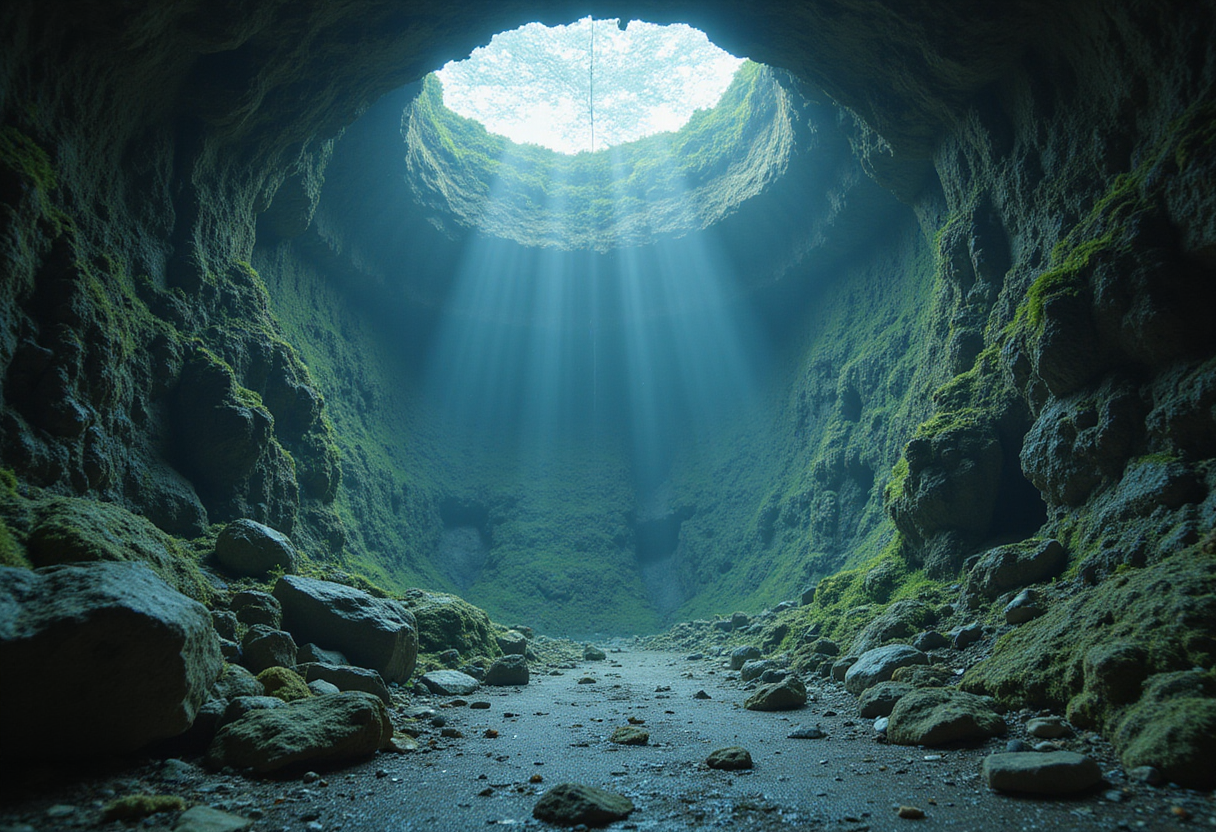
A rock-covered mountainside near Salt Lake City conceals about 1.5 million cubic meters of frozen water, enough to fill 600 Olympic swimming pools, according to two University of Utah studies published in 2026.
Geologists mapping the buried Timpanogos Rock Glacier, beneath the prominent summit of Mount Timpanogos, found the formation is 83% ice and 17% loose rock. Researchers used sensitive gravity measurements at 232 locations to build a three-dimensional image of the hidden ice.
"Timpanogos Rock Glacier is surprisingly ice rich," said Bronson Cvijanovich, lead author of one of the two studies and a former graduate student in the Department of Geology & Geophysics.
The buried ice volume is roughly equal to the Great Pyramid of Giza, the largest pyramid on Egypt's Giza Plateau, according to Cvijanovich.
How did researchers find the ice?
A team led by Cvijanovich carried a state-of-the-art gravimeter to the buried ice above Emerald Lake during six field trips in fall 2024. The device picks up tiny differences in gravitational pull, letting scientists distinguish dense rock from lighter buried ice.
"There is a large contrast in mass density between the rock that makes up Mount Timpanogos and the much lower density ice that is in the rock glacier adjacent to it," said Michael Thorne, a geophysics professor who oversaw the work.
The team arranged measurements on a grid with each point separated by 25 meters (about 80 feet). They then corrected the readings for changes caused by the sun and moon's positions, terrain, latitude, and elevation. Finally, they applied a new statistical method called Bayesian inversion — a mathematical technique that weighs multiple possible models against the data to find the most likely answer — to reconstruct the glacier's internal shape in three dimensions.
"We spent months of computation time doing the imaging with our new techniques," Thorne said.
Why does the ice exist?
Rock glaciers differ from conventional glaciers because their ice sits hidden under a cover of loose rock. In Utah's Wasatch and Uinta ranges, these formations are widespread. Similar features appear on the Colorado Plateau in the La Sal Mountains near Moab.
Researchers propose that the mountains themselves create the ice. Falling rock debris covers persistent snow in upper sections of the glaciers, shielding it from sun and warm air. Over thousands of years, repeated rockfalls build up debris layers that preserve the snowpack beneath.
"In the Wasatch, the mountains themselves are eroding and burying the snow, and that's why the rock glaciers exist," said Leif Anderson, a glaciology professor who co-led the studies.
The team's mathematical model suggests Utah's rock glaciers formed long after the Ice Age, which peaked 21,000 to 18,000 years ago. They developed during the thousands of years after large ice-age glaciers disappeared from the region.
How much water could Utah's rock glaciers hold?
Satellite imagery has identified 836 rock glaciers across Utah. Using the area-to-volume relationship established at Timpanogos, the researchers estimate these features may collectively hold about 1 gigaton of water, roughly 815,000 acre-feet. One acre-foot covers one acre of land under one foot of water, about 1,233 cubic meters.
"There's a lot of ice that's hidden in Utah's mountains," Anderson said. "When we are high in the mountains and walking across loose rocks or rubble, you don't realize there could be 120 feet of ice buried beneath your feet."
The estimate carries uncertainty. Rock glaciers in different climates may have very different ice-to-rock ratios. Direct measurements exist for only a handful of sites worldwide.
Could similar ice stores exist elsewhere?
Approximately 50,000 rock glaciers have been cataloged globally. Applying the Utah scaling relationship, the team estimates they may collectively contain about 48 gigatons of water. One gigaton equals one cubic kilometer, enough to fill 400,000 Olympic swimming pools.
The global estimate is preliminary, the researchers caution. The 83% ice fraction measured at Timpanogos may not apply to drier or warmer regions.
Where can I read the studies?
The first paper, "Mass Addition to Timpanogos Rock Glacier: Debris-Covered Snow and the Importance of Interannual Variability in Headwall Erosion and Climate," appeared in Geophysical Research Letters on April 2, 2026. Stanford undergraduate Isaiah Davies led that work during a 2023 summer at the University of Utah.
The second paper, "The Internal Ice Content of Timpanogos Rock Glacier, Utah, USA From 3-D Bayesian Inversion of Gravity Data," was published in the Journal of Geophysical Research on August 26, 2026. Funding came from the U.S. Geological Survey, the National Science Foundation, the University of Utah's Wilkes Center for Climate Science & Policy, and other university programs.
via attheu.utah.edu (Original)
More from Marcus Bennett
Show full bio
News editor covering regulation, policy and their impact on general science news at SciBeat.
243 articles
Nearby plates
- 76 km² Ice Island Breaks Off Greenland's Petermann Glacier
- A Lost Kilometer-High Cliff May Explain the Grand Canyon's Missing Billion Years
- A 76-Square-Kilometer Ice Island Breaks Free From Petermann Glacier
- Perseverance Finds Early Mars Hosted Complex, Hot Water Systems
- African Superplume May Be Reshaping the East African Rift from Below