Recorded November 25, 2026
Space & AstronomyReported finding
Hubble Maps Star Ocean in Milky Way's Bulge to Prep Roman Telescope
Hubble's new survey of the Milky Way's galactic bulge, holding a quarter of the galaxy's stars, builds baseline data the Nancy Grace Roman Space Telescope will use to hunt exoplanets via microlensing.
By Elena Vasquez3 min read646 words
In brief
- The galactic bulge holds nearly a quarter of the Milky Way's stellar mass.
- The new observations come from Hubble program #17776, led by S. Terry, to support Roman's exoplanet, black hole and neutron star searches.
- Hubble observed in red visible and near-infrared wavelengths to overlap with Roman's sensitivity range.
- The earlier SWEEPS survey examined 180,000 stars in the galactic bulge using Hubble's Advanced Camera for Surveys.
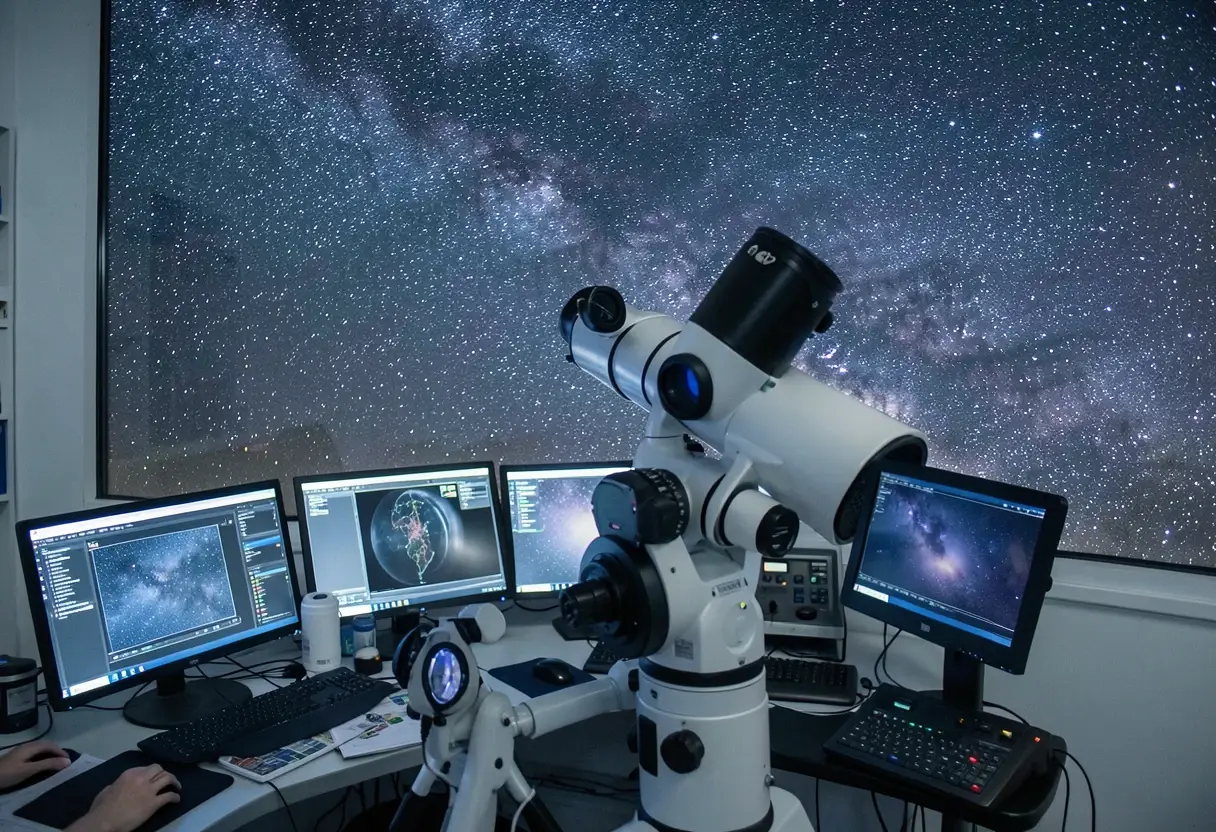
NASA's Hubble Space Telescope has released new images of a dense star field near the Milky Way's center, and every observation has a second job: preparing the ground for the Nancy Grace Roman Space Telescope.
The images show the galactic bulge, a crowded, roughly spherical region of stars wrapped around the center of our galaxy's disk. Hubble's new survey of this region will help researchers interpret Roman's future data as they hunt for exoplanets and characterize stars in one of the busiest parts of the Milky Way. The program, numbered #17776 and led by S. Terry, is explicitly designed to aid Roman's search for exoplanets, black holes, neutron stars and more.
Why the bulge matters
Astronomers keep returning to this region for a simple reason. The bulge holds nearly a quarter of the Milky Way's stellar mass, and it sits close enough that researchers can study it in unusual detail.
Other galaxies have bulges too, but we can't pick out individual stars in them. Too jam-packed, too far away. The Milky Way's bulge is the only one we can resolve star by star. Researchers hope studying it will turn up new planets and clarify how galaxies form, evolve and interact over billions of years.
How the wavelengths were chosen
Hubble views the universe mainly in ultraviolet, visible and near-infrared light. Roman collects data in near-infrared light and some visible light. Because the teams want to compare the two telescopes' observations directly, Hubble deliberately studied the bulge in the wavelengths both instruments share: the red end of the visible spectrum and near-infrared.
That overlap is the whole point. Matching data makes future comparisons cleaner.
What Hubble's data deliver
Hubble's high resolution lets its instruments track the brightness, ages, composition and motion of stars over time. Astronomers use that information to search for potential exoplanets, locate black holes or dark matter, and better understand the galaxy's environment and evolution.
The bigger prize is microlensing. A key part of Roman's mission is catching microlensing events, a small-scale form of gravitational lensing in which light from a distant object gets magnified and distorted by the mass of a closer object sitting along the line of sight. The way that light bends and brightens can reveal the nature of the foreground star and any planets orbiting it. These events operate on the scale of stars and planets, far smaller than the galaxy- and cluster-sized gravitational lenses astronomers usually study.
A before-and-after strategy
Here's the mechanics. Hubble characterizes stars in the bulge now, before any lensing event occurs. Months or years from now, when Roman records a microlensing event involving one of those stars, researchers can set Hubble's baseline data against Roman's event data. The comparison makes the event easier to interpret.
In plain terms: know the star before the trick happens, and the trick becomes measurable.
A long legacy in the bulge
Hubble has observed the galactic bulge many times across its decades in orbit. Past efforts include the WFC3 Galactic Bulge Treasury Program, which used Hubble's Wide Field Camera 3 to measure the brightness, precise positions and motions of stars in the region. Another, the Sagittarius Window Eclipsing Extrasolar Planet Search, or SWEEPS, used Hubble's Advanced Camera for Surveys to examine 180,000 stars in the bulge.
The new program adds to that legacy of high-precision stellar measurements. NASA supplied the details of the observations and the images, which show the bulge's stars gleaming in a rainbow of colors — reds, blues and golds packed into a single field of view.
The takeaway: Hubble is doing its homework now so Roman, which has yet to launch, can hit the ground running when it starts watching the bulge for planets and dark, compact objects.
via phys.org/rss-feed/ (Source)
More from Elena Vasquez
Show full bio
Correspondent covering money, funding and market shifts around general science news at SciBeat.
634 articles
Nearby plates
- Hubble catalogue reveals 30,000 baby stars in N44 superbubble
- NASA's Roman Telescope Will Image 100× More Sky Than Hubble
- A Milky Way Spiral Arm May Be a Giant Star-Forming Shock Wave
- Hubble Images Gravitational Lens to Prepare for Roman Telescope
- NASA's Roman Telescope Will Survey 200 Times More Sky Than Hubble