Plate Nº 26 · recorded November 15, 2026
Space & AstronomyReported finding
JWST Spots Supernova That Will Explode Again—in 73 and 76 Years
SN Ares exploded 8.8 billion years ago. Thanks to gravitational lensing, astronomers predict its light will reach Earth twice more, in about 73 and 76 years.
By Nathan Brooks3 min read690 words
In brief
- SN Ares was spotted in JWST images in August 2025; the study was posted to arXiv on Oct. 23.
- The supernova exploded about 8.8 billion years ago, when the universe was 4.9 billion years old.
- Two additional lensed images are predicted to arrive in roughly 73 and 76 years — record-breaking delays.
- Measuring the delays could constrain the Hubble constant, the universe's expansion rate.
- Follow-up spectroscopic measurements are planned for early 2027 to refine the predictions.
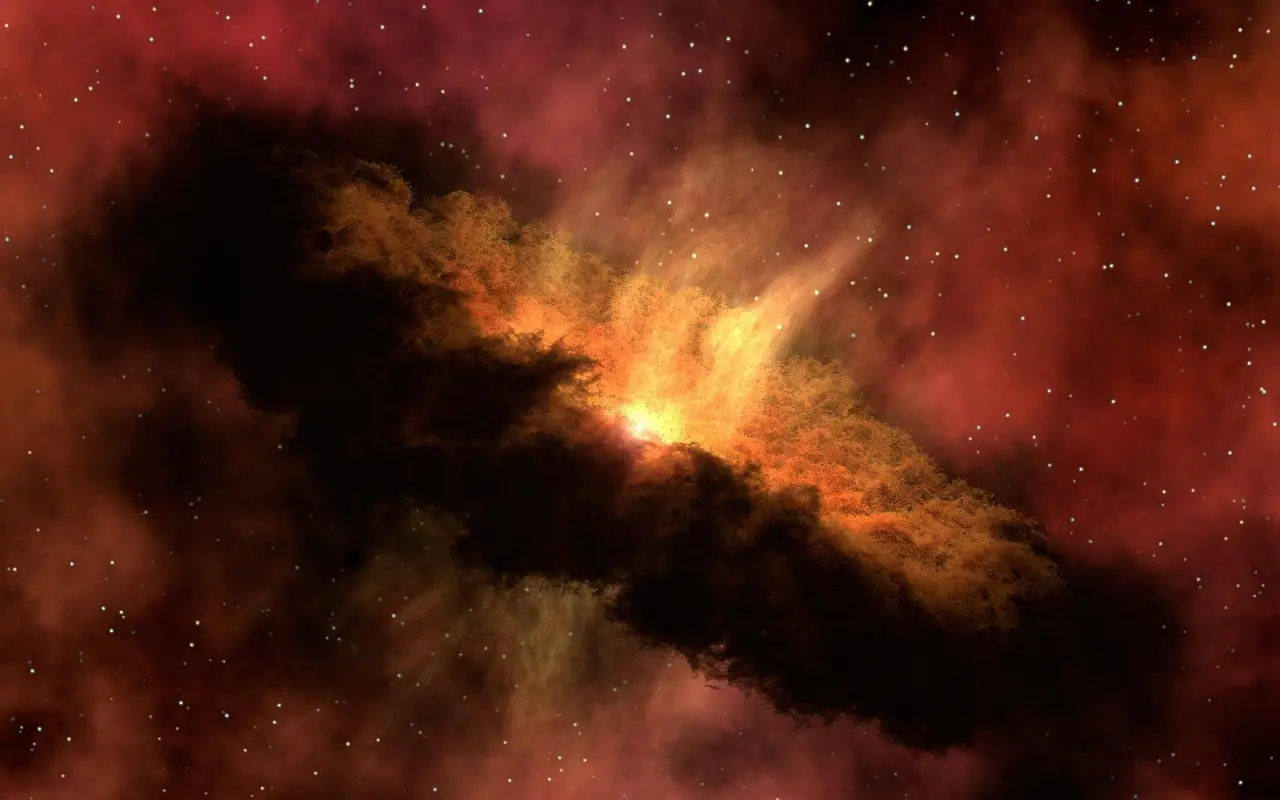
Astronomers say the same supernova will appear in Earth's sky two more times — in roughly 73 and 76 years. The prediction comes from a study posted to the arXiv preprint server on Oct. 23, led by Conor Larison of the Space Telescope Science Institute, and it rests on images from the James Webb Space Telescope.
The exploding star, nicknamed SN Ares, went off about 8.8 billion years ago, when the universe was only 4.9 billion years old. Larison's team spotted it in August 2025, buried in JWST near-infrared images of the galaxy cluster MACS J0308.9+2645. In cosmic terms, that's like finding a candle flame from more than halfway back to the Big Bang.
"It is the highest-redshift member of its class spectroscopically identified," the researchers write — meaning no supernova of this type has ever been confirmed at such an early epoch.
What is gravitational lensing?
Here's the mechanism. When a massive galaxy cluster sits between us and a more distant galaxy, the cluster's gravity bends and magnifies the background light, acting like a natural lens. Astronomers call this gravitational lensing, and it can split one object into several images.
Because each light ray takes a slightly different path around the cluster, the images arrive at different times — sometimes hours apart, sometimes decades. Famous examples of multiple-image lensing include the Einstein Cross, the Molten Ring and the Smiley Face.
JWST spectroscopy of SN Ares revealed helium and hydrogen features. Those are telltale signs of a star that shed most of its outer hydrogen layer before detonating — a category known as a Type IIb supernova.
Why will the same explosion arrive twice more?
Right now, astronomers see only one magnified image of Ares. But the team ran three separate lens models, and all of them point the same way: two additional images are still in transit, due to arrive in about 73 and 76 years respectively.
At an assumed 70-year timeline, "the SN Ares system has by far the highest predicted delays of any discovered lensed SN system so far," the team writes in its paper. For comparison, delays in known lensed supernova systems typically run from hours to a few decades — Ares roughly triples the record.
How could this measure the universe's expansion?
The arrival delays depend on the geometry of space itself. But space isn't static — it's expanding, with galaxies receding and light stretching as it travels. Measuring how far apart the images arrive therefore helps pin down the Hubble constant, the number that describes how fast the universe expands.
"Due to the direct relationship between these delays and geometric distance, a measurement of the offset in image arrival times leads to constraints on cosmological parameters such as the local expansion rate of the universe, H0," the researchers explain.
If astronomers in 70 years can catch the reappearance, they could time the delay extremely precisely. That timing, the team suggests, could yield one of the most precise single measurements of the universe's expansion rate ever made.
What happens next?
The team isn't waiting around. They plan additional spectroscopic redshift measurements in early 2027, which should clarify the lens cluster's properties and tighten the delay predictions.
The study also offers a rare chance to watch gravitational lensing play out across generations of scientists. The researchers admit they can't predict what cosmology will look like 70 years from now. But they're confident the return of SN Ares will be a scientifically rich event — one worth marking on a calendar, even if the calendar belongs to your grandchildren.
One caveat worth flagging: the paper is a preprint, posted to arXiv on Oct. 23, and has not yet completed peer review. The delay estimates also depend on lens models that the 2027 measurements could still refine. The headline numbers — 73 and 76 years — are predictions, not certainties.
The discovery is documented in Conor Larison et al., "SN Ares: A Strongly Lensed Type IIb Supernova at z=1.276 with a Predicted 70-Year Time Delay," arXiv (2026), DOI: 10.48550/arxiv.2610.33161.
via phys.org/rss-feed/ (Source)
More from Nathan Brooks
Show full bio
Market editor covering companies, deals and strategy in general science news at SciBeat.
372 articles
Nearby plates
- Webb Telescope Magnifies Galaxies 300-Fold in Cosmic Cluster Image
- Supernova SN 2026ahvu Flares Up Just 50 Million Light-Years Away
- Hubble Images Gravitational Lens to Prepare for Roman Telescope
- Black Hole Caught Faking 27 Supernovas in a Nearby Galaxy
- Supernova SN 2026ahvu Brightens Near NGC 1433: Why Astronomers Are Racing