Recorded November 22, 2026
Space & AstronomyReported finding
Marsquake Traced to an Active Fault Under the Solar System's Biggest Canyon
A marsquake detected by InSight on the far side of Mars traces back 20–40 km beneath Valles Marineris, revealing what looks like an active fault under the solar system's largest canyon.
By James Calloway4 min read708 words
In brief
- The quake S0976a was detected on the 976th Martian day of InSight's operation, almost on the opposite side of Mars from its source.
- Researchers traced its origin to 20–40 km beneath Valles Marineris, indicating an active fault.
- Valles Marineris runs over 4,000 km long, up to 200 km wide, and at least 7 km deep — nearly 10 times the Grand Canyon's length.
- The study appears in Nature Communications; lead author Jung-Hun Song is at Imperial College London.
- An Yin first proposed a strike-slip fault under the canyon in 2012, based on orbiter imagery, not seismic data.
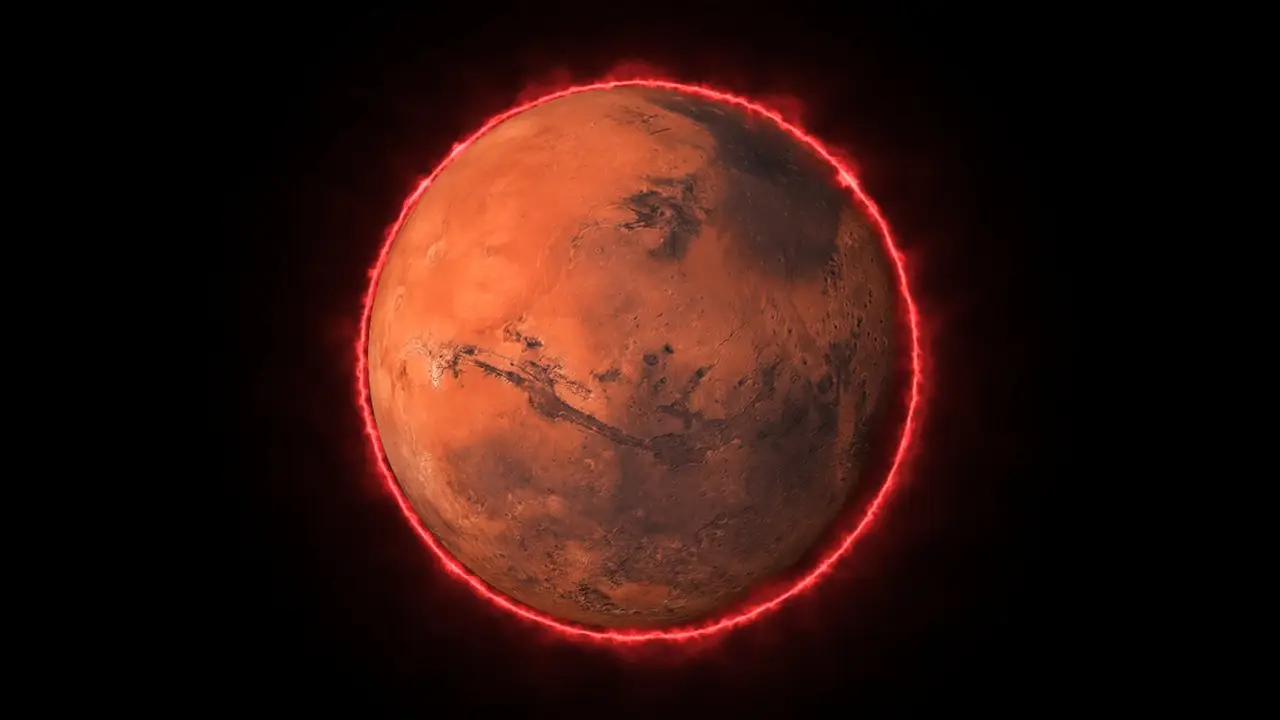
A marsquake recorded on the 976th Martian day of NASA's InSight mission originated 20–40 kilometers beneath Valles Marineris, researchers report in Nature Communications — and that depth points to something remarkable: an active fault under the largest canyon system in the solar system.
That's the headline finding. Now the caveats, because there are always caveats.
Mars is a geologically quiet world compared with Earth. Its volcanoes are old and dormant, and with no evidence of tectonic plates, most seismic shaking comes from meteorite impacts. But a growing pile of results suggests Mars still produces some shaking of its own — modest by Earth's standards, yet enough to reshape the planet over time.
The quake, labeled S0976a, was detected by the InSight lander sitting at Elysium Planitia, almost on the opposite side of the planet from the canyon. Despite that distance, the signal was clean.
What did the researchers actually find?
Jung-Hun Song, a seismologist at Imperial College London and lead author of the study, said most earlier work on S0976a mined the quake for what it revealed about Mars's interior — not for what it said about the quake's source. His team flipped that question around.
"This is the farthest event recorded by InSight mission, but it's very high quality," Song said. "If we can identify it as some tectonic quake, then we can say something about the Valles Marineris system: Is it still active, is it still a rifting system, or is it a closing system?"
The team characterized the quake's properties and ruled out rival explanations — landslides, meteorite impacts — before classifying the source. They ran simulations of synthetic waves and compared S0976a against other possible sources and various types of tectonic quakes.
"The quake is different from surface events," Song said. "There is reflection from the surface and interactions between the crustal layering that only deep [subsurface] events can generate."
The verdict: a tectonic quake from 20–40 kilometers down, suggesting an active fault beneath the canyon — perhaps similar to midcontinent rifts like the New Madrid Seismic Zone on Earth.
Is the canyon still alive?
Valles Marineris, named for NASA's Mariner 9 spacecraft whose data revealed it, staggers the imagination. It runs more than 4,000 kilometers end to end, stretches up to 200 kilometers wide, and plunges at least 7 kilometers deep. That's nearly 10 times the length of Arizona's Grand Canyon and more than 4 times its depth.
Geologically, it resembles the East African Rift more than any water-carved canyon, because both formed through crustal movement rather than erosion. But Mars is a "single-lid" planet — one solid shell, no plate boundaries — so the canyon almost certainly began as cracks in the crust as the planet cooled, with erosion widening the gaps over eons.
In 2012, geologist An Yin hypothesized, using imagery from the Mars Odyssey and Mars Reconnaissance Orbiter spacecraft rather than seismic data, that a strike-slip fault shaped the canyon system. S0976a now supplies the missing seismic evidence.
Caroline Beghein, a planetary geologist at UCLA who worked on InSight but wasn't part of this study, put it bluntly: "This is an ancient fault that just got reactivated recently, with this quake being the proof."
She also flagged the uncertainty that lingers: "There is no current plate tectonics, but maybe there was some in the past. We don't actually know for sure."
What does this change for planetary science?
One quake doesn't settle anything — but it sharpens the big question. Beghein framed it: "Why did they all start from the same mix, and yet Earth is the only rocky planet we know that has active tectonics? Did [Mars] have it before and it stopped, and, [if so,] why? These are really all-important questions to understand where we come from."
Both Song and Beghein said a quake like S0976a is probably not rare. Both also called for future missions carrying multiple seismometers spread across the planet. InSight's single instrument did solid work, but even one additional probe would improve triangulation, cut noise, and sharpen source identification.
Until then, the fault under Mars's grandest canyon stays mostly inference — a well-supported one, but an inference all the same.
via eos.org/feed (Source)
More from James Calloway
Show full bio
Staff writer covering regulation, policy and their impact on general science news at SciBeat.
570 articles
Nearby plates
- Mars' Grand Canyon Is Still Tectonically Active, Study Finds
- NASA's Viking 2 Likely Caught Real Marsquakes in 1976, Study Finds
- Runny Lava Traveled 200 Kilometers to Build Mars's Séítah Formation
- Low-Viscosity Lava Offers Clues to Mars’s Ancient Interior
- 362 Hidden Earthquakes Detected Under Antarctica's Doomsday Glacier