Plate Nº 89 · recorded October 14, 2026
Space & AstronomyReported finding
Oklahoma's Ames Crater Is 100 Million Years Younger Than Thought
Zircon crystals show Oklahoma's 10-mile-wide Ames crater formed 370 million years ago, during the Late Devonian mass extinction — not the Ordovician meteor event.
By Nathan Brooks4 min read760 words
In brief
- Ames crater in Oklahoma dates to 370 million years ago, about 100 million years younger than previously thought.
- The study was published July 7 in Meteoritics and Planetary Science.
- The 10-mile-wide crater is the fourth-largest impact structure in the U.S. and was discovered by oil drillers in 1991.
- The new date places the impact during the Frasnian-Famennian mass extinction, which killed up to half of all marine life.
- The impactor was Eiffel Tower-sized and hit Earth at more than 70,000 mph.
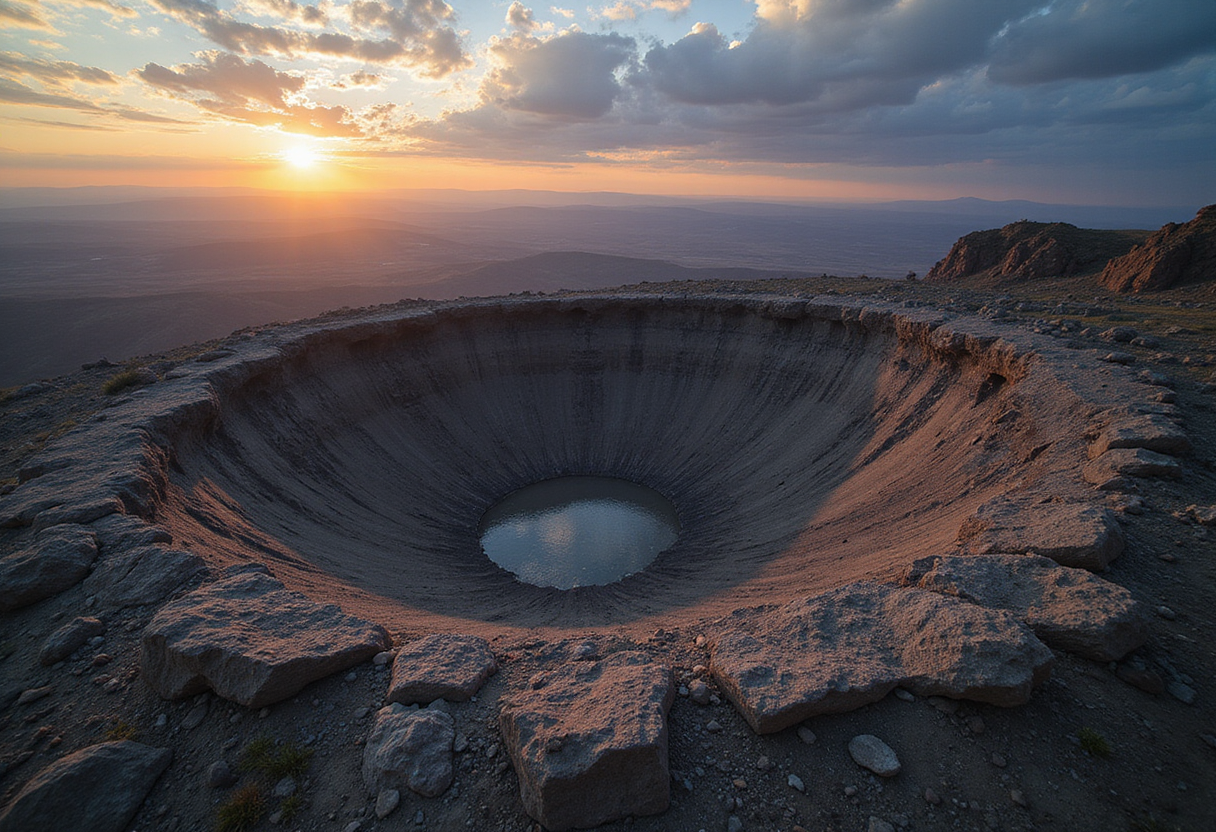
America's fourth-largest meteor crater is roughly 100 million years younger than scientists believed, according to a study published July 7 in the journal Meteoritics and Planetary Science. Tiny crystals pulled from the underground Ames crater in northwest Oklahoma push its age down to 370 million years ago — meaning the impact landed during one of the five biggest extinction events in Earth's history.
The finding doesn't just reshuffle a date. It moves a major impact out of one cosmic bombardment episode and into the window of a global die-off, raising the possibility that the crash added stress to an already-struggling planet.
How big was the impact?
Ames crater spans about 10 miles (16 kilometers), making it the fourth-largest impact structure in the United States. An Eiffel Tower-size space rock created it, slamming into Earth at more than 70,000 mph (110,000 km/h) — fast enough to circle the planet in about 14 minutes at that speed.
At the time, a shallow ocean covered the region. Seafloor sediment eventually buried the crater, so nothing at the surface hints at what lies below. Oil prospectors only discovered it by accident in 1991, when a drill bit punched into it.
Until now, researchers pegged Ames to the Ordovician meteor event around 467 million years ago. That period saw an unusually high number of large space rocks hit Earth, likely because a single parent body fragmented somewhere in space. Fossils of marine animals in and around the crater seemed to support that timing.
What did the zircon crystals reveal?
The research team analyzed fracture patterns inside zircon crystals — tiny fragments of a near-indestructible mineral called zirconium silicate — embedded in the buried crater. Those fractures record exposure to extreme heat and pressure, leaving a physical timestamp of the impact.
The verdict: Ames formed 370 million years ago, about 97 million years after the Ordovician event. Every analytical approach the team tried pointed the same way.
"No matter what technique we used, it was coming back to this younger signal," study first author Elizabeth Catlos, a geologist and planetary scientist at the University of Texas at Austin, said in a statement.
This crystal-reading method has recently overturned other crater ages, too:
- In July, researchers in Australia reported the North Pole Dome crater is around 500 million years younger than initial studies predicted.
- In 2025, experts found that the impact behind Scotland's Stac Fada Member structure happened roughly 200 million years later than earlier estimates.
The same crystals have also helped scientists more accurately date the moon.
"These small crystals allow us to go back in time and learn about the major changes to Earth's ancient landscapes," study co-author Danny Stockli, a geologist and dean of the Jackson School of Geosciences at UT Austin, said in the statement. "It would be great to do this for more of the meteor impact sites across the continent so we could get a more accurate timeline for these major events."
Where does the crater fit in Earth's history now?
The new age places Ames squarely within the Frasnian-Famennian mass extinction, also called the Kellwasser event or the Late Devonian mass extinction. That event began around 372 million years ago and ran for several million years, wiping out as much as half of all marine life as Earth's oceans lost their oxygen.
Scientists most likely blame increased volcanic activity, which drove global cooling.
The researchers are careful here: they emphasize the Ames impact did not cause the extinction. But they note the collision would have injected huge clouds of dust into the atmosphere, and that fallout may have contributed to regional cooling during an already fragile period.
In their paper, the team frames the result as a reminder that accurately dating individual events sharpens our picture of global patterns. Get one timestamp wrong, and a piece of the puzzle sits in the wrong epoch entirely.
"With this research, we're basically taking a major pawn out of the Ordovician Meteor Event and dumping it into the Frasnian-Famennian event, and saying, 'This is where this impact belongs,'" Catlos said.
The study was dedicated to co-authors Andrew Parisi and Michael Brookfield, who died before publication.
One caveat worth keeping in mind: this is a single structure, and the regional-cooling contribution remains a hypothesis rather than a demonstrated effect. The dating itself, though, held steady across every technique the team applied — which is exactly what you want from a 370-million-year-old crime scene.
via doi.org (Original)
More from Nathan Brooks
Show full bio
Market editor covering companies, deals and strategy in general science news at SciBeat.
226 articles
Nearby plates
- Oklahoma's Hidden Meteor Crater Is 100 Million Years Younger Than Thought
- NASA's Moon Orbiter Spots 728-Foot Crater That Formed in 2024
- A Lost Kilometer-High Cliff May Explain the Grand Canyon's Missing Billion Years
- New Simulations: The Moon May Have Formed Intact in Five Hours
- Soviet-Era Satellite Breaks Apart, Adding Tens of Debris Fragments to Orbit